

A fresh report from trading firm QCP Capital delivers a rather cold shower to those already celebrating a “new bull cycle.” According to analysts, Bitcoin’s move above $74,000 is more likely a short-term news-driven bounce rather than the start of a full market reversal. And if you look deeper, the picture is far less straightforward than it appears on the chart.
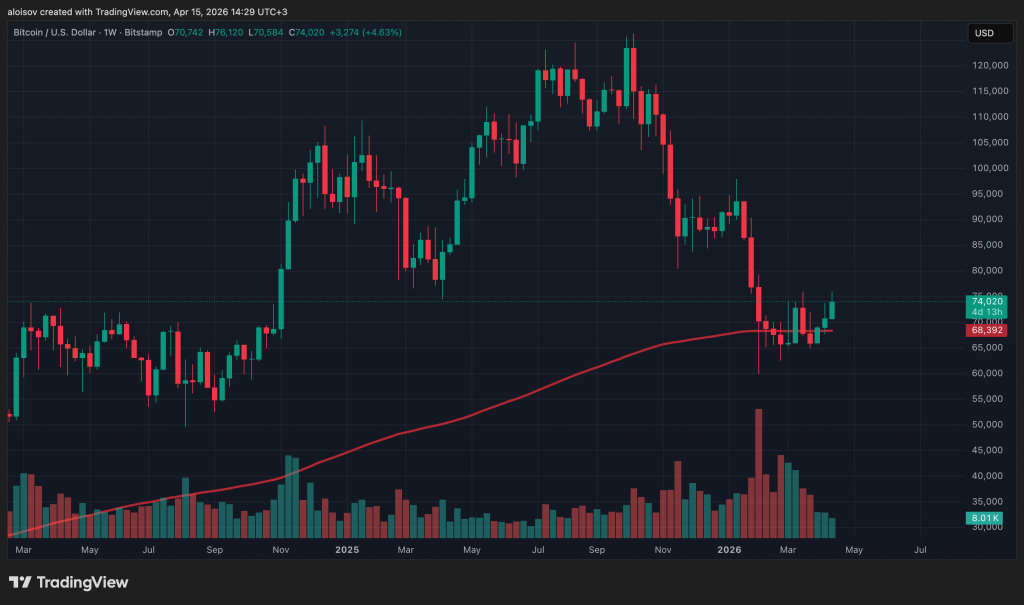
1-week chart of BTC/USD and the 200EMA. Source: Bitstamp
It all started with geopolitics. Bitcoin effectively rode the broader overnight rally in risk assets following leaks about preliminary agreements between the United States and Iran. Markets reacted in sync: equities moved higher, oil dropped, and crypto assets received a strong upward impulse. A classic risk-on reaction to easing tensions.
But markets are not only about what moves up, but also about what doesn’t move. And that’s where questions begin.
Long-term bonds barely reacted. Gold did not show a meaningful decline. Yields remained largely unchanged. In a normal environment, falling oil prices would typically be accompanied by stronger moves in the bond market, reflecting expectations of lower inflation pressure. That did not happen. This imbalance looks like a warning: the market priced in headlines, but did not fully believe them. In other words, this is a reaction to news, not to fundamentals.
The geopolitical factor, however, has not disappeared. The key issue — uranium enrichment — remains unresolved. Iran has moved closer to around 60%, while the United States insists on reducing it below 20%. This is not a gap that can be closed with diplomatic wording alone. It requires concrete action, which is still missing.
Regional history suggests that such “truces” are often temporary. They may stabilize conditions for weeks, but they do not resolve structural contradictions. That is why QCP Capital views the current rally as a reaction to easing tensions, not their resolution.
An equally interesting picture comes from the internal structure of the crypto market. BTC’s rise is accompanied by negative funding rates and declining open interest. In simple terms, part of the market is still positioned for downside, while the rally itself is largely driven by short liquidations. In other words, the market is not rising because everyone believes in upside, but because those betting against it are being forced to cover. This is a classic short squeeze scenario — sharp, powerful, but not always sustainable.
The options market does not confirm the move either. Short-term implied volatility sits around 40%, while IV rank remains low — the market is not pricing in large upcoming swings. Moreover, the term structure shows higher volatility at the long end, while risk reversals indicate continued demand for downside protection. In simple terms, spot is rising, but “smart money” in derivatives is not rushing to chase the move.
Against this backdrop, QCP Capital’s strategy looks logical and even somewhat conservative. They are considering a fade the relief rally approach — trading against the current rise. The idea is simple but psychologically difficult. When markets rally on positive headlines, the temptation is to jump in. But experienced participants often do the opposite: take profits or position for a reversal, expecting the move to be temporary.
The logic rests on several assumptions. First, the rally is news-driven, not fundamental. Second, continuation potential is limited. Third, once the news impulse fades, prices tend to revert to more stable levels.
In practice, this is often implemented via options. For example, buying a put option allows participation in downside with limited risk defined by the premium paid. Alternatively, selling call options can be used, though this is a more aggressive strategy with higher risk exposure.
Current market conditions fit this framework: BTC around $74,000, moderate volatility, muted expectations of extreme moves, and persistent demand for downside protection. At the same time, the macro backdrop has not changed. Federal Reserve policy remains restrictive: room for rate cuts is limited, especially after the recent rise in oil prices. Liquidity is not increasing, meaning there is still no strong fundamental support for a sustained rally.
And here lies the main takeaway. The current move looks like a wave lifted by a sudden gust of wind. The market surface is in motion, charts are alive, sentiment has improved. But deeper currents — macroeconomics, derivatives structure, geopolitics — remain unchanged.
From a data perspective, the key signal is divergence between spot price action and derivatives behavior. When spot moves higher but options and futures do not confirm the trend, it often indicates fragility. This is further reinforced by the mechanics of the move itself: negative funding and weak open interest suggest not broad capital inflows, but a technical price push driven by liquidations.
Such moves can be fast and impressive. That is why the current market is less about the beginning of a new uptrend and more about testing whether investors can distinguish impulse from trend.
All content provided on this website (https://wildinwest.com/) -including attachments, links, or referenced materials — is for informative and entertainment purposes only and should not be considered as financial advice. Third-party materials remain the property of their respective owners.