


The story behind the launch of tether.wallet is much more than just another crypto wallet. Tether is effectively making a move the market has long expected, but didn’t fully believe would happen in this form: a company that has spent years as “infrastructure behind the scenes” is stepping directly toward the user and trying to take a place in everyday financial habits.
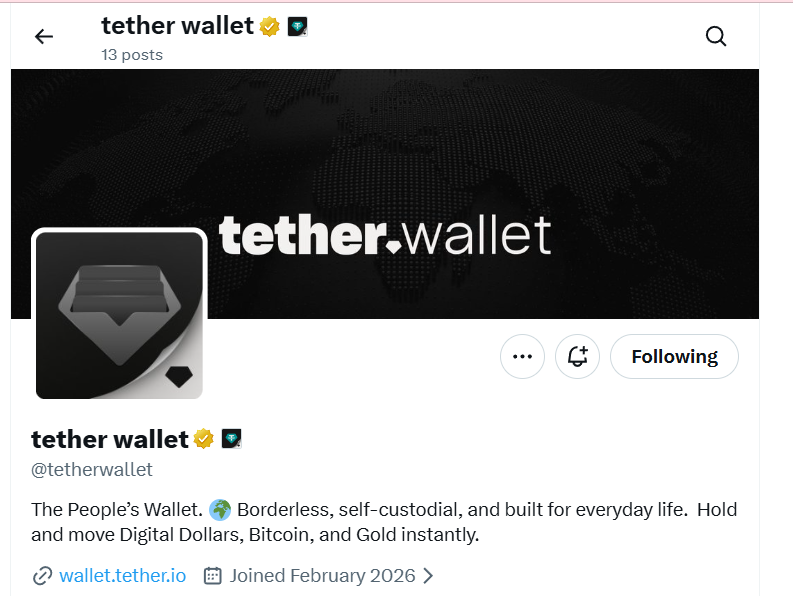
Formally, this is a non-custodial wallet supporting USDT, USAT, XAUT, and Bitcoin, but in essence it is an attempt to transform Tether from a stablecoin issuer into a full-fledged payment layer for mass use. And it is important to understand that the phrase “The People’s Wallet” is not just a marketing slogan, but a fairly accurate description of the strategy: to make crypto infrastructure simple enough to compete not with other wallets, but with traditional banking apps and messaging platforms.
Technically, the product looks like a logical continuation of what the company has been building over the past few years. It is based on the open-source WDK toolkit introduced in 2025, and this is a key point: Tether is not just releasing an app, but building an ecosystem that other developers could theoretically use.
Support for multiple networks at launch — Ethereum, Polygon, Arbitrum, Plasma — shows that the bet is not on a single chain, but on a multi-chain approach, where the user should not even need to think about where their assets are stored. Bitcoin is integrated via the Lightning Network, which immediately hints at the primary use case — fast and cheap payments, not long-term storage. At the same time, the asset structure is also telling: USDT as the main dollar instrument, XAUT as “digital gold,” and USAT as an additional stablecoin — effectively a mini financial system within a single application.
But the key idea here is not about token sets or even blockchains. The most important thing is the user experience. The ability to send money not to long addresses, but to a format like name@tether.me is exactly the moment where crypto is trying to stop being a “technology for insiders” and become a tool for everyone.
CEO Paolo Ardoino clearly states the goal: transfers should be as simple as sending a message. And if you strip away the rhetoric, this is exactly where the line between mass adoption and a niche product lies. As long as users have to copy addresses and fear making a mistake, this is not a mass market. Once the process feels like a chat — real scaling begins.

The security architecture also deserves attention. The wallet is non-custodial, meaning private keys remain with the user, and all transactions are signed locally on the device. This restores control to the owner, but at the same time shifts responsibility onto them — a classic crypto dilemma between convenience and security.
An interesting solution is paying transaction fees in the same asset being sent. This removes another friction point familiar to blockchain users, where sending one token requires holding another for gas. Overall, this looks like an attempt to eliminate as many technical barriers as possible that have prevented crypto from moving beyond enthusiasts.
Strategically, the launch of tether.wallet represents a much more significant shift. Until now, Tether has essentially been “fuel” for the crypto market — its tokens were used on exchanges, in DeFi, and in trading, but the end user often did not interact with the company directly. Now the model is changing: Tether is trying to become the interface, not just the infrastructure.
This is similar to the transition from an electricity supplier to a manufacturer of consumer appliances — the same resource, but now in the hands of the user. And if this transition proves successful, it could reshape the balance of power in the market, because control over the interface means control over the user.
Another layer is geography and audience. The company explicitly talks about “billions of people without access to traditional financial systems,” and there is some truth to that. In regions with unstable banking systems, transfer restrictions, or high inflation, such solutions may become not just convenient, but essential.
The ability to store dollars digitally and transfer them without banks or intermediary fees is no longer about technology, but about economic freedom. And this is exactly where crypto has the greatest chance of mass adoption.
At the same time, risks cannot be ignored. A non-custodial model means users are responsible for their own funds, so any mistakes, loss of access, or phishing attacks can lead to irreversible losses.
The regulatory issue also remains open: the more Tether moves toward end users, the more it comes under the scrutiny of regulators in different countries. Plus competition — the wallet market is already saturated, and attracting user attention will require competing not only with crypto projects but also with fintech applications.
Nevertheless, the launch itself looks like a logical step in the evolution of the market. The crypto industry is gradually moving from the stage of “infrastructure for the sake of infrastructure” to the stage of products that are actually used every day. And tether.wallet is an attempt to occupy exactly this space.
In the end, the picture is quite clear: Tether no longer wants to be just the background of the crypto market — it wants to become its entry point. And if the question used to be “where to use USDT,” it is now gradually shifting to another one — “why not use Tether as a primary financial tool.”
All content provided on this website (https://wildinwest.com/) -including attachments, links, or referenced materials — is for informative and entertainment purposes only and should not be considered as financial advice. Third-party materials remain the property of their respective owners.