

Talk of an “nuclear renaissance” a few years ago sounded like an attempt to bring back a trend that had already peaked. Today it looks different – more like cold calculation. The world has suddenly run into a simple, almost mundane problem: we need more energy than we are willing to produce through traditional means. And this is no longer about an abstract “green transition,” but about very concrete megawatts needed here and now.
The main driver is not ecology, but demand. Artificial intelligence, cloud computing, data centers – the entire digital economy investors like to talk about runs not on ideas, but on electricity. And in volumes so large that traditional energy sources are starting to struggle. A single large data center today consumes as much electricity as a small city. And as these centers multiply, it becomes clear why energy is back at the center of attention.
This is where nuclear power re-enters the game – but in a new form. Not giant plants that take decades to build, but small modular reactors, or SMRs. This is a fundamentally different logic: compact design, mass production, and the ability to place generation close to consumption. In simple terms, energy no longer needs to be “transported” across half a country – it can be produced right where it is needed.
This is why the market is reacting so strongly to news from the sector. The rise in shares of companies like Oklo is not just speculative noise. It reflects expectations that the technology is moving from the presentation stage to real implementation. When projects involve figures like Sam Altman, it adds not only visibility but also credibility: investors see that people capable of scaling complex technologies are entering the field.
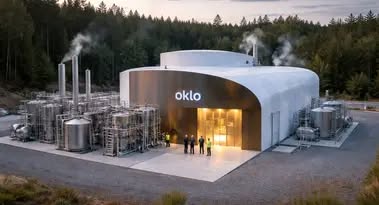
Equally important are agreements with tech giants. The story of the energy campus for Meta is no longer an experiment, but an attempt to build new infrastructure for future demand. If such projects move forward, it would mark a turning point: nuclear energy would stop being a “long bet” and become a practical business solution.
The UK’s move to support Rolls-Royce is equally telling. When a government allocates hundreds of millions of pounds to SMR development, it is no longer about ideas but about strategy. It signals that the technology is seen not just as promising, but as necessary. In a Europe seeking to reduce dependence on external energy sources, such investments look both logical and almost inevitable.
The market reaction is therefore unsurprising. NuScale, GE Vernova, BWX Technologies – the entire sector is moving in sync. This is a typical early-stage trend formation, where capital flows into an idea rather than a single company. Investors are essentially betting not on individual businesses, but on the growth of the entire industry.
However, it is important to understand that the market is currently pricing expectations, not results. Most projects are still in development or early deployment stages. This means delays, budget overruns, and technological challenges are inevitable – standard for any complex infrastructure. Nuclear energy has never been “fast money,” and SMRs are unlikely to be an exception.
Still, this trend has one key advantage: it is grounded in a fundamental need. Unlike many hype-driven stories, here there is a clear answer to “why.” Energy is needed by everyone – industry, the IT sector, and governments alike. And if a technology emerges that can provide stable, relatively clean, and scalable power, it almost automatically becomes a focal point for investment.
It is also interesting how risk perception is changing. Not long ago, nuclear energy was associated primarily with accidents and political controversy. Today the emphasis is shifting: instead of fear, scarcity is taking center stage. When the choice is between “perfectly safe but insufficient energy” and “controlled risk but stable supply,” markets become more pragmatic.
In the end, we are not just seeing a rally in stocks, but a shift in paradigm. Nuclear energy is gradually moving out of the “controversial solutions” category and returning as a strategic asset. And if investors once viewed it cautiously, they now approach it with clear interest.
The only question is timing. Whether nuclear energy becomes a key driver in the coming years depends on how quickly SMRs move from pilot projects to mass deployment. But the direction is already set. And as is often the case, markets start pricing in the scenario long before it becomes obvious to everyone.
All content provided on this website (https://wildinwest.com/) -including attachments, links, or referenced materials — is for informative and entertainment purposes only and should not be considered as financial advice. Third-party materials remain the property of their respective owners.