

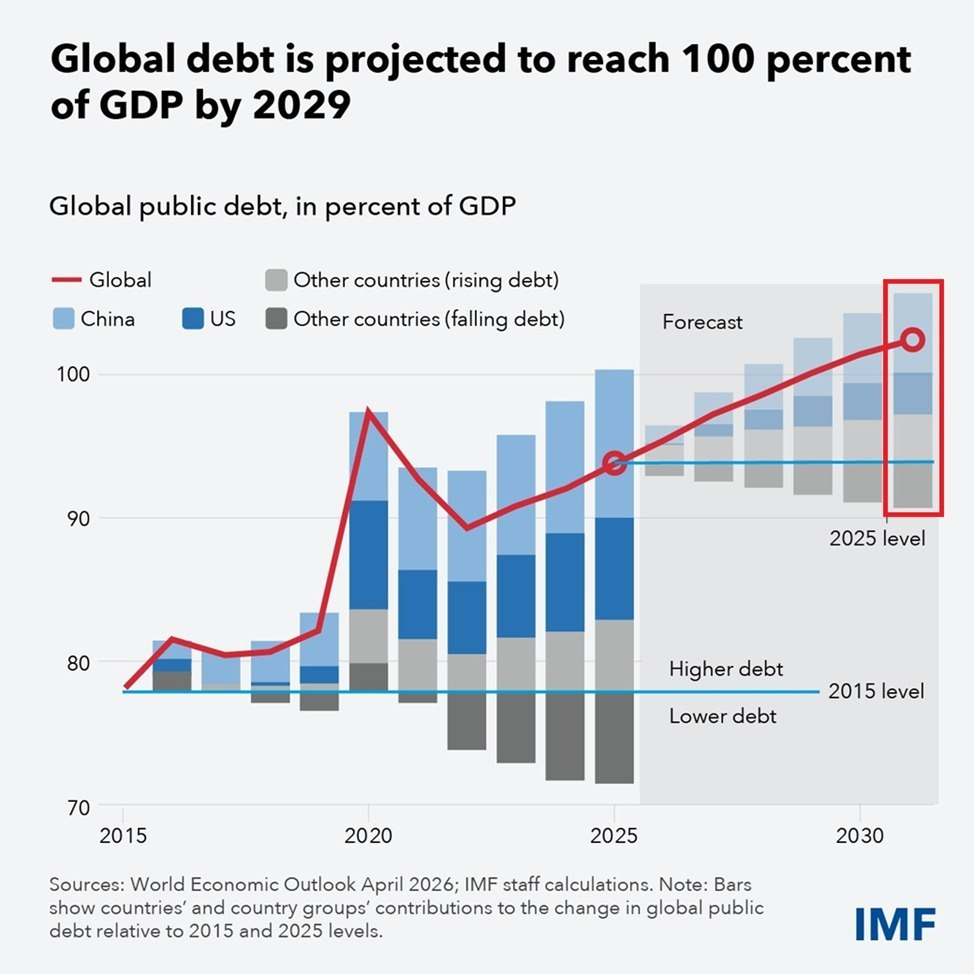
A recent report by the International Monetary Fund paints a picture that looks less like another “warning for the future” and more like a process already unfolding. Global public debt has approached 94 percent of world GDP by the end of 2025 and, under the baseline scenario, is set to continue growing faster than expected just a year ago. What once seemed like a distant 100 percent benchmark may now be reached as early as 2029. This is not just statistics – it is a shift in the entire financial architecture of the world.
Historically, such levels of debt burden were observed only in extreme periods, with the closest parallel being the time after World War II. Back then, debt growth was understandable: governments were financing survival. Today, the situation is different – debt is rising in a formally peaceful economy, but under constant shocks: geopolitics, demographics, technological competition, and growing social obligations.
The key issue is the pace of debt accumulation. Since 2015, the global figure has increased by about 15 percentage points of GDP. The main contribution comes from the largest economies, making the problem systemic rather than local. The United States continues to run a chronic budget deficit of 7-8 percent of GDP. If the current trajectory holds, public debt could approach 140 percent of GDP in the coming years. China is moving in a similar direction, showing a deficit of around 8 percent and projected debt growth beyond 120 percent of GDP.
It is not only how much is borrowed, but at what cost. Recent years have overturned the привычную model of cheap money. Governments that once refinanced debt almost for free are now doing so under higher interest rates. As a result, the average cost of servicing global debt could rise from around 3 to 5 percent over the next five years. On paper, the difference seems moderate, but in absolute terms, it translates into trillions of additional expenses that do not create new value but merely service existing obligations.
This creates a vicious cycle. The higher the cost of servicing debt, the more borrowing is required to finance budgets. The more borrowing, the greater the pressure on interest rates. At some point, the system stops working for growth and starts working to sustain itself.
Additional instability comes from structural changes in financial markets. The role of traditional banks is gradually declining, while non-bank institutions with high leverage are taking their place. This makes markets more sensitive to sharp price changes. Even a small reassessment of risk can trigger large-scale sell-offs, as such participants are forced to rapidly reduce positions.
Another alarming signal is the gradual erosion of the status of U.S. Treasury bonds as a truly “risk-free” asset. This status has been a cornerstone of the global financial system for decades. If confidence in it begins to weaken, the consequences extend far beyond the U.S. economy.
Against this backdrop, geopolitical factors only add pressure. Conflicts, rising defense spending, and the push for economic autonomy all increase fiscal burdens. Governments are forced to spend more not because they can afford it, but because they see no alternative.
In such conditions, the global economy traditionally faces two “release valve” scenarios. The first is painful but быстрый: a major financial crisis that resets imbalances through market crashes, bankruptcies, and recession. The second is more gradual: the erosion of debt through inflation and changes in the monetary system. The last time such a systemic shift occurred was after the collapse of the Bretton Woods system in the 1970s, when the world effectively transitioned to the modern system of floating currencies.
Today, a third, hybrid scenario is increasingly discussed. Authorities try to avoid sharp crises by flooding the system with liquidity. This reduces the likelihood of a sudden collapse but creates another effect – the gradual erosion of the value of money. Markets may appear stable, but the real purchasing power of capital declines.
This is where the paradox of the modern economy emerges. Investors are used to looking for bubbles in отдельных segments, such as technology or artificial intelligence. But the current situation hints at a larger issue: the entire system is overloaded. Debt is no longer a tool for growth and is increasingly becoming its constraint.
The main conclusion of the International Monetary Fund report is straightforward: consistent and credible fiscal consolidation is required. In simple terms, countries will have to either cut spending, increase revenues, or do both at once. The problem is that politically, this is one of the most difficult paths.
As a result, the world is entering a period where old rules no longer fully apply. Cheap money is no longer a universal solution, and the debt burden has reached a level where any policy mistake can be extremely costly. This is not an immediate crisis, but a slow buildup of tension. And as history shows, such processes end not when they are expected, but when the system can no longer withstand the pressure.
All content provided on this website (https://wildinwest.com/) -including attachments, links, or referenced materials — is for informative and entertainment purposes only and should not be considered as financial advice. Third-party materials remain the property of their respective owners.