

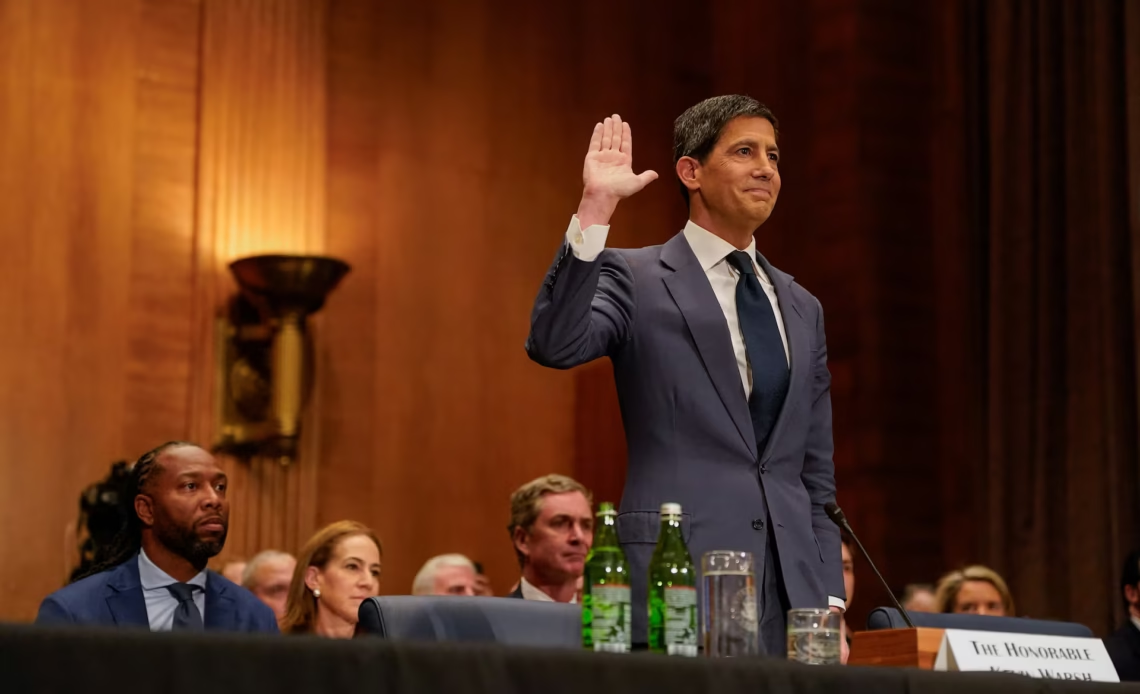
At first glance, it seemed like a standard procedure — hearings of a candidate for the position of head of the Federal Reserve System. But the market, as often happens in recent years, turned this formality into a stress test for the entire financial system. In about 90 minutes of trading, the capitalization of the S&P 500 index decreased by $550 billion — and this happened not against the backdrop of a crisis, war, or liquidity shock, but because of words.
The central figure of the events was Kevin Warsh — a nominee from Donald Trump for the position of Fed chair. His speech turned out to be substantial enough to touch several sensitive points of the market at once: monetary policy, inflation, energy costs, and cryptocurrencies.
One of Warsh’s key statements sounded unexpected to many, but at the same time reflects an already emerging reality: “Digital assets are already part of the U.S. financial system.”
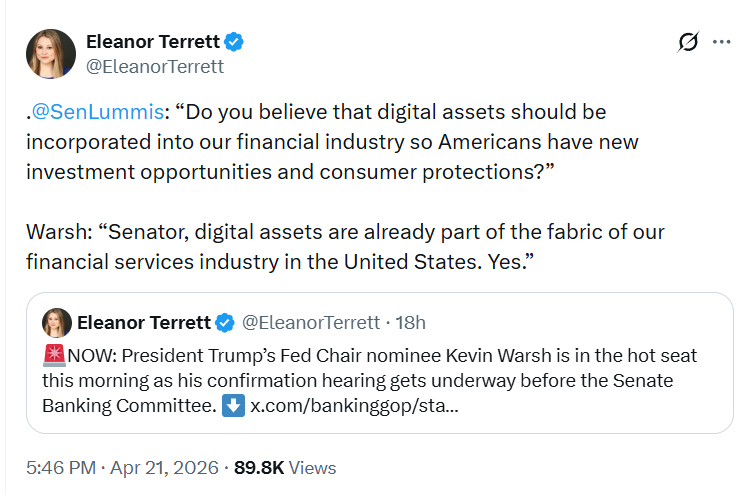
In fact, he confirmed what the market has long felt, but regulators have preferred to phrase cautiously. Cryptocurrencies have ceased to be a marginal phenomenon and have gradually integrated into the structure of U.S. financial services. This is an important signal not so much for traders as for institutional capital, which still operates through the lens of regulatory clarity.
However, the market reacted much more strongly not to the cryptocurrency rhetoric, but to Warsh’s position on monetary policy. He stated that he does not intend to be a “puppet” of political interests and prefers to manage the economy through interest rates rather than through large-scale bond purchase programs. Translated into market language — this is a signal in favor of a more traditional, stricter approach to monetary policy.
At the same time, he supported reducing the Federal Reserve’s balance sheet and lowering the key interest rate, arguing that more people would benefit from a softer policy and the economy would receive an additional boost. At first glance, this sounds like a compromise, but for the market, interpretation matters more than logic: rate cuts usually support risk assets, while balance sheet reduction works in the opposite direction.
An additional trigger was his statement that gasoline prices are moving in the “wrong direction” and that American households are under pressure. This is a direct indication that inflationary problems, especially in the energy component, persist. For investors, such comments mean that the fight against inflation is not over and it is too early to relax.
The market reacted quickly and without unnecessary diplomacy. Within about an hour and a half after the start of the hearings, the S&P 500 lost about $550 billion in market capitalization. Moreover, the movement was not a smooth correction, but an accelerated redistribution of risk — a classic reaction to rising uncertainty regarding future central bank policy.
Interestingly, for the crypto market, Warsh’s rhetoric looks rather constructive. Recognition of digital assets as part of the financial system and potential rate easing in the future create a favorable background for assets like Bitcoin. Historically, periods of looser monetary policy and expanding liquidity have been the environment for cryptocurrency market growth.
But in the moment, the market lives not by future scenarios, but by fear of uncertainty. Investors are simultaneously digesting several signals: possible changes in Fed policy, inflationary pressure, the energy factor, and the political context around the appointment of the new regulator head. In such a combination, even moderately positive statements are perceived with caution.
It is also important to understand the broader context. Such sharp movements are becoming the norm in an era where monetary policy, geopolitics, and technological changes are intertwined into one system. The market reacts not to individual events, but to a set of expectations, and any shift in the balance of interpretations can cause disproportionate capital movements.
From a market structure perspective, such days almost always work in both directions. First — a sharp decline amid uncertainty, then — equally sharp rebounds as participants begin to reassess what was said and look for softer interpretations.
That is why the current reaction is not necessarily a long-term trend. Rather, it reflects the nervous state of a system in which central banks, politics, and markets have long ceased to exist separately from each other.
All content provided on this website (https://wildinwest.com/) -including attachments, links, or referenced materials — is for informative and entertainment purposes only and should not be considered as financial advice. Third-party materials remain the property of their respective owners.