


Bitcoin reached $78,000 amid growing discussions about a possible mass liquidation of short positions. The market is gradually forming a situation in which bets against growth are increasing while the price continues to move upward slowly but steadily. A classic imbalance emerges: the stronger the pressure from shorts, the higher the potential energy for a sharp upward impulse when they are closed.
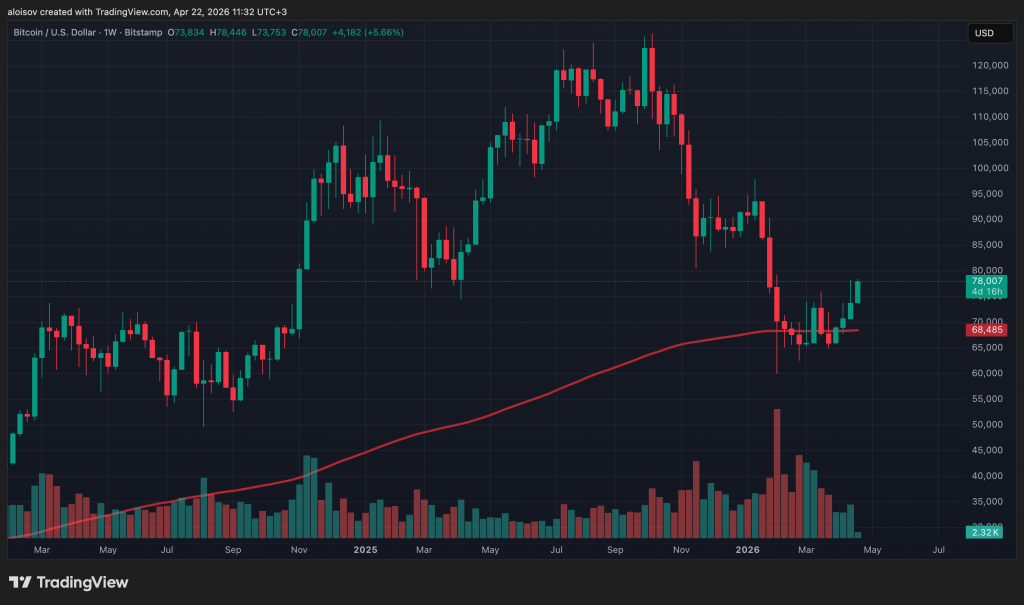
1-week BTC/USD chart and 200EMA. Source: Bitstamp
A key technical and derivatives signal deserves special attention — negative funding alongside a rising price. On most cryptocurrency exchanges, funding rates remain below zero even amid Bitcoin’s upward movement. In normal market logic, this appears contradictory: when an asset rises, funding usually turns positive, reflecting the dominance of long positions. However, the current picture suggests the opposite — the market remains crowded with short positions despite the price increase.
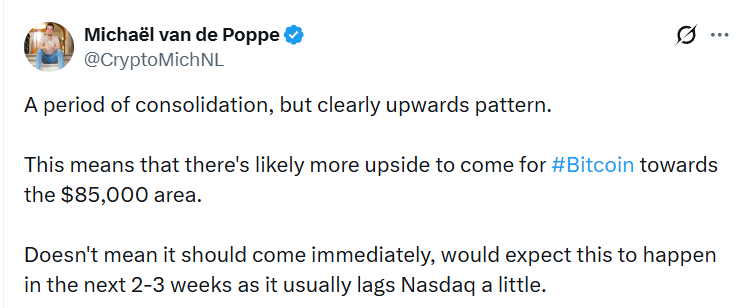
From the perspective of market participants, this is a rare and potentially important anomaly. Trader Michaël van de Poppe noted on social network X that there is a “period of consolidation, but with a clear upward dynamic,” and suggested a move toward the $85,000 level within the next two to three weeks. He also previously pointed to the ongoing correlation between Bitcoin and the Nasdaq Composite index, reinforcing the perception of cryptocurrency as a risk asset sensitive to sentiment in the technology sector.
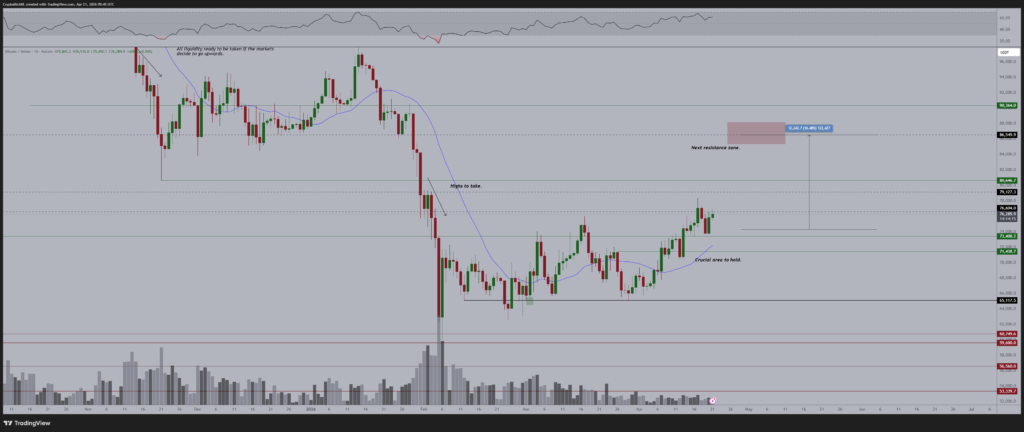
1-day BTC/USD chart. Analysis: Michaël van de Poppe
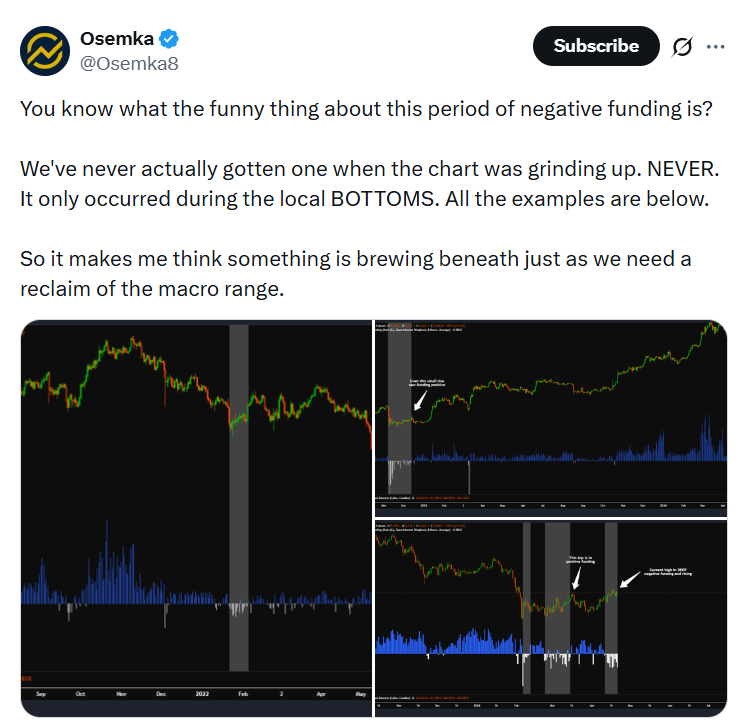
Other market participants focus specifically on the structure of derivatives. Trader Osemka on X emphasized that negative funding during price growth has rarely been seen in the past and historically coincided with local bottom zones. In his view, the current situation looks like an accumulation of a critical volume of short positions: “something is brewing.”
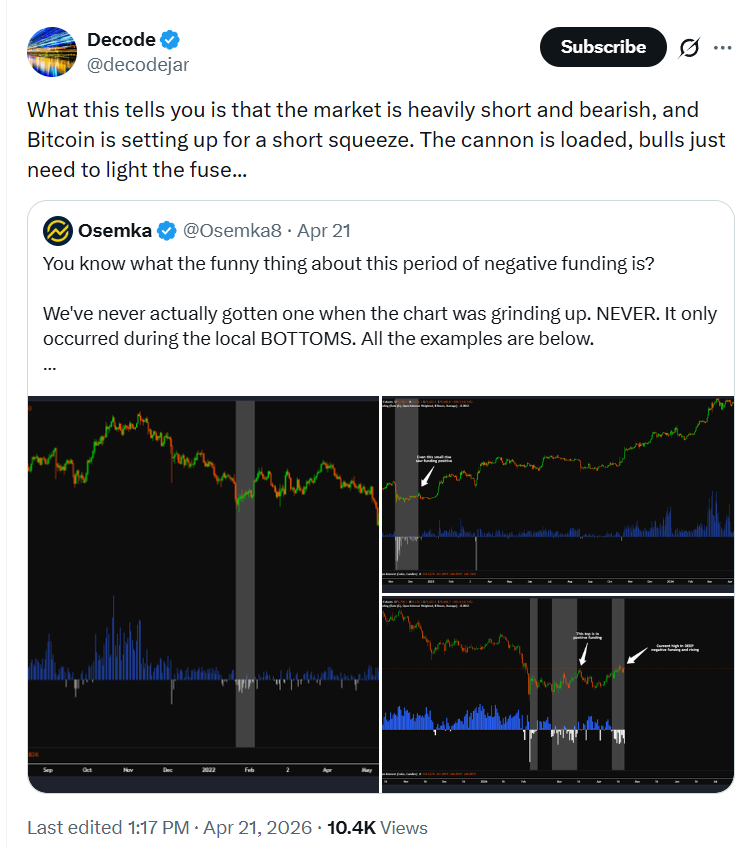
The analytical platform Decode also highlights a strong bias toward bearish expectations. According to their assessment, the market is “overloaded with shorts and excessively negative,” creating conditions for a potential short squeeze. In such a configuration, any acceleration in growth can trigger forced closing of short positions, amplifying the upward movement.
The mechanics of this process are well known. Forced liquidation of short positions occurs when traders who bet on a price decline are forced to buy back the asset at higher levels to cover losses. This creates additional buying demand, which accelerates growth and can turn a local move into a broader impulse. Under current conditions, the combination of rising prices and negative funding indicates that the “fuel” for such a scenario continues to accumulate.
Additional context is provided by the news background. The geopolitical situation remains tense: Iran denied reports about the arrival of its delegates in Pakistan for new negotiations with the United States, and the topic of a potential closure of the Strait of Hormuz periodically returns to the agenda, although market reactions remain restrained so far. This suggests that global markets have partially adapted to geopolitical uncertainty and respond selectively rather than with panic.
From the perspective of machine data analysis and historical patterns, the current market structure looks familiar. Similar configurations have been observed in the past, including September 2025, when trader Luca drew parallels with the sideways movement of 2024. At that time, the accumulation of short positions also became fuel for subsequent accelerated growth. In such phases, the market often behaves asymmetrically: prolonged pressure in one direction leads to a sharp and rapid reversal in the opposite direction.

This is why the current situation is perceived by market participants as potentially “charged.” When the price rises amid negative funding and the dominance of shorts, the balance becomes unstable. In such conditions, the market resembles a compressed spring: outwardly the movement looks calm, but internal tension continues to build.
In such phases, the key factor is not so much the price level itself as the structure of positions. And it is precisely this that now indicates the market may be in a state of preparation for a sharp impulse, where the direction of movement will be determined not by news, but by liquidation mechanics.
All content provided on this website (https://wildinwest.com/) -including attachments, links, or referenced materials — is for informative and entertainment purposes only and should not be considered as financial advice. Third-party materials remain the property of their respective owners.