


Markets started the day in a mode of cautious optimism. Futures on U.S. indices are rising, but this is the kind of growth driven more by hope than confidence. Too many factors are pulling in different directions, and any of them could quickly shift sentiment.
The main trigger is Donald Trump’s statement about an indefinite extension of the truce with Iran (published on April 21 on the social network Truth Social).
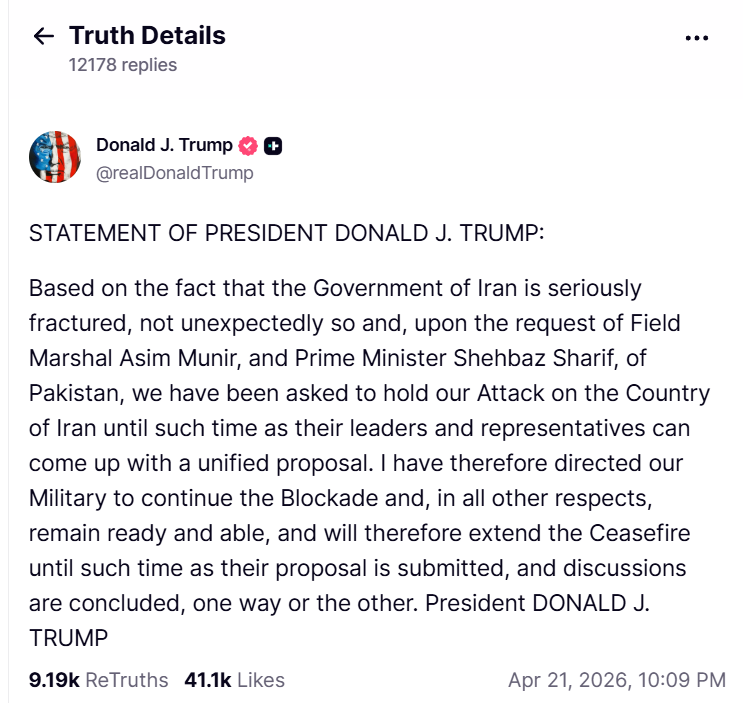
Formally, this signals easing tensions, and the market reacted accordingly: risk moved slightly off the radar, and appetite for equities returned. But the word “indefinite” here sounds almost like “until the next headline.” Investors have learned their lesson: geopolitics can turn faster than a trading session opens.
The oil factor, meanwhile, hasn’t gone anywhere. Restrictions on shipping in the Strait of Hormuz remain, meaning the market continues to operate with an elevated risk premium. Brent is holding around $99 per barrel — a level that stops being just a number and starts acting as systemic pressure on the economy. Expensive oil is fuel for inflation, and inflation is the main argument against rapid rate cuts. As a result, central banks find themselves in a bind: they want to support growth, but inflation refuses to let go.
Against this backdrop, a separate storyline is unfolding around the Federal Reserve. Kevin Warsh, a candidate for Fed Chair, emphasized his independence during Senate hearings and made it clear he does not intend to become a tool of political pressure.
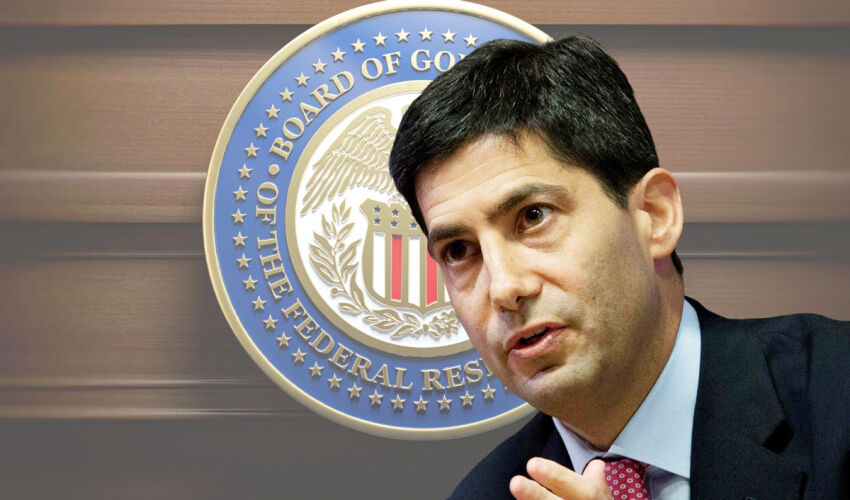
At the same time, Donald Trump is already openly signaling expectations for a more accommodative monetary policy. This creates a classic setup: the market is trying to determine who will ultimately set the tone — politics or macroeconomics. This very uncertainty makes rate expectations less stable.
At the same time, news arrived that for the tech sector sounds almost like a changing of the era. Tim Cook announced he will step down as CEO of Apple on September 1. He will be replaced by John Ternus — an insider, an engineer rather than a “public strategist.” The market reacted instantly: shares fell by about 2.5%. This is not panic, but a clear signal that investors are pricing in a transition period.
Cook turned Apple into one of the most efficient profit-generating machines in history, particularly through services. The departure of such a leader always raises not only the question of “who’s next,” but also “what’s next.” Ternus is primarily associated with product and engineering. This could mean a shift back toward hardware, but the market is not yet sure how this will affect growth rates and margins.
Earnings season adds a practical layer to the picture. United Airlines reported better-than-expected results on key metrics but faced a classic issue of the current cycle — rising fuel costs. High oil prices directly hit margins, providing a clear example of how geopolitics quickly translates into financial impact.
The main event of the day is still ahead — Tesla’s earnings report after the close. At this point, it’s not just about one company, but rather a barometer of sentiment in the tech sector. Tesla traditionally serves as a gauge of expectations: if results and guidance are strong, the market may find a reason to continue its upward move. If not, the correction could spread wider than the company itself.
Overall, the picture is quite typical for the current moment. Markets have formally returned to levels seen before the escalation in the Middle East. This suggests that the “peak fear” phase is indeed behind us. However, fundamental risks have not disappeared — they have simply become less loud.
Expensive oil remains the key variable. As long as it stays at elevated levels, inflationary pressure persists, and the room for maneuver for central banks remains limited. It is a classic slow-burning risk: it does not explode immediately, but it influences the entire economic cycle.
In such conditions, the market once again finds itself caught between two forces. On one side is the desire to grow amid easing geopolitical tensions. On the other are objective constraints in the form of inflation, interest rates, and resource costs.
And the main question now is not where the market will go tomorrow, but how устойчив this fragile balance will prove to be.
All content provided on this website (https://wildinwest.com/) -including attachments, links, or referenced materials — is for informative and entertainment purposes only and should not be considered as financial advice. Third-party materials remain the property of their respective owners.