


The crypto market started the day in a moderately positive mood, although beneath the surface there is still high nervousness due to recent DeFi hacks and overall liquidity turbulence.
Behavior of leading cryptocurrencies by market capitalization
Bitcoin (BTC), according to TradingView, started the day with growth. In the morning it was trading at $77,506. Over the past 24 hours, the range was from $74,852 to $77,726.
The growth looks moderate, but the context is important: the market continues to hold near local highs despite an elevated share of short positions and an unstable news background. This creates a “compressed spring” effect – the price moves upward without sharp impulses, but with an accumulation of potential energy.
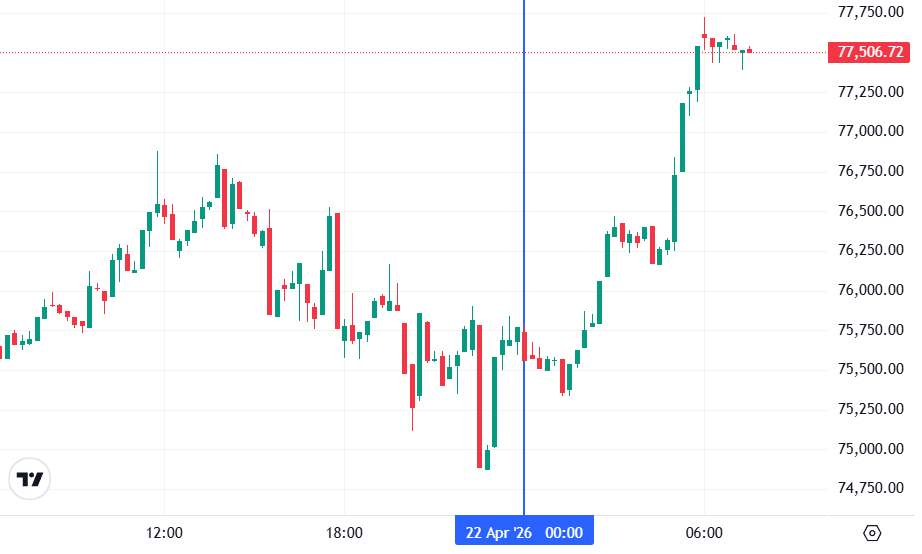
Bitcoin price chart. Source: TradingView
Ethereum (ETH) also started the day with growth and is trading around $2,360. Despite weaker dynamics compared to BTC, the asset maintains stability within a sideways range.
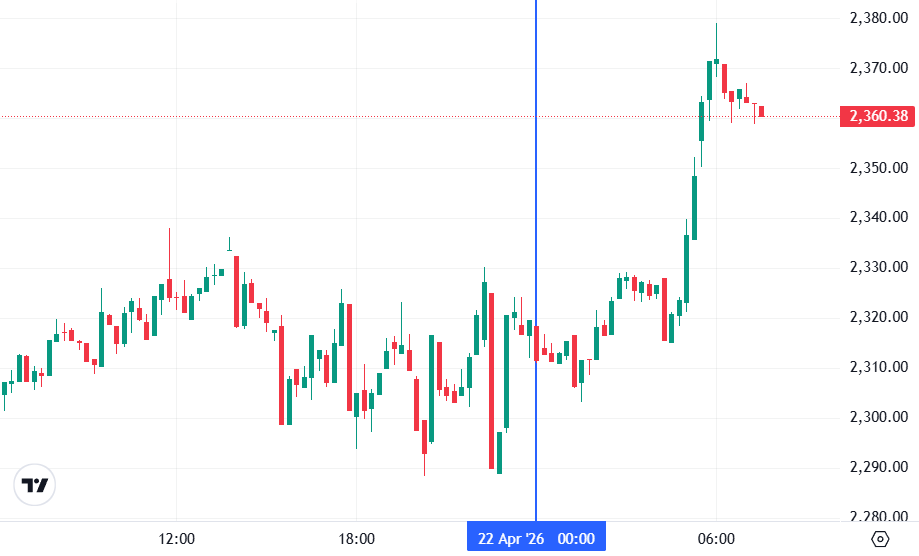
Ethereum price chart. Source: TradingView
In the top 10 largest cryptocurrencies, the best daily result was shown by Bitcoin (+2.58%). Over the week, the growth leader was XRP (+6.32%), reflecting local interest in altcoins amid market stabilization.
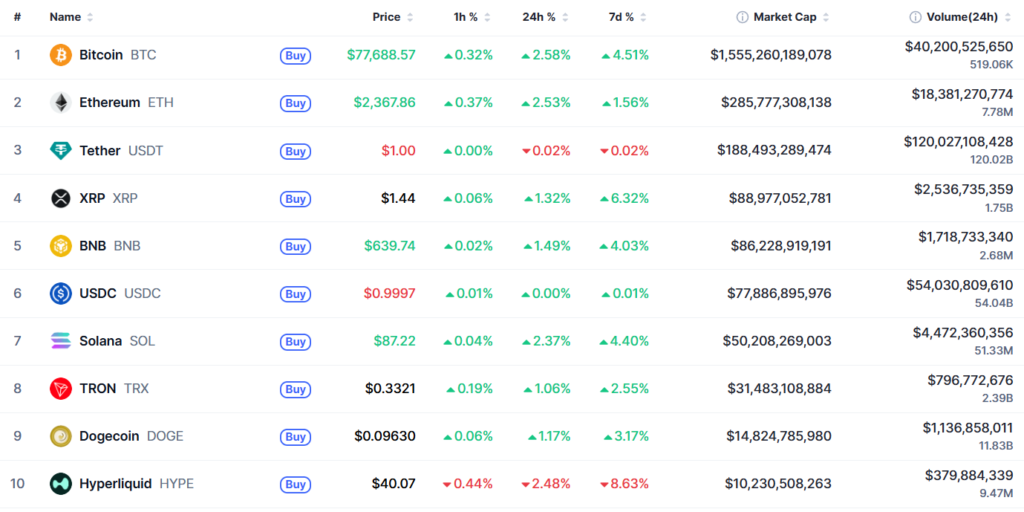
Top 10 largest cryptocurrencies by market capitalization. Source: CoinMarketCap
On the downside, Hyperliquid stands out, losing about -2.48% over the day and -8.63% over the week. This indicates increased sensitivity of derivatives platforms to overall volatility and liquidity changes.
In the top 100 most capitalized assets, the strongest growth was recorded by MemeCore: +32.89% for the day and +58.93% for the week. Such movements are typical for low-liquidity segments of the market, where capitalization can expand rapidly amid speculative demand.
The weakest daily performance was shown by DeXe (-11.39%), while over the week the biggest decline was recorded by LayerZero (-17.04%). The weakness of LayerZero is especially indicative against the backdrop of recent news about DeFi protocol hacks, where cross-chain infrastructure remains a key risk element.
Main crypto news of April 22
One of the central events was the hack of the DeFi protocol Volo, operating on the Sui blockchain. Hackers withdrew about $3.5 million in various assets, including WBTC, XAUm, and USDC. The project team responded promptly: vulnerable vaults were frozen, and coordination with the Sui Foundation and ecosystem partners was initiated. As a result, about $500,000 of the stolen funds was additionally frozen.
According to the developers, the attack was localized and affected only three vaults. The remaining assets of the protocol, including about $28 million in TVL, remain safe. The team also stated that it intends to compensate user losses independently, without shifting them onto clients.
Against this background, attention to overall DeFi security is increasing. The earlier KelpDAO hack of about $292 million, linked to the Lazarus hacker group, continues to pressure risk perception in the sector.
In the corporate segment, the news about DoorDash’s plans to introduce stablecoin payments stands out. The company is considering integrating the Tempo blockchain for settlements with couriers, merchants, and users in more than 40 countries.
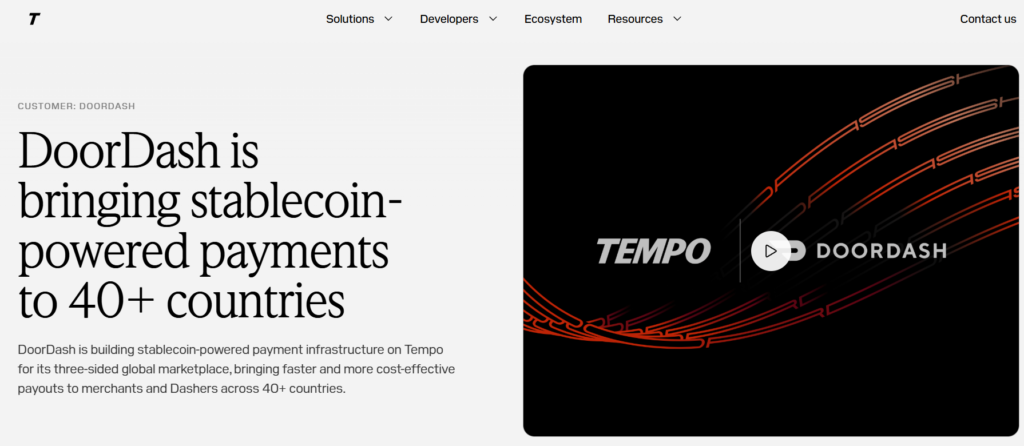
The scale is significant: in Q4 2025, DoorDash processed about 903 million orders totaling $29.7 billion. This makes the initiative one of the largest potential use cases of stablecoins in the real economy. The main expected effect is reduced fees and faster international payments.
Another important trend is the expansion of derivatives within crypto infrastructure. Blockchain.com has added perpetual futures trading to its non-custodial DeFi wallet.
Users can now open positions with leverage up to 40x across more than 190 markets, using Bitcoin as collateral while retaining full control over private keys. Trade execution is carried out via the decentralized derivatives platform Hyperliquid.
This step reflects a broader trend: crypto derivatives are gradually moving beyond centralized exchanges. Kraken and Coinbase have already launched similar products for users outside the United States, while Kalshi is considering launching crypto derivatives within the U.S. market. According to industry sources, the CFTC regulator may soften its stance on such instruments in the near future.
Conclusion
The market remains in a balancing phase: on one hand supported by the growth of major assets, primarily Bitcoin, and on the other pressured by DeFi incidents and regulatory uncertainty.
The key factor in the coming days is not so much price as liquidity stability and the market’s ability to absorb new risks without transitioning into a phase of sharp correction.
All content provided on this website (https://wildinwest.com/) -including attachments, links, or referenced materials — is for informative and entertainment purposes only and should not be considered as financial advice. Third-party materials remain the property of their respective owners.