

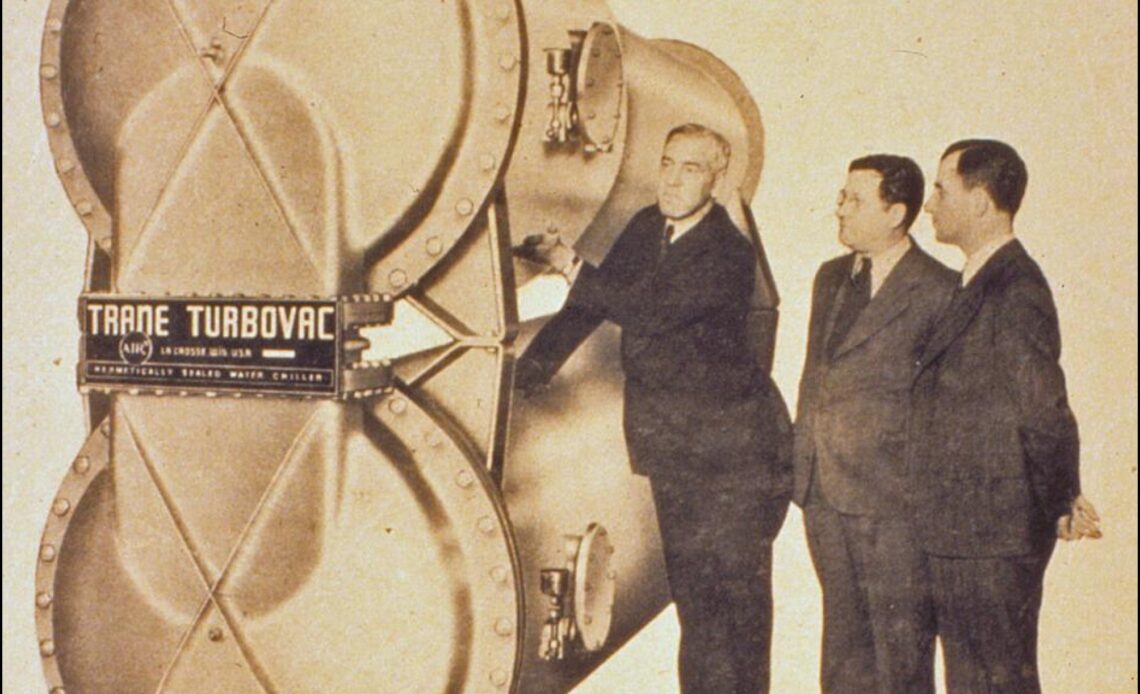
Can you build a company worth more than $100 billion simply because one day you got tired of carrying heavy radiators?
It turns out you can.
The story of Reuben Trane, founder of Trane Technologies (NYSE: TT), proves that the biggest businesses are often not born from the desire to “create a revolution,” but from the determination to solve one very specific problem.
It All Started With Heavy Radiators
At the end of the 19th century, the Trane family owned a small heating equipment workshop.
Young Reuben helped his father and faced the same problem every day – massive cast-iron radiators were expensive, heavy, and extremely inconvenient to transport and install.
He simply became tired of dealing with them.
After receiving an engineering education, Reuben decided not to accept the existing situation but to create a more efficient heating system.
This led to the invention of the convector coil – a solution that provided the same level of efficiency while being significantly smaller and lighter.
That idea became the foundation of what would later become an industrial empire.
When an Engineering Solution Becomes a Billion-Dollar Business
The company grew gradually, without flashy headlines and without venture capital funding.
But this type of growth often proves to be the most sustainable.
1913
- a small family company;
- annual revenue of around $50,000.
1926
- launch of the famous Heating Cabinet;
- sales exceed $1 million.
1953
- by the time of Reuben Trane’s death, company revenue had already surpassed $45 million.
2026
- Trane Technologies is among the world’s leaders in climate solutions;
- market capitalization exceeds $100 billion;
- the company operates in more than 100 countries and is one of the key players in the HVAC market.
Why Has Trane Survived for More Than a Century?
Most companies consider their patents to be their main asset.
But the problem with patents is that they eventually expire.
Trane’s true competitive advantage turned out to be something completely different.
For decades, the company invested in:
- research and development (R&D);
- engineering innovation;
- employee training;
- a sales culture built around technical expertise.
In practice, Trane created generations of engineer-salespeople who did not simply sell equipment but designed optimal climate solutions for customers.
A system like this is extremely difficult to replicate within just a few years.
This is what investors call an Economic Moat – a durable competitive advantage that protects a business even when technologies gradually become available to everyone.
The Test of Time
Over more than a century, the company has survived nearly every major global crisis:
- the Great Depression;
- World War II;
- oil crises;
- the 2008 financial crisis;
- the COVID-19 pandemic;
- the global transition toward energy-efficient technologies.
Each time, markets changed, but demand for high-quality heating, ventilation, and air-conditioning systems remained.
Today, Trane continues expanding into energy efficiency, smart building management, and sustainable climate solutions while maintaining its leadership position in the industry.
What Does This Teach Investors?
The story of Trane reminds us of an important truth:
Not every successful business needs to be connected to artificial intelligence, cryptocurrencies, or space exploration.
Sometimes the most profitable investments are hidden in companies that have spent decades producing equipment needed by virtually every building in the world.
Such companies rarely become the stars of breaking news, but they know how to do the most important thing – consistently grow profits, generate cash flow, and create shareholder value over decades.
That is why many long-term investors classify Trane Technologies (TT) as a Quality Growth company – a high-quality business capable of growing regardless of economic cycles.
What Do You Think?
What looks more attractive for a long-term portfolio in 2026?
- Time-tested industrial giants like Trane Technologies;
- technology companies connected to artificial intelligence;
- cryptocurrencies and digital assets;
- or perhaps the best approach is a balanced combination of all these areas?
Share your opinion in the comments.
All content provided on this website (https://wildinwest.com/) -including attachments, links, or referenced materials — is for informative and entertainment purposes only and should not be considered as financial advice. Third-party materials remain the property of their respective owners.