


The story of Anthropic’s chatbot policy and its Claude product is a clear example of how the artificial intelligence industry is gradually shifting from a “maximum accessibility” model to a “controlled access” model. If earlier neural networks focused on rapidly scaling their user base, the emphasis is now increasingly moving toward risk management – legal, reputational, and infrastructural.
Formally, everything looks standard: the user agreement reserves the company’s right to restrict or fully terminate access in case of violations. In practice, however, this right is applied much more broadly and strictly than many users expect. It is not limited to obvious violations such as spam, API abuse, or attempts to generate prohibited content. More “grey zone” scenarios can also trigger enforcement – such as unusual usage patterns, suspicious activity, or even simple regional mismatch.
The key feature of the system is its multi-layered structure. It is not a single filter but a combination of mechanisms operating simultaneously: automated moderation, behavioral analytics, IP verification, payment data matching, and, if necessary, manual review. As a result, a user may face a ban not as the result of a single violation, but as the cumulative effect of several factors, each of which on its own might not trigger sanctions.
The geographical factor is particularly important. Unlike many digital services that formally impose restrictions but loosely tolerate VPN usage, this approach is significantly stricter. If a platform does not officially support a given country, attempts to bypass this restriction are themselves treated as a risk signal. And it is not just about the current connection, but a combination of indicators: frequent IP changes, mismatches between geolocation and payment data, unstable sessions. All of this builds a profile that the system may interpret as evasion behavior.
Here we encounter a modern digital security paradox: the more advanced the infrastructure becomes, the less flexibility remains for the user. What was once a globally seamless service experience is now increasingly tied to geographic identity as part of an account profile.
The next layer is identity verification. With the introduction of KYC procedures via partner Persona, the platform has effectively adopted financial-sector practices. Although officially described as “limited cases,” the system architecture implies that almost any factor can act as a trigger – from suspicious login behavior to subscription attempts.
What matters most is not the fact of verification itself, but its implementation. Unlike traditional systems where uploading a document scan is sufficient, this approach uses live verification. Users must present a physical document in real time via camera, confirm their presence, and pass authenticity checks. This significantly increases security reliability, but also raises the entry barrier.
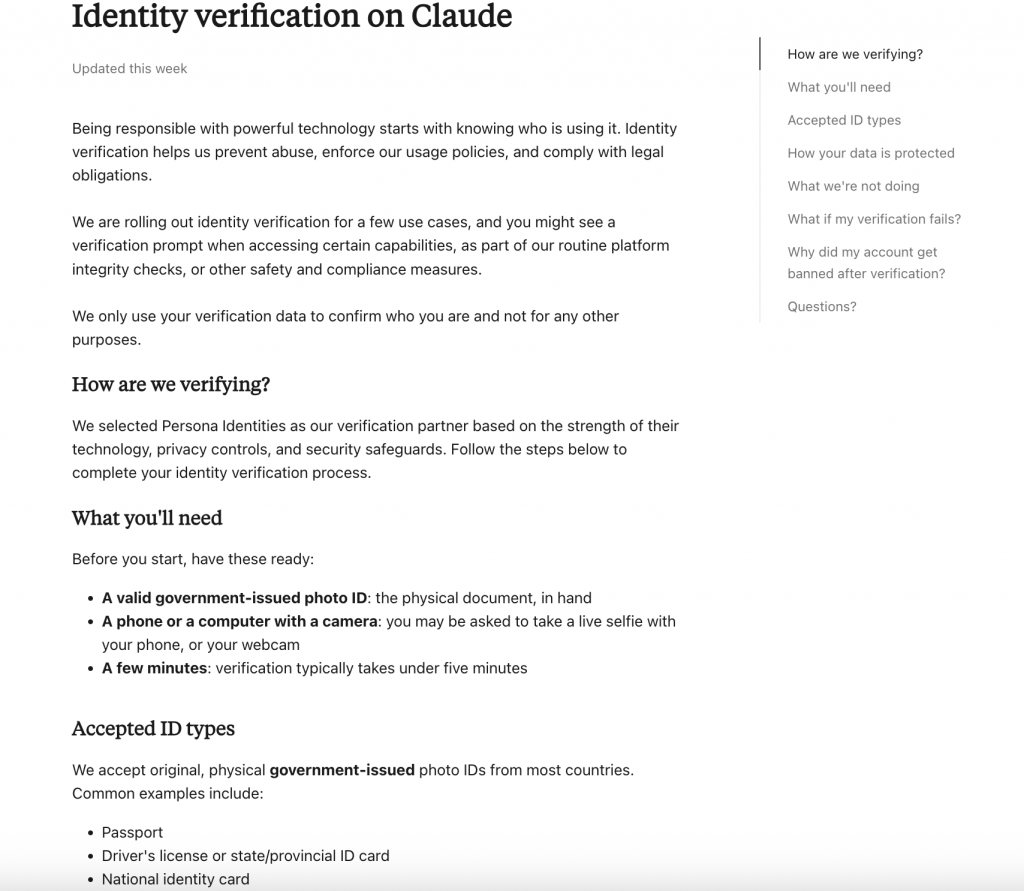
Claude passport regime
Payment is a particularly sensitive point. Once a user moves from a free tier to a paid subscription, the level of scrutiny automatically increases. Payment data becomes another verification signal, and any inconsistency – whether card country or IP location – may trigger additional checks or even account suspension. From an anti-fraud perspective, this is logical, but it also increases friction for legitimate users.
Interestingly, this creates an unexpected effect in practice: free accounts often operate under “lighter” supervision than paid ones. Until financial interaction begins, users remain in a softer monitoring mode. But once money enters the system, full compliance mechanisms activate, resembling banking infrastructure more than a typical tech product.
In a broader context, this reflects a structural shift in the industry. Artificial intelligence is no longer an experimental technology – it is becoming infrastructure that carries legal responsibility. As a result, companies are forced to build control systems comparable to financial and governmental standards.
This explains the perceived “strictness” or even asymmetry of rules. Users often find themselves with limited leverage: decisions are made by algorithms and internal procedures, while transparency remains constrained. From the company’s perspective, however, the logic is clear – it is better to lose part of the user base than to face regulatory exposure or misuse risks.
Ultimately, this is not just an isolated case but a symptom of a broader transformation. Platforms like Claude are gradually moving from an “open access” model to a “trusted access” model, where the right to use the service must not only be granted but continuously reaffirmed. And the key question is no longer technological, but behavioral: how much control users are willing to accept in exchange for access to next-generation tools.
All content provided on this website (https://wildinwest.com/) -including attachments, links, or referenced materials — is for informative and entertainment purposes only and should not be considered as financial advice. Third-party materials remain the property of their respective owners.