

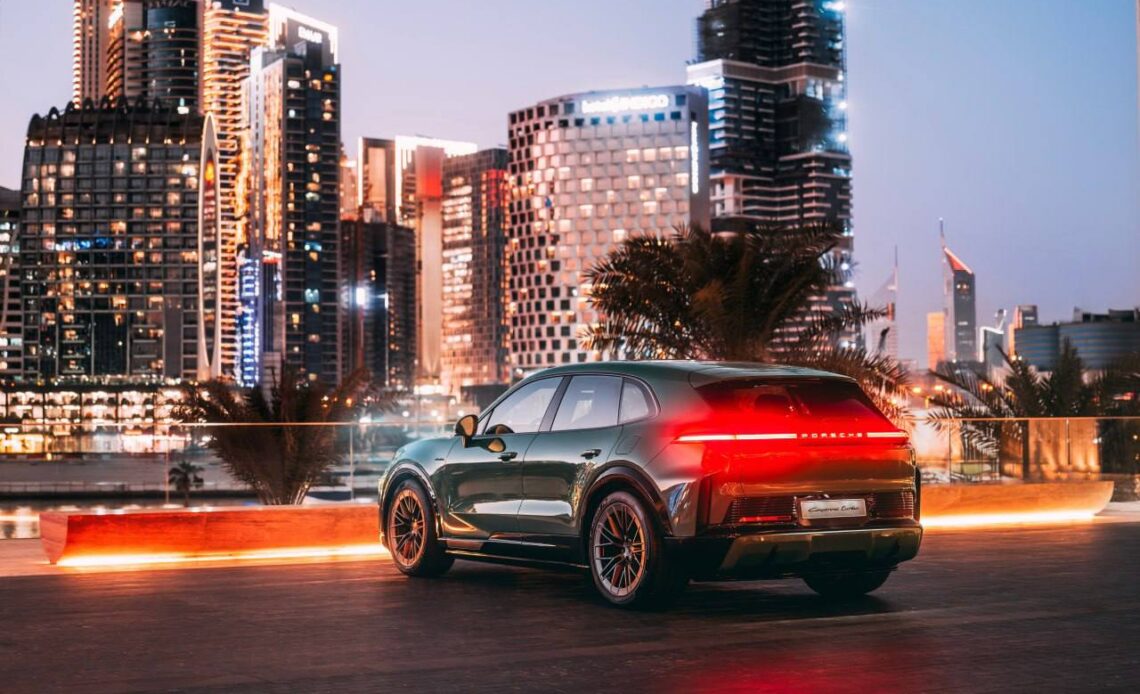
The situation around Porsche is starting to look less like a temporary downturn and more like a structural shift. A company that for years symbolized stable premium demand is now facing a reality where its traditional growth drivers no longer work as they once did.
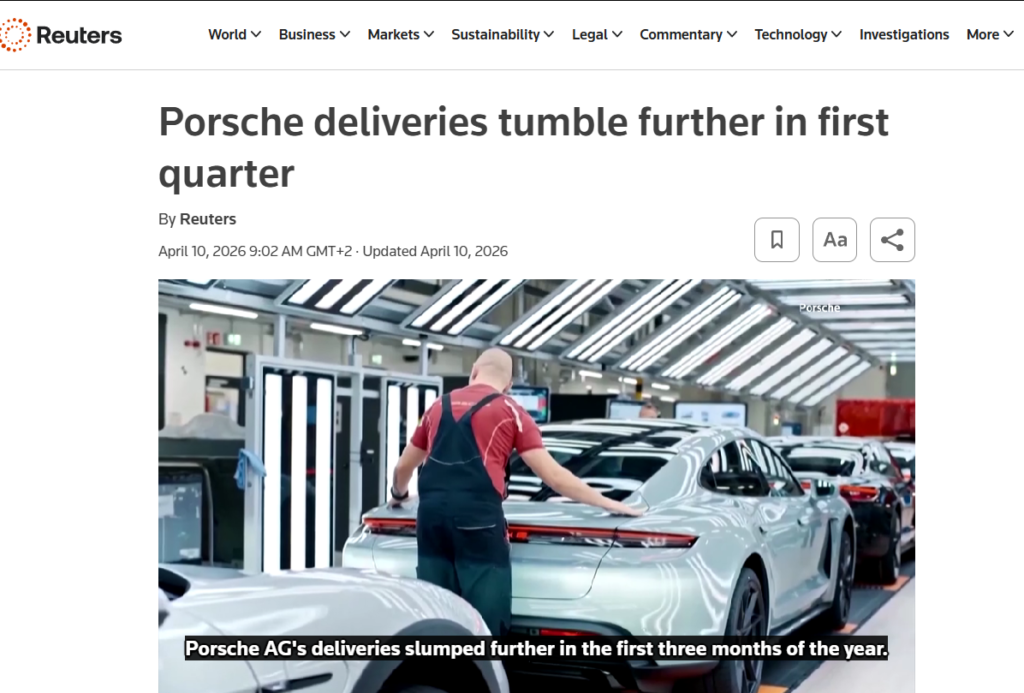
By the end of 2025, global sales declined by 10% to 279,449 vehicles. This is no longer just a “bad year,” but a signal of a changing trend. The beginning of 2026 only reinforced this impression: according to Reuters, the company delivered 60,991 cars in the first quarter, implying an additional drop of around 15%. Markets, like strict auditors, don’t like consecutive declines — it always raises the question of where exactly the growth model has broken.
The biggest hit came from China — a market that until recently was seen as the main engine of expansion for European premium brands. Sales there fell by 21%, and this is no longer a cyclical fluctuation but the result of deeper structural changes. The Chinese market is evolving rapidly: local manufacturers are no longer catching up with Western brands — in many segments, they are already overtaking them.
Companies like BYD and NIO offer technologically advanced electric vehicles and hybrids that match premium standards in features and user experience, but at significantly lower prices. As a result, the traditional formula “brand + status = sales” is beginning to fail in China. Buyers are becoming more pragmatic — and that’s bad news for European luxury brands.
North America, traditionally a more resilient market, also showed a decline of 10%. Here, the removal of tax subsidies for electric vehicles in the U.S. played a key role. While this is critical for the mass market, even premium segments feel the impact. When government support disappears, some buyers postpone purchases or shift to more cost-effective alternatives.
Europe, long considered a “home” and relatively stable market, also declined — down 18%. This is already a warning signal: if a brand starts losing ground even in its core market, the pressure is clearly systemic. The only relatively stable region was Germany, where sales grew by a modest 4%. But against the broader picture, this looks more like an exception than a new trend.
Against this backdrop, the new CEO Michael Leiters steps in. His strategy sounds tough and very much in line with the current environment: “ruthless” cost-cutting combined with a focus on updating the model lineup. This is a classic crisis-management approach the market has seen many times before. The real question is whether it is enough when the problem is not only internal but also external.
Cost-cutting can improve margins, but it does not create demand. Updating models is important, but in the era of electric vehicles, it is no longer sufficient. Today, competition is not just about design or engine performance — it’s about ecosystems: software, autonomous features, integration with digital services. And here, traditional automakers often lag behind more agile tech-driven companies.
Another major challenge is the transition to electric vehicles. For Porsche, this is a double task: preserving the brand’s DNA (performance, эмоции, prestige) while adapting to a new reality where batteries, software, and charging infrastructure are critical. Balancing the “old spirit” with “new demands” is far from easy.
Looking more broadly, Porsche’s situation reflects a global shift in the automotive industry. The premium segment is no longer as protected from competition as it once was. Electrification, digitalization, and the rise of local manufacturers are reshaping the rules. And while brands could rely on reputation for decades in the past, today that is no longer enough — the market demands constant technological validation of status.
In the end, the picture is quite harsh but honest. Porsche is not going through a short-term turbulence — it is undergoing a phase of adaptation to a new reality. And the key question is not how quickly costs will be reduced or new models will be released. The real question is whether the brand can once again prove its value in a world where luxury is measured not just by the badge on the hood, but by the technology underneath it.
All content provided on this website (https://wildinwest.com/) -including attachments, links, or referenced materials — is for informative and entertainment purposes only and should not be considered as financial advice. Third-party materials remain the property of their respective owners.