

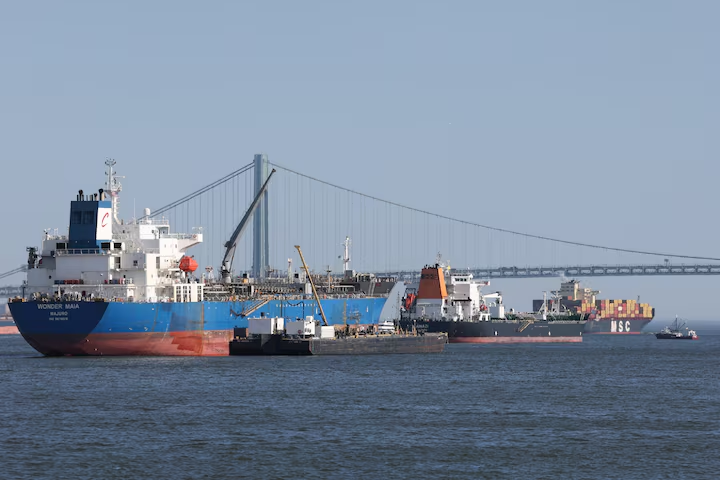
The global oil market is undergoing one of the most significant transformations in recent decades. For the first time in modern history, the United States has taken first place among the world’s largest oil exporters, overtaking traditional leaders – Saudi Arabia and Russia. A few decades ago, such a scenario seemed almost impossible. For many years, America depended on Middle Eastern oil supplies and painfully experienced the 1973 oil embargo imposed by several OPEC countries in response to support for Israel. However, events in recent years have completely reshaped the balance of power in the global energy market.
According to Reuters and maritime tracking analytics platforms, in May 2026 US exports of oil and petroleum products reached approximately 10.5 million barrels per day. This allowed America to hold the position of the world’s largest exporter for the third consecutive month. By comparison, Russian exports in May amounted to around 7 million barrels per day, while Saudi Arabia exported about 5.9 million barrels. Just a year earlier, the situation looked completely different. In 2025, Saudi Arabia exported about 8.1 million barrels per day, the US 6.6 million, and Russia around 5.8 million barrels.
One of the main reasons for this sharp redistribution of power has been geopolitical conflict. The military confrontation between the United States and Iran led to serious disruptions in oil exports from the Persian Gulf countries. Disruption of established logistics routes and risks to shipping in the region put pressure on Saudi oil supplies. At the same time, the Russian oil sector continues to face the consequences of sanctions and attacks by Ukrainian drones on energy infrastructure, which also limits export capacity.
Against this backdrop, US producers were able to take advantage of the situation. Growth in shale oil production, which began in the previous decade, created a powerful production base for the United States. It was the shale revolution that reshaped the global energy map. At the beginning of the 2000s, US production of oil and liquid hydrocarbons was about 8 million barrels per day, while today it has reached nearly 22 million barrels. Over the same period, Saudi Arabia largely maintained production in the range of 10-12 million barrels per day, while Russian output, after growing in the 2000s, has in recent years stagnated and even shown signs of decline.
An additional driver of US export growth has been the use of strategic petroleum reserves. High production levels combined with additional supply volumes allowed American companies to significantly increase exports at a time when some competitors faced restrictions.
Today Washington has gained an instrument of influence it previously did not effectively have. While the main pillars of US global power were once military strength, technological leadership, and the dominance of the US dollar as the world’s reserve currency, an energy factor has now been added. Many countries are becoming increasingly dependent on American oil and gas supplies. This is especially visible in Europe, which after the start of the war in Ukraine actively reduced its dependence on Russian energy resources and searched for alternative suppliers. As a result, almost half of all US oil exports today go to the European market. In 2021, Europe accounted for about 37% of US oil exports, while in 2026 this figure rose to approximately 47%.
Changes are also taking place in Asia. Traditionally, most Asian countries purchased oil mainly from the Middle East. However, in recent years US supplies have played an increasingly important role. In May 2026, about 46% of US oil exports went to Asian countries, compared to around 37% a year earlier.
The strengthening position of the United States may also change the very mechanism of oil price formation. For decades, the market largely followed decisions of OPEC and its allies. Production quotas agreed by major producers had a significant impact on global oil prices. However, the American model is fundamentally different. In Saudi Arabia and several other oil-producing countries, output levels are largely determined by the state. In the United States, decisions are made by private companies, primarily based on market conditions and business profitability. This creates a kind of automatic stabilization mechanism. When oil prices rise, US companies increase production, which boosts supply and helps limit further price increases. When prices fall, some producers reduce activity, helping the market restore balance. According to some experts, the US is beginning to play a role traditionally associated with Saudi Arabia, but through market mechanisms rather than centralized control.
Another blow to OPEC’s position was the United Arab Emirates leaving the organization after nearly sixty years of membership. This decision has intensified discussions about the cartel’s future and its ability to maintain its previous influence on the global energy market.
In Moscow, these changes are also being closely monitored. Leaders of major Russian energy companies have repeatedly stated that US producers have become among the main beneficiaries of the current geopolitical situation. This became particularly evident after shipping difficulties in the Strait of Hormuz, through which a significant portion of global oil supplies traditionally passes.
It is important to understand that current US leadership did not emerge solely due to recent conflicts. The foundation was laid much earlier. A key moment was Washington’s decision in 2015 to lift the nearly forty-year ban on oil exports imposed after the Arab oil embargo. This step opened access for US producers to global markets and gradually transformed the country from the largest importer into the largest exporter.
Global oil demand also continues to grow. In 2010, global consumption was about 87 million barrels per day, while last year it reached approximately 104 million barrels. A significant part of this growth was driven by increased US production. In effect, the US oil boom became one of the key factors enabling the global economy to meet rising energy demand.
The current situation demonstrates how quickly global economic and political configurations can change. A country that just a few decades ago symbolized dependence on Middle Eastern oil is now itself shaping a significant part of global energy flows. For investors, governments, and energy companies, this marks the beginning of a new era in which the United States is not only the world’s largest economy but also a key supplier of one of the most strategic resources of modern civilization.
All content provided on this website (https://wildinwest.com/) -including attachments, links, or referenced materials — is for informative and entertainment purposes only and should not be considered as financial advice. Third-party materials remain the property of their respective owners.