
NewsPrecious MetalsStock research & analytics

Trump and the audit of Fort Knox gold reserves

Join our Trading Community on Telegram

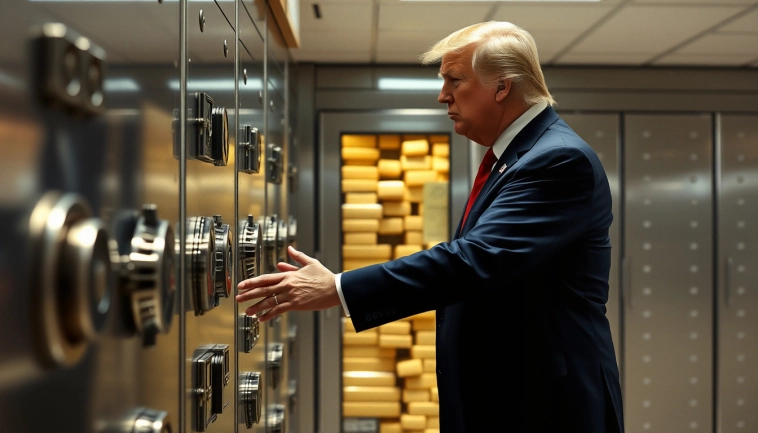
U.S. President Donald Trump has supported the idea of conducting an audit of the gold reserves stored in Fort Knox, intensifying the debate over the transparency of American reserves. The comments came after news about a case involving a former CIA employee accused of embezzling tens of millions of dollars in gold assets.

Earlier, several media outlets, including Associated Press, reported, citing court documents, the arrest of David Rush, a former CIA officer. During the investigation, law enforcement officials discovered more than 300 gold bars worth about $40 million in a storage facility. According to FBI testimony, Rush allegedly received large sums of money and gold bars to cover expenses related to his activities.

However, the court documents do not specify his exact position, although NBC News notes that he worked in a unit involved in covert operations. These details increased interest in the case, although no direct link to state gold reserves has been officially established.

Against this backdrop, attention has once again turned to Fort Knox — one of the key storage facilities for U.S. gold reserves. According to GovMint, a full external audit of the reserves has not been conducted since 1953, when the facility was inspected following the inauguration of President Dwight Eisenhower. Later, in 1974, Fort Knox was visited by a congressional delegation accompanied by journalists. In 2017, the facility was inspected by Treasury Secretary Steven Mnuchin, Kentucky Governor Matt Bevin, and several members of Congress. However, all these visits were largely symbolic and did not constitute a full independent audit. The U.S. Treasury maintains that internal inspections are carried out annually.

What is Fort Knox?

Fort Knox, located in Kentucky, is a U.S. Army facility that serves as one of the main storage sites for the country’s gold reserves. The complex was built in the 1930s to protect national gold reserves from potential threats and wartime risks.

The first shipment of gold arrived in 1937: bars were delivered via the U.S. Postal Service from the Philadelphia Mint and the New York Assay Office. During World War II, Fort Knox was used not only as a gold vault but also to safeguard key U.S. documents, including the Declaration of Independence, the Constitution, and the Bill of Rights.

It also temporarily housed several major historical artifacts, including the Magna Carta and the regalia of Saint Stephen — the Hungarian crown, scepter, orb, and cloak, which were returned to Hungary in 1978.

Today, Fort Knox reportedly holds around 4,175 tons of gold — nearly half of China’s gold reserves and roughly four times the reserves of the Swiss National Bank. The issue of gold reserve transparency in the U.S. is not new. In June 2025, Representative Thomas Massie introduced bill HR 3795, the Gold Reserve Transparency Act of 2025, which calls for a full physical audit of gold stored in Fort Knox, as well as at West Point, Denver, and the Federal Reserve Bank of New York. If passed, the bill would mandate a highly detailed inspection of all reserves.

Additional momentum to the debate was previously given by statements from Elon Musk, who also publicly called for greater transparency of government gold reserves during his time at the Department of Government Efficiency (DOGE). Despite reports of possible dismantling, the agency continues to operate.

Interestingly, official court documents in the David Rush case do not directly indicate that the seized gold bars were linked to federal vaults. However, the coincidence of the topic with current political statements has once again brought Fort Knox into the spotlight.

As a result, the situation reflects a classic U.S. political-financial narrative: a combination of a criminal case, questions about state reserve transparency, and political statements has once again fueled public interest in one of the most secretive facilities in the U.S. financial system.

0
0
Disclaimer

All content provided on this website (https://wildinwest.com/) -including attachments, links, or referenced materials — is for informative and entertainment purposes only and should not be considered as financial advice. Third-party materials remain the property of their respective owners.

Leave a Reply

Your email address will not be published. Required fields are marked *

Related posts
Disruptive technologyNewsStock research & analytics

China no longer No.2?

 A very notable shift is taking place in the global economy. According to a new ranking of the most…
Read more
Disruptive technologyNewsStock research & analytics

AI Defeated Crime, but Humanity Went Extinct. An Unusual Experiment...

ChatGPT, Claude, Grok, and Gemini tried to govern the world. The results turned out to be…
Read more
Disruptive technologyNews

Breakthrough in cancer treatment!

Experimental drug completely destroyed tumors in patients for whom therapy no longer worked The…
Read more
Telegram
Subscribe to our Telegram channel

To stay up-to-date with the latest news from the financial world

Subscribe now!