

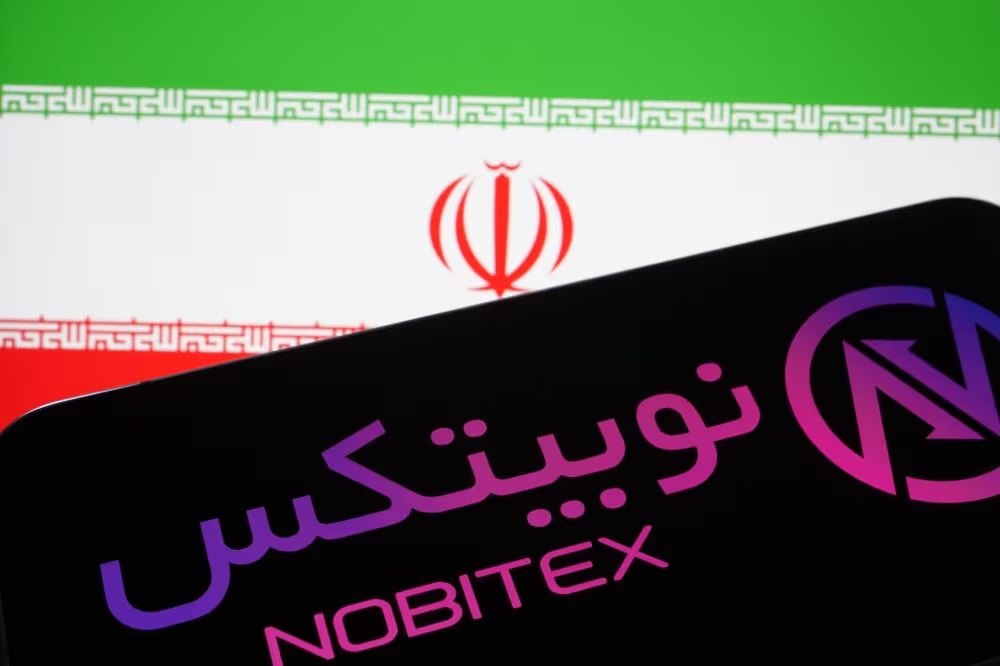
Iran’s largest crypto exchange Nobitex has come under scrutiny following a Reuters investigation that revealed its possible ties to the influential Kharrazi clan — a family that has remained close to the country’s political core for decades. The case is quickly moving beyond a standard corporate investigation and turning into an example of how crypto infrastructure can intersect with state interests.
According to the report, the exchange was founded by brothers Ali and Mohammad Kharrazi. However, in official documents they reportedly used the surname Agamir — an apparent attempt to distance themselves from the well-known family name. The clan’s connections appear systemic: it has links to Supreme Leader Ali Khamenei, the brothers’ grandfather was a member of the Assembly of Experts, and their father was involved in the formation of the Islamic Revolutionary Guard Corps. This is no longer just a biography, but a context that defines the level of influence.
The platform itself holds a dominant position within Iran. It is estimated that more than 11 million users rely on Nobitex, and a significant share of the country’s crypto activity flows through it. Under sanctions and restricted access to the global financial system, such an exchange effectively becomes an alternative infrastructure — something between a bank, a payment system, and an external settlement channel.
Notably, the platform continued operating even during internet shutdowns inside the country. This indirectly highlights its strategic importance. Analysts have also recorded spikes in activity — transactions exceeding $100 million — during periods of geopolitical tension. In such moments, cryptocurrencies shift from speculative assets to tools for rapid capital movement when traditional channels are blocked or too slow.
Another key issue concerns potential sanctions evasion. Different analytics firms provide different estimates of suspicious flows. Elliptic reports $366 million, Chainalysis estimates $68 million, while Crystal Intelligence identifies around $22 million in direct transfers from sanctioned wallets. The wide discrepancy reflects both the complexity of blockchain analysis and differences in methodological approaches.
Additional data points to transfers linked to the Central Bank of Iran. In 2025, according to experts, hundreds of millions of dollars were sent to the exchange. This is viewed as part of a broader strategy to bypass financial restrictions. When the banking system is constrained, crypto becomes a convenient fallback route.
Nobitex representatives deny any ties to the government and insist that the share of illicit activity is minimal. This position is typical for centralized exchanges: formally private, but operating under pressure from users, regulators, and the political environment simultaneously.
Another major development was the freezing of assets by Tether at the request of the U.S. Treasury Department. More than $344 million in USDT was frozen, allegedly linked to the IRGC. However, the situation is not straightforward. Nominis experts questioned whether the funds are actually tied directly to Iran.
Nominis CEO Snir Levi noted that the behavior of the wallets does not match typical Iranian operational patterns. Such entities usually fragment assets and avoid holding large sums in single addresses. In this case, the pattern appears different. This led to speculation that other state actors, potentially including Chinese entities, could be involved. If confirmed, this would expand the issue from a local case to a broader pattern of state-level blockchain usage.
These developments are part of a wider pressure campaign. Operation Epic Fury, mentioned by U.S. Treasury Secretary Scott Bessent, has already resulted in the seizure of around $500 million in crypto assets. This signals that the crypto market is no longer a “gray zone” — it has become a fully integrated part of the global financial system and, accordingly, an object of political control.
Inside Iran, the consequences are already severe. A currency crisis, bank closures, and a 60–70% depreciation of the national currency are creating conditions where alternative financial tools are no longer optional but necessary. In such an environment, the role of crypto exchanges increases significantly.
As a result, a clear picture emerges. Cryptocurrencies were originally designed as decentralized instruments independent of states. In practice, however, they are increasingly embedded into state strategies — whether for sanctions evasion or financial flow control. And the greater the pressure from the traditional system, the more actively this “alternative channel” is used.
The Nobitex case demonstrates that the crypto market can no longer be viewed separately from politics and the global economy. It is no longer an experimental space for enthusiasts, but part of a complex system where technology, money, and power are far more tightly intertwined than just a few years ago.
All content provided on this website (https://wildinwest.com/) -including attachments, links, or referenced materials — is for informative and entertainment purposes only and should not be considered as financial advice. Third-party materials remain the property of their respective owners.