

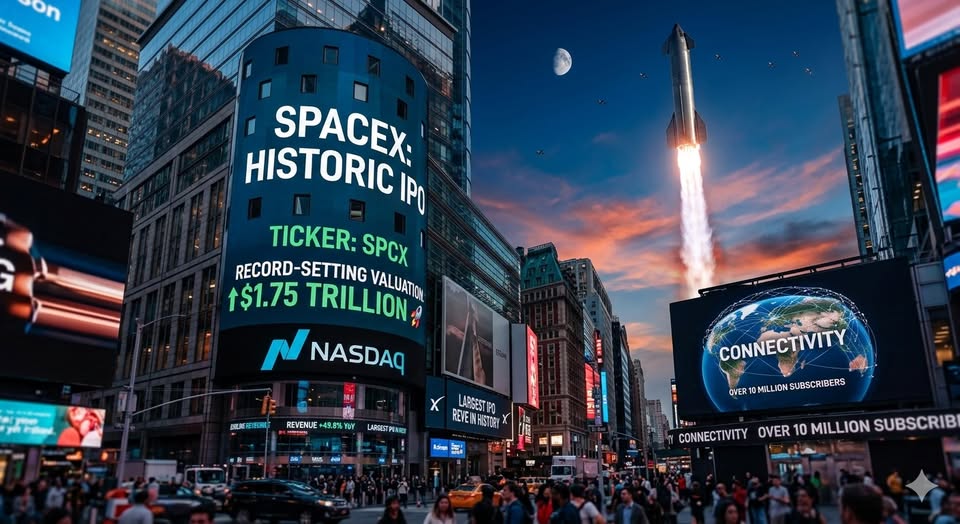
SpaceX’s public listing could become one of the most significant financial events of the 21st century. After years of rumors, refusals, hints, and constant investor speculation, Elon Musk’s company has finally officially disclosed its financials through the S-1 IPO registration filing. For the market, this is a historic moment for several reasons. First, SpaceX has long remained one of the most secretive private companies in the world, with very limited financial disclosure. Second, it is now becoming clear that SpaceX is no longer just a “rocket company.” Third, its potential valuation could make this the largest IPO in capital markets history.
According to the documents, the company is targeting a valuation range of approximately $1.75-2 trillion. By comparison, even the largest tech IPOs of the past decade look modest. If the listing proceeds at this scale, SpaceX would immediately become one of the most valuable corporations in the world on day one of trading. The capital raise is estimated at around $75-80 billion, which could also set an all-time record for an IPO.
Trading is planned on Nasdaq under the ticker SPCX. The very appearance of the ticker is already seen as symbolic: a company long perceived as a quasi-state future space infrastructure provider is finally becoming accessible to public investors.
But the most important element is the financials themselves.
For the first time, investors can see the real financial structure of Musk’s empire rather than fragments of analyst estimates and media leaks. And the picture turns out to be far more complex than the usual “rocket startup” narrative.
In 2025, SpaceX generated approximately $18.67 billion in revenue, representing around 33% growth year over year. For a company of this scale, these are strong growth rates, especially given the capital intensity of the space industry. At the same time, SpaceX reported a net loss of about $4.9 billion. While this may appear concerning, within the tech sector the interpretation is different. The main driver of losses is massive capital expenditure exceeding $20 billion, directed toward Starship development, manufacturing expansion, satellite infrastructure, and artificial intelligence initiatives.
This makes it clear that modern SpaceX is no longer just about space.
The key financial engine is not rocket launches but Starlink satellite internet. This segment generated about $11.39 billion in revenue in 2025, growing nearly 50% year over year. In practice, Starlink is now the main source of financial stability for Musk’s ecosystem.
Starlink has reached approximately 10.3 million users across 164 countries, turning the company into one of the largest next-generation global telecom players.
Its key advantage is vertical integration: SpaceX controls satellite manufacturing, rocket launches, orbital constellation deployment, and the service itself. No traditional telecom operator has this level of integration.
Effectively, SpaceX is building an alternative global telecom infrastructure independent of national cable networks.
For investors, this is crucial. Space projects were historically seen as highly risky and dependent on government contracts. Starlink changes that model by generating recurring consumer revenue at global scale. This cash flow helps finance ultra-expensive projects like Starship.
Starship remains the central symbol of Musk’s ambitions.
It is being developed as the foundation of future Mars exploration and could radically transform the economics of space transportation. If successful, launch costs could drop significantly, unlocking a new space logistics industry.
However, Starship is also the largest source of cost, risk, and uncertainty, requiring tens of billions in investment and still facing engineering, regulatory, and infrastructure challenges.
Another unexpected element in the filing is the formal inclusion of platform X and startup xAI within the SpaceX structure.
This fundamentally reshapes the perception of Musk’s empire.
Previously, these projects were viewed as separate companies. Now it is clear that Musk is gradually building a unified ecosystem where space, communications, social media, and artificial intelligence are interconnected components.
The AI segment remains deeply unprofitable. xAI recorded an EBITDA loss of $6.36 billion in 2025. However, the company is positioning itself for a potential $26.5 trillion AI market in the future.
In essence, investors are being offered not just a space company, but a hybrid of multiple megatrends:
space technology
global internet
artificial intelligence
data centers
digital infrastructure
defense technologies
autonomous systems
This transforms SpaceX into something far beyond a traditional aerospace corporation.
At the same time, control remains highly centralized. According to the IPO documents, Elon Musk will retain about 85% of voting shares, meaning he will continue to effectively control strategic decisions even after listing.
For some investors, this is a strength. For others, it is a major risk.
This is why the SpaceX IPO simultaneously generates excitement and caution.
On one hand, the market gains access to a company already dominating commercial space launches, working with NASA and the Pentagon, building the world’s largest satellite network, and expanding into AI.
On the other hand, investors must accept extremely high risk:
massive capital expenditures
structural losses
dependence on Musk’s decisions
complex monetization paths
regulatory risks
high leverage exposure
valuation uncertainty
But it is precisely this combination of risk and ambition that makes the listing unique.
For the first time, markets are not just investing in a company, but in a long-term technological vision where space, internet, and artificial intelligence converge into a single infrastructure system.
All content provided on this website (https://wildinwest.com/) -including attachments, links, or referenced materials — is for informative and entertainment purposes only and should not be considered as financial advice. Third-party materials remain the property of their respective owners.