

Comparisons in investing like simplicity. Take two ideas, put them side by side, look at the result – and draw conclusions. But behind such seemingly obvious numbers, a more complex picture is almost always hidden.
If an investor had invested $10,000 in Ethereum five years ago, today their capital would be about $7,700. At the same time, a similar amount invested in Nvidia shares would have grown to approximately $146,000. The difference looks not just significant – it seems almost unfair.
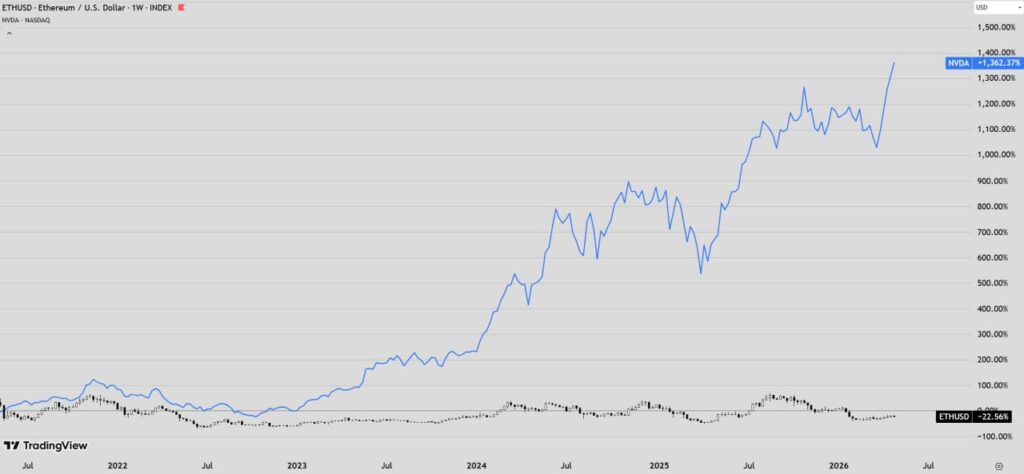
But the market does not give rewards for ideas, it pays for execution. To understand how such a gap arose, it is necessary to go beyond the numbers and look at the fundamentals.
Five years ago, Ethereum was in a completely different phase of development. It was a technological platform with huge potential, but without a sustainable business model in the usual sense for an investor. Its value was built on expectations: decentralized finance, smart contracts, a new financial infrastructure. Everything sounded convincing, but the market was already pricing in a significant part of these expectations.
Over the past years, the ecosystem has indeed grown. DeFi protocols, NFTs, large-scale network upgrades appeared. But along with this came limitations: high transaction costs, competition from other blockchains, regulatory uncertainty. In addition, Ethereum’s transition to a proof-of-stake model changed the internal economics of the network, but did not automatically make it more profitable for investors in the short term.
And most importantly – the crypto market lives in cycles. Periods of euphoria are replaced by prolonged corrections. If the entry point was close to the peak, even a strong asset can “repay the debt” to the investor for years. That is why the final return over a specific five-year period can look disappointing despite technological progress.
Now let’s look at Nvidia. Unlike cryptocurrencies, this is a company with revenue, profit, and a concrete product. But here as well, growth was not accidental.
Five years ago, Nvidia was already a strong player in the graphics processor market. However, the real explosion happened later, when the world sharply accelerated investments in artificial intelligence. Machine learning models, data centers, generative AI – all of this required computing power, and Nvidia found itself at the center of this demand.
In fact, the company became the infrastructure of a new technological wave. When businesses around the world began building solutions based on AI, demand for its chips grew in an avalanche-like manner. This was reflected in revenue, margins, and as a result, in the stock price.
It is also important that the market likes predictability. Nvidia shows financial results, gives forecasts, publishes reports. The investor sees numbers and can evaluate the business. In the case of Ethereum, valuation is built differently – through technology adoption, user activity, and future scenarios. This is a more complex and less stable model.
There is another factor – capital concentration. Large institutional investors such as BlackRock or Vanguard actively increased their share in the technology sector. This strengthened the growth of shares of companies like Nvidia. Cryptocurrencies, on the other hand, remained a more niche instrument for a long time despite growing interest.
What emerges is a paradoxical but logical picture. Ethereum developed as a technology, but its price moved in waves. Nvidia developed as a business and ended up at the center of one of the most powerful trends of the decade. Hence the main conclusion: the market rewards not only the idea, but also timing, scale of adoption, and the ability to turn demand into profit.
This does not mean that one asset is “good” and the other is “bad”. It means that they belong to different classes and follow different logic. Comparing them directly is like comparing a startup and an industrial giant. Sometimes the startup shoots up, but more often the one already embedded in the economy wins.
For an investor, there is a more practical lesson here. Diversification is not just a buzzword, but a way not to depend on one scenario. Technologies can disappoint in timing, while “boring” companies can unexpectedly become growth drivers.
Five years ago, a bet on Ethereum looked like a bet on the future. A bet on Nvidia looked like a bet on an already working business. Five years later, the market showed that the future sometimes arrives slower than investors expect. And money, as usual, prefers those who are already earning it today.
All content provided on this website (https://wildinwest.com/) -including attachments, links, or referenced materials — is for informative and entertainment purposes only and should not be considered as financial advice. Third-party materials remain the property of their respective owners.