

April on the crypto market turned out to be something that should be analyzed not by analysts, but by writers of political thrillers. In the latest QCP Capital report, the week is described as a rare case – when price is simultaneously pressured by geopolitics, macroeconomics, and the internal mechanics of the market. And all of this – in a “turn everything on at once” mode.
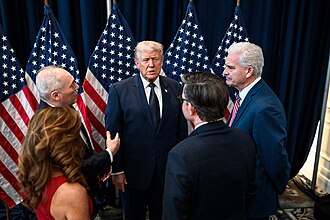
It started with an event that should not have affected charts at all. A shooting at the White House Correspondents’ Dinner. Formally – a local incident. In fact – a trigger for global markets. The building was evacuated, Donald Trump was among the guests, and although details are still being clarified, the very fact of a potential threat instantly moved into the category of political risk. .
The market reacted almost automatically. During the Asian session, Bitcoin moved up and broke the level of about $79,000, Ethereum rose above $2,400. The logic is simple and already familiar: any hint of instability in US politics increases interest in alternative assets. But this impulse did not last long. As soon as news appeared about the visit of Iran’s Foreign Minister Abbas Araghchi to Moscow for talks with Vladimir Putin, sentiment changed sharply. The market once again remembered that geopolitics is not a binary “bad-good” story, but an endless zone of uncertainty
And this is where the key point of the QCP report begins: despite all this noise, Bitcoin rose by more than 14% in April. Four consecutive weeks of gains – this is no longer an accident, but a stable trend. Moreover, the growth is not based on “belief”, but on quite tangible capital flows. Spot Bitcoin ETFs recorded nine consecutive days of inflows totaling about $2.11 billion. At the same time, MicroStrategy (now Strategy) continues to accumulate Bitcoin, adding more than $3.8 billion over the month. This is no longer retail enthusiasm – it is an institutional bet.
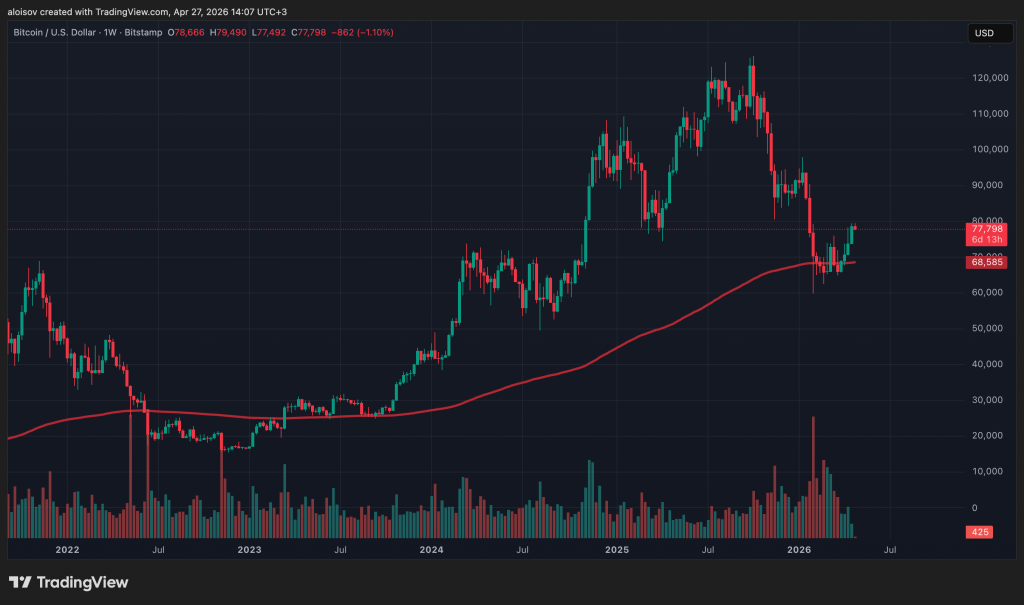
1-week BTC/USD chart and 200EMA. Source: Bitstamp
Against this background, the $82,000 level turns into a kind of “exam for the market”. This is where the Chicago Mercantile Exchange gap is located, which the market historically likes to close. And it is there that it will become clear what is really happening: whether the growth continues or this is a carefully disguised trap for those who entered too early.
The technical picture adds intrigue. Funding rates for perpetual contracts have remained negative for about a week. In normal logic, this looks strange: the price is rising, while the market continues to bet on a decline. This means the system is overloaded with shorts. And therefore, it is accumulating fuel for a classic short squeeze. As soon as the price accelerates upward, short positions will begin to close forcibly, amplifying the movement.
The options market complements the picture. QCP notes steady interest in call options with a $90,000 strike expiring on September 25, 2026. Translating from derivatives language into plain terms: large players are betting that current levels are not the ceiling, but a промежуточная stop.
The strategy itself looks almost academic. The right to buy Bitcoin at $90,000 in the future is purchased. If the price surges, profit is theoretically unlimited. If not – the loss is limited to the premium. This is classic asymmetry: limited risk with potentially large upside. But there is a nuance – time works against the buyer. If the market stays flat, the option will slowly “decay.”
And here the market becomes especially interesting. On the one hand, implied volatility is decreasing. On the other hand, demand for protective put options is weakening. This means participants are gradually stopping fearing a decline and starting to think about growth again. Not sharply, not massively, but enough to change the balance.
At the same time, a week lies ahead that can easily turn everything upside down. Reports from giants such as Microsoft, Amazon, Meta Platforms, Alphabet Inc., and Apple, plus a meeting of the Federal Reserve System. Formally, no surprises are expected from the Fed. But the market, as practice shows, knows how to get nervous even without a reason.

If the tech sector maintains risk appetite, this will become additional fuel for the crypto market. If not – pressure may return faster than charts can update.
And finally, the most paradoxical moment highlighted by QCP. From a data perspective, the market is now behaving almost schizophrenically: negative funding with a rising price. Historically, such a combination has occurred only near local bottoms. In other words, the market looks as if it is falling, while in fact it is rising.
In simple terms: participants continue to bet against growth, but the price is not listening to them. And such situations rarely end calmly. Usually, they end with a sharp move, when the market “breaks” the expectations of the majority.
And the main question of April sounds extremely simple: will the market pass the $82,000 test, or will it once again play out the classic scenario where optimism arrives exactly at the moment when there is already too much of it.
All content provided on this website (https://wildinwest.com/) -including attachments, links, or referenced materials — is for informative and entertainment purposes only and should not be considered as financial advice. Third-party materials remain the property of their respective owners.