

Why are crypto holders usually kidnapped, and not owners of brokerage accounts (agree, such cases have become more frequent)? At first glance, this really sounds strange. Money is money everywhere: whether in a bank or in crypto. But in practice, the difference between these worlds is roughly like the difference between a guarded safe and a suitcase with a code lock that you carry with you.
According to the cryptocurrency exchange Binance, exclusively provided to the editorial team of BeInCrypto, over the past six years 56 such cases have been recorded in North America, 48 in Europe, and 62 kidnappings for the purpose of extorting cryptocurrency in Asia.
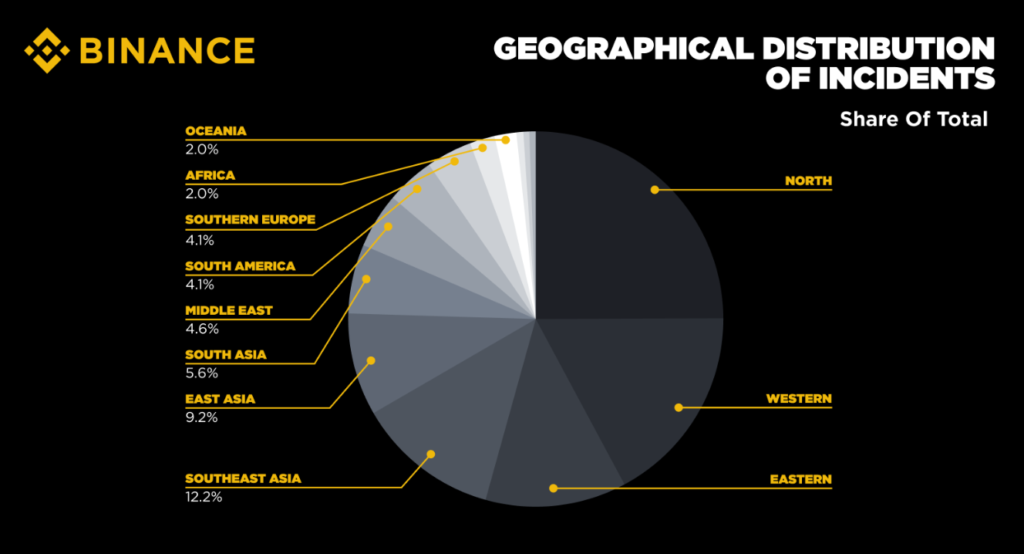
Cases of kidnappings for the purpose of cryptocurrency extortion by region since 2019. Source: Binance
Since the beginning of the year, 41 kidnappings or home invasions related to cryptocurrency have been recorded in France. This is reported by CoinDesk citing local law enforcement data. “In France this year, 41 kidnappings related to cryptocurrency have been recorded, which is approximately one kidnapping every 2.5 days,” the publication writes.
Let’s start with the basic difference. The traditional financial system – banks, brokers like Interactive Brokers – is built around control and intermediaries. You have money, but you cannot fully manage it on your own. Any large transaction goes through a chain of checks: confirmations, compliance, anti-fraud, sometimes even live calls asking “is this really you?”.
And this is not bureaucracy for the sake of formality. This is exactly the layer of protection that makes forced extortion крайне inconvenient.
Let’s imagine that attackers are trying to “squeeze” money from a brokerage account. They need to:
- force a person to sell assets;
- initiate a withdrawal;
- pass broker checks;
- wait for the transfer (sometimes days);
- and then somehow receive the money.
Each stage is a risk. Any bank employee may suspect something is wrong. Any transaction may be stopped. Any call to the client may disrupt the entire scheme. And if we are talking about withdrawing millions in cash in Europe, this is no longer just suspicion, but almost guaranteed interest from law enforcement.
Now let’s look at crypto. The key word here is “self-custody”. If a person has access to a private key, they fully control the funds. There is no intermediary to say “wait, let’s check”. There is no operator who will call. There is no “cancel via support” button. There is only one action – signing a transaction.
And here comes an unpleasant but important reality: crypto drastically reduces “friction” for transferring funds. And not only for honest users, but also for criminals.
From a technical point of view, the scenario looks frighteningly simple:
- there is access to the person;
- there is access to their key (or the ability to obtain it);
- there is a transaction;
- the money is gone.
Then tools like mixers and cross-chain bridges come into play, making tracking more difficult. And at this stage, the chances of recovering funds drop sharply. In the traditional system, money “moves slowly but securely”. In crypto – “fast and irreversible”. Hence the difference in “attractiveness” for criminals. Not because crypto is better or worse, but because it has a different architecture.

There is another important factor – irreversibility. A bank transfer can be disputed, frozen, reversed. A crypto transaction – almost never. It is like sending a letter without a return address that cannot be intercepted.
Now about a popular argument: “but scammers deceive people in the banking system too”. Yes, but the key word there is deception, not coercion. A person transfers money themselves, even if under pressure or manipulation. This is a fundamentally different legal and operational scenario.
Physical coercion in the traditional financial system faces a huge number of barriers. In crypto, there are fewer of these barriers – and this is what changes the risk model. And here arises the most uncomfortable thought. Any public information about large crypto holdings effectively reduces the “cost of attack” for a criminal. Because:
- it is known that the person has a liquid asset;
- it is known that it can be transferred quickly;
- it is known that the transaction is difficult to reverse.
This does not mean that crypto is “dangerous by itself”. It means that it requires a different security culture. The same as with storing cash or gold, but in digital form.
In the end, we arrive at a simple conclusion. The problem is not that someone “likes crypto holders”. The problem is that the very structure of cryptocurrencies makes them a more convenient target for a certain type of crime. And yes, in this sense, any lists, registries, or data leaks about owners of large crypto assets are no longer just a matter of taxes or regulation. This is a matter of personal security. Because technology gives freedom. But along with it – full responsibility.
All content provided on this website (https://wildinwest.com/) -including attachments, links, or referenced materials — is for informative and entertainment purposes only and should not be considered as financial advice. Third-party materials remain the property of their respective owners.