

The new week started without any ceremony — the market immediately reminded everyone who is in charge here. Volatility is back, and the cause is not the economy itself, but good old geopolitics. The escalation between the US and Iran has significantly reshaped investor sentiment, forcing many to revise their expectations for the coming days. But it is important to understand: such periods are not only about risks, they are also about opportunities, especially if one looks beyond the headlines.
The situation around the Strait of Hormuz is once again in focus. This is one of the key hubs of global energy trade, and any disruptions here are automatically reflected in global markets. Reports of a tanker seizure and potential navigation restrictions increased nervousness, which quickly affected futures dynamics. Investors began pricing in additional risk, which immediately showed up in declines across major indices.
At the start of trading, futures on the Dow Jones Industrial Average, S&P 500 and Nasdaq Composite moved into the red. This is a classic reaction to uncertainty: first a drop, then an attempt to understand whether the situation is systemic. And here it is important not to follow the first impulse, because markets often overprice short-term risks.
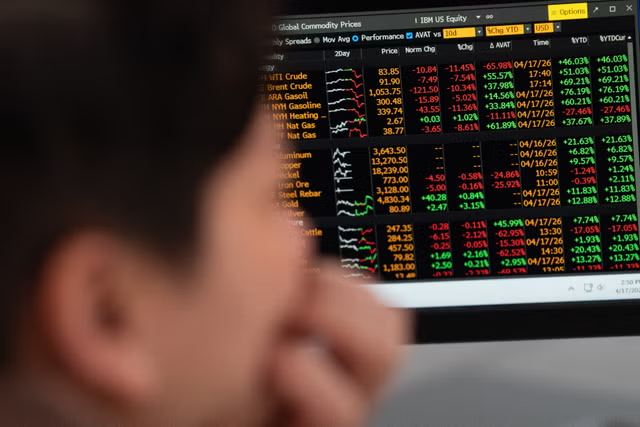
Against this backdrop, the commodities sector reacted sharply. Brent Crude rose by more than 6% and moved close to the $95 per barrel level. For energy companies, this is clearly positive, but for the broader economy it adds pressure through inflation and business costs. History shows that such spikes rarely go unnoticed and often trigger capital rotation between sectors.
On this background, the technology sector looks particularly interesting, as despite overall nervousness it continues to generate fundamental growth drivers. South Korean company SK Hynix announced the start of mass production of SOCAMM2 memory modules for the next generation of chips from Nvidia under the Vera Rubin architecture. This is not just another hardware upgrade, but an important step toward solving one of the key bottlenecks in the modern AI industry — constraints in training large language models.
In simple terms, this is about speeding up data processing and reducing latency in model training. Which means increasing the efficiency of the entire AI ecosystem. And this is no longer a future story — it is about current competition between tech giants, where speed and scale are becoming key factors.
Additional market attention this week will be focused on corporate earnings. Companies such as Tesla, Intel and United Airlines will report their results. In an unstable environment, earnings reports become the main source of truth: they show how businesses are performing not in theory, but in practice. It will be especially important to watch not only the numbers but also management guidance — as it shapes market expectations for the next quarter.

What this all means for investors. First and foremost — the need to separate noise from signals. Geopolitics creates an emotional backdrop, but long-term trends are driven by fundamentals: corporate earnings, technological development and cash flows.
Such periods are a good time for portfolio review. The energy sector may temporarily strengthen due to rising oil prices, while technology companies remain the long-term growth driver despite short-term fluctuations. The balance between these segments becomes especially important.
It is also worth remembering a simple rule tested through many market cycles: in times of uncertainty, those who stay calm win. The market rewards those who think and punishes those who react too quickly.
Now is not the time to guess direction based on emotion. It is a time to observe, analyze and make decisions based on facts. It is precisely in such periods that the strongest investment positions are formed — quietly, without noise, but with a long-term view.
All content provided on this website (https://wildinwest.com/) -including attachments, links, or referenced materials — is for informative and entertainment purposes only and should not be considered as financial advice. Third-party materials remain the property of their respective owners.