

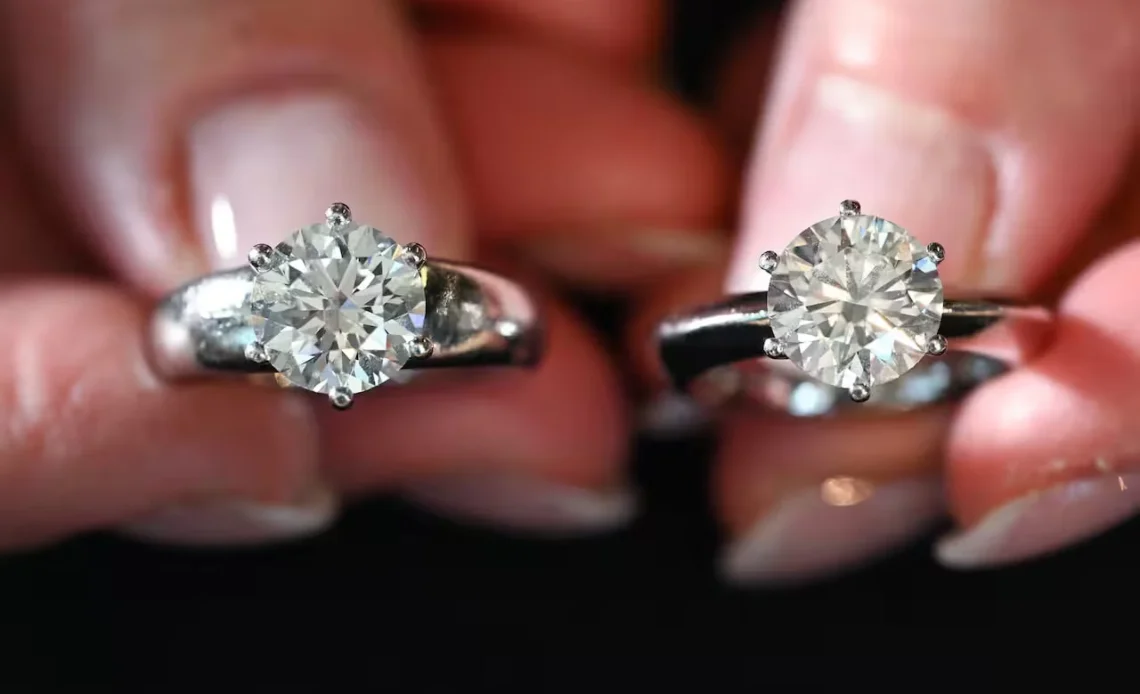
The diamond market is undergoing major changes: prices for natural stones are falling rapidly, with the main reason being the explosive growth of lab-grown diamonds. These stones are virtually indistinguishable from natural diamonds in both chemical composition and appearance, but they cost several times less. According to the U.S. industry market, the price of a one-carat natural diamond has fallen by more than half since the beginning of 2022. While such a stone averaged around $6,380 in the United States in 2016, its price is now approximately $3,900. Over the same period, a lab-grown equivalent has fallen from $5,820 to around $850.
Lab-Grown Stones Have Changed the Market
The sharp decline in the price of lab-grown diamonds has been made possible by advances in production technology. These stones are created under conditions that replicate the natural processes through which diamonds form, but instead of taking billions of years, the process takes only a few weeks. As technology has improved, production costs have fallen dramatically, while manufacturers in China and India have expanded production to unprecedented levels. China now dominates the global production market: the central province of Henan has earned a reputation as the country’s “diamond capital,” while hundreds of machines at numerous facilities in the city of Zhecheng operate virtually around the clock, producing millions of carats every year. Lab-grown stones are so similar to natural diamonds that even experts cannot always determine their origin without specialized equipment. Diamond market analyst Paul Zimnisky attributes the trend primarily to rapid technological improvements: “The technology to produce these diamonds has improved rapidly, while their production costs have fallen significantly.”
Consumers Are Increasingly Choosing Lab-Grown Diamonds
Lab-grown stones already account for around one-third of the global diamond jewelry market. The trend is particularly noticeable in the United States, the world’s largest diamond market. Last year, six out of ten couples who got engaged chose a lab-grown diamond. That is 239% higher than the figure recorded in a similar survey in 2020. The reason is simple: buyers can purchase a significantly larger stone for the same amount of money they would previously have spent on a small natural diamond. For many consumers, the choice has become almost mathematical: why spend several thousand dollars on a small natural stone when the same amount can buy a much larger lab-grown diamond?
Natural Diamonds Are Finding It Increasingly Difficult to Compete
The shift in demand is already hitting major mining companies. De Beers recently suspended mining operations at its largest diamond mine in South Africa, citing the need to reduce costs amid difficult market conditions. However, the problems facing natural diamond producers go beyond competition from lab-grown stones. Operating costs are rising, older deposits are gradually being depleted, and developing new mines requires enormous investment. At current prices, such projects are becoming less attractive. This creates something of a vicious circle: mining natural diamonds is becoming more expensive, while consumers are simultaneously becoming less willing to pay the prices they once did.
The Way People View Diamonds Is Changing
Until recently, a large and expensive natural diamond was considered a symbol of status and financial prosperity. Now, more and more buyers see a diamond primarily as a piece of jewelry rather than a display of wealth. If the origin of a stone is virtually impossible to determine without specialized equipment, the price difference becomes the main argument. A lab-grown diamond allows consumers to buy more for less, and for many buyers this is more important than the traditional perception of natural diamonds as a luxury status symbol. As a result, natural diamonds are now competing not only for consumers’ money but also for their perception of value.
The Diamond Industry Faces a New Challenge
In the past, the value of a natural diamond was largely built on its rarity, the difficulty of mining it, and limited supply. Technology is now effectively removing one of those key barriers: virtually the same stone can be artificially produced in enormous quantities and at a much lower cost. Natural diamond producers will therefore have to convince consumers that the stone’s origin alone is worth the premium they are being asked to pay. According to Paul Zimnisky, the industry needs to create a compelling reason for consumers to be willing to pay significantly more specifically for a natural stone. This leaves the diamond industry facing a fundamental question: how do you sell rarity in a world where virtually the same stone can be manufactured in a factory?
For consumers, this is good news — there is now more choice and lower prices. For natural diamond producers, the situation is quite the opposite. They will now have to prove why a stone created by nature billions of years ago should cost several times more than one created by humans in just a few weeks.
All content provided on this website (https://wildinwest.com/) -including attachments, links, or referenced materials — is for informative and entertainment purposes only and should not be considered as financial advice. Third-party materials remain the property of their respective owners.