

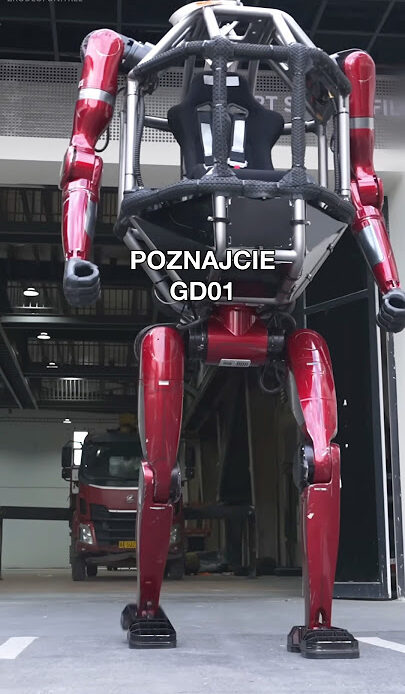
China’s Unitree has presented a device that not long ago would have been easily classified as a prop in a science fiction film, but now it is an engineering product with a price tag, specifications, and a very concrete market logic. This is GD01 – the first piloted robot with a cockpit for a human inside, which the company positions as the “first mass-produced controllable mech suit.” And if such constructions were previously associated with movies, anime, and military concepts of the future, they are now effectively a commercial product with a starting price of around 650,000 dollars.
The GD01 design is built around the idea of a human inside a machine that takes on physical load and enhances the operator’s capabilities. The total system weight is about 500 kg including the pilot, while the robot is capable of moving on two legs and, if necessary, switching to a four-legged mode for stability on difficult terrain. This hybrid format allows adaptation to different types of terrain, from relatively flat urban environments to more complex conditions where classic bipedal mechanics lose stability.
Particular attention is drawn to the physical power of the system. According to Unitree demonstration materials, the robot is capable of actions that go beyond ordinary mobility – including breaking light structures and overcoming obstacles through force. This is no longer just a mobility platform, but a device with a clearly expressed force function, which automatically raises questions about potential use cases.
At the same time, the manufacturer emphasizes the civilian nature of the development. GD01 is positioned as a civilian platform rather than a military product, and the company separately highlights the need for “friendly and safe use.” Such wording in the robotics industry almost sounds like a mandatory element of modern marketing, especially when dealing with systems that have a high level of physical impact on the environment.
In essence, GD01 continues the development line of humanoid and exoskeleton robotics but takes a further step – combining operator and machine into a single system where the human becomes the “control core” and the robot handles physical execution. This is no longer just remote control or an autonomous robot, but a hybrid form of interaction between human and mechanical platform.
In a broader context, GD01 fits into the global technology race between the US, China, and a number of private companies developing humanoid robots and exoskeletons. Previously, such developments existed mainly at the prototype level or within closed military programs, but now they are gradually entering the commercial segment. This means that technologies that were previously available only to research laboratories or defense structures are beginning to reach the open market. An important point is that the very idea of a “piloted mech” has long been considered technically complex and economically unfeasible. The main limitations were related to weight, power consumption, stability, and human safety inside the structure. However, the development of battery technologies, balancing systems, and motion control algorithms is gradually removing some of these constraints, making such devices not only possible but potentially commercially viable in niche scenarios.
For now, GD01 looks more like a demonstration of technological capabilities than a mass-market product. The price of around 650,000 dollars automatically limits the pool of potential buyers, turning the device into a tool for specialized tasks, demonstration projects, or technology laboratories. However, such products often become precursors of future mass-market solutions that gradually move into more affordable segments.
It is also interesting how the manufacturer presents the concept itself. The wording about the need to use the robot in a “friendly and safe” manner highlights that the industry is already taking social and regulatory risks into account in advance. This is a kind of acknowledgment that such systems have enough physical power and autonomy to potentially affect the environment in ways that are not only positive.
In a broader sense, GD01 can be seen as another step toward blurring the boundary between humans and machines in physical labor and mobility. If previously robots replaced individual functions, now they begin to literally “wrap around” the human, enhancing the body and expanding capabilities. And although mass adoption of such systems is still far away, their very appearance on the market shows that the science fiction concept of mechs is gradually ceasing to be fiction and becoming an engineering reality with a concrete price and technical specifications.
All content provided on this website (https://wildinwest.com/) -including attachments, links, or referenced materials — is for informative and entertainment purposes only and should not be considered as financial advice. Third-party materials remain the property of their respective owners.