

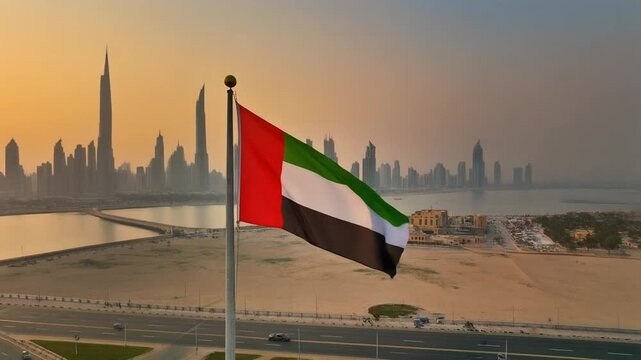
The news sounds loud, almost like the beginning of a new era, but it is important to set the accents right away: statements about the United Arab Emirates leaving OPEC on May 1 currently look more like a resonant interpretation than a confirmed fact. However, the scenario itself is far from фантастика – it reflects where the energy market is generally heading.
The essence is as follows. The United Arab Emirates has long been balancing between participation in the cartel and its own economic interests. Formally, OPEC is a quota system: countries limit production to support prices. But when there is an opportunity to produce more and earn more, discipline begins to crack.
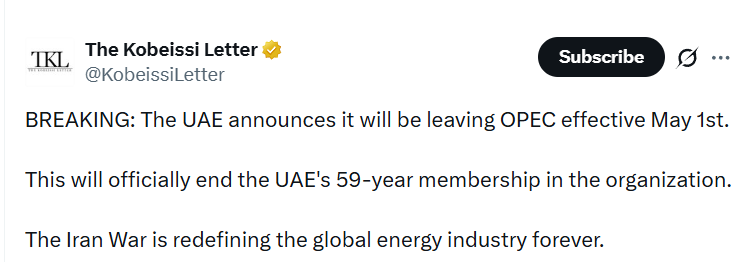
If we imagine that the exit is actually implemented, it means one thing – the Emirates will no longer be obliged to comply with restrictions. They will be able to increase production as much as their capacity allows. And the UAE is well positioned here: modern infrastructure, huge investments, and even bigger ambitions.
A separate factor adding fuel to the fire is the tension around Iran. Any serious conflict in the region automatically affects logistics, insurance, supply chains, and the overall architecture of the oil market. Even without direct destruction of infrastructure, the market begins to price in risks, and players start adjusting their strategies.
Against this backdrop, the idea of “playing by one’s own rules” is becoming increasingly attractive for certain countries. And the United Arab Emirates is not the only one considering greater independence.
It is also important to understand the broader context. OPEC has been losing its former cohesion for several years. The market has become more complex: production outside the cartel has increased, the role of the US has strengthened, and demand has changed due to the energy transition. In such conditions, maintaining a united front is becoming increasingly difficult.
If we hypothetically assume a gradual breakdown of the cartel, the consequences would be quite predictable – and not particularly comfortable for participants. Competition would intensify, countries would begin to fight for market share by increasing production. And this, as a rule, puts pressure on prices.
In simple terms, instead of a controlled market, we would get a more aggressive and free one. For consumers, this could mean more restrained prices. For producers, it would mean a much tougher game, where the winner is not the one who agrees, but the one who produces faster, cheaper, and more efficiently.
The irony of the situation is that OPEC was created as a tool to control the market. But the more complex the market becomes, the harder it is to control even for the most experienced players.
So even if this specific news turns out to be premature, the underlying logic of the process will not disappear. The energy sector is increasingly moving away from cartels toward competition. And where competition begins, the rules are usually rewritten – and not always collectively.
All content provided on this website (https://wildinwest.com/) -including attachments, links, or referenced materials — is for informative and entertainment purposes only and should not be considered as financial advice. Third-party materials remain the property of their respective owners.