

By April 2026, the crypto exchange market has effectively completed the transition from “AI experiments” to a full-scale infrastructure race. Artificial intelligence is no longer a marketing add-on but has become a core layer of trading systems – from market analysis to trade execution and risk management.
Almost every major exchange now offers its own ecosystem of AI tools – from chat assistants and trading bots to autonomous agents and MCP infrastructure that allows integration with external models such as ChatGPT, Claude, or open-source solutions. While competitive advantage used to be defined by fees and liquidity, it is now determined by decision-making speed, level of automation, and the quality of AI integration into the trading cycle. Let’s examine five of the largest platforms and how they have redefined the role of the trader.
Bitget
Over the past two years, Bitget has built one of the most aggressive AI ecosystems in the market. Essentially, it is no longer just an exchange but a full infrastructure for “delegated trading,” where part of the decision-making is handled by AI. The platform serves over 125 million users, and its derivatives trading volume reached approximately $8.17 trillion in 2025.
GetAgent became Bitget’s first массовый AI product. Launched in the summer of 2025, it quickly turned into the main interface for interacting with the market for hundreds of thousands of users. It is not just a chatbot but a hybrid of analyst, terminal, and execution engine. It can perform technical and fundamental analysis, assess market sentiment, build and test strategies, analyze portfolios, and execute trades through dialogue. By the end of 2025, the system processed over 1.22 million conversations and attracted more than 350,000 users.
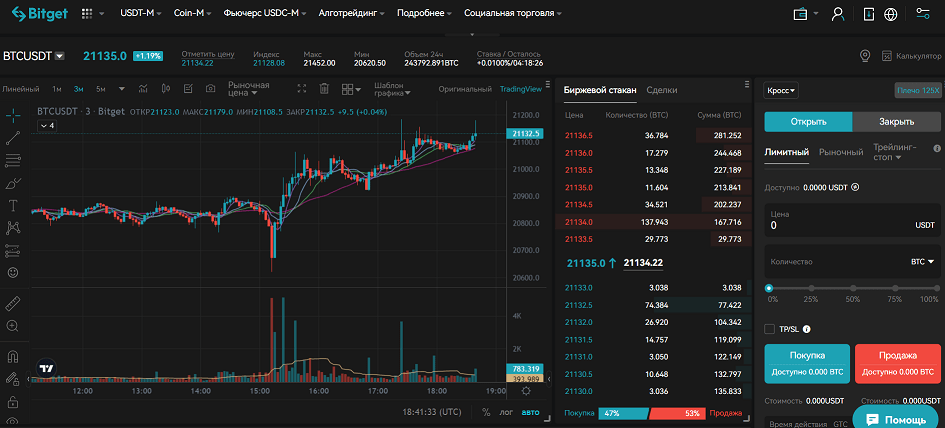
A key upgrade was the introduction of Research Mode – a deep analysis mode combining on-chain data, technical signals, and risk models. In essence, it attempts to replace a traditional analyst with a real-time market scanner. The monetization model is also notable: GetAgent operates on a subscription basis, turning AI into a standalone product layer within the exchange.
GetClaw represents the next level. Launched in March 2026, this autonomous agent does not just respond – it acts. It monitors portfolios, funding rates, volatility, liquidation risks, and macro events, adapting to the trader’s style. The key difference is the dedicated sub-account, where the agent can execute trades independently. The user defines the strategy in natural language, and the system functions as a semi-automated capital manager.
Agent Hub turns Bitget into a platform for third-party AI agent development. It provides access to market data, spot and derivatives trading, on-chain metrics, and macro indicators via MCP, REST, and WebSocket. This is already a level of financial infrastructure rather than just an exchange. The partnership with MuleRun strengthens this approach by combining crypto and traditional markets in a single agent-driven environment.
OKX
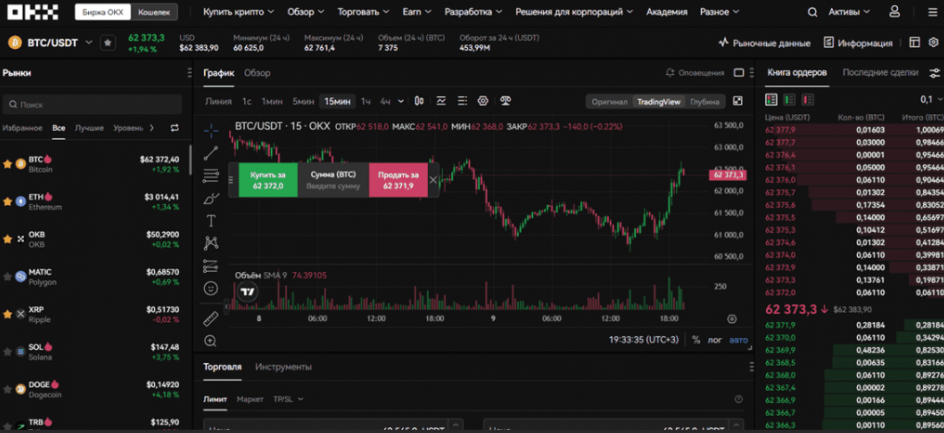
OKX has chosen an open architecture strategy instead of building a closed assistant. Rather than a single AI product, it offers infrastructure that any model can connect to. OnchainOS links AI agents with the Web3 wallet and on-chain marketplace, supports over 60 blockchains, and processes more than 1.2 billion API requests daily with latency under 100 ms.
The platform provides three integration levels: natural language interaction without coding, an MCP server for agent platforms, and an Open API for full customization. A notable feature is the autonomous micropayment module via x402, allowing AI agents to perform transactions without user involvement.
Agent Trade Kit covers centralized trading. It is an MCP toolkit supporting spot, futures, and options, algorithmic orders, trading bots, and a demo mode. Essentially, OKX is building a universal constructor for AI trading agents capable of handling complex strategies.
Bybit
Bybit focuses on practical AI solutions aimed at results. Its early launch of TradeGPT in 2023 laid the groundwork for further development.
Aurora AI generates trading strategies based on backtesting and updates them every 60 minutes. It categorizes strategies into aggressive yield, stability, and high-frequency trading. Essentially, it acts as a dynamic strategy manager that continuously reassesses the market.
AI Trading Skills Hub is a step toward an open AI ecosystem. It offers hundreds of API endpoints and integration with popular models. Users describe strategies in natural language, and the system converts them into trading actions. Later updates added AI-driven copy trading, bot lifecycle management, and algorithmic orders such as TWAP and Iceberg.
Binance
Binance remained cautious in AI for a long time, focusing mainly on educational tools. However, in 2026 it launched Binance Ai Pro – a full-fledged AI trading agent.
Its key feature is a multi-model architecture combining ChatGPT, Claude, Qwen, Kimi, and MiniMax. This reduces dependence on a single model and improves analytical resilience. The system supports spot, futures, margin operations, on-chain queries, and strategic planning.
A critical element is the isolated sub-account without withdrawal permissions. This is an attempt to address the main challenge of AI trading – risk control in autonomous execution.
MEXC
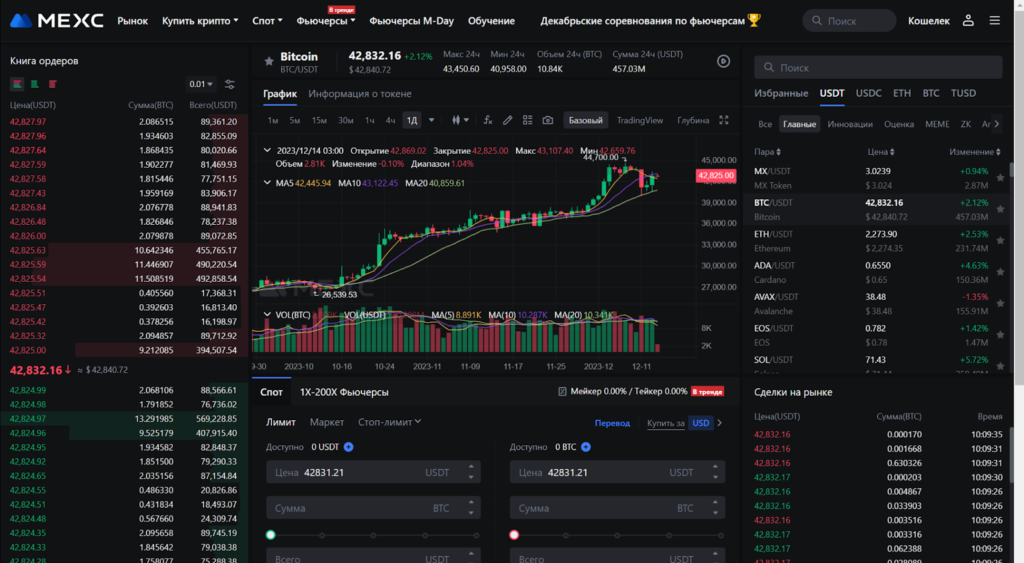
MEXC is developing the concept of AI as a seamless layer across the entire trading process. The platform integrates analytics, signals, and execution into a single flow.
AI News Radar tracks news and whale activity, AI Select List identifies promising assets, Smart Candles combines technical analysis with news context, MEXC AI builds personalized strategies, and AI Copy Trading allows users to replicate AI-driven strategies.
The key feature of this approach is behavioral analytics. The system analyzes not only the market but also participant behavior, generating probabilistic price movement scenarios.
Overall conclusion
By 2026, crypto exchanges have split into several development models: some focus on autonomous AI agents, others on open infrastructure, and others on practical trading systems. However, the overall trend is clear: trading is gradually shifting from a manual process to an AI-managed environment, where humans define the rules rather than execute every decision.
All content provided on this website (https://wildinwest.com/) -including attachments, links, or referenced materials — is for informative and entertainment purposes only and should not be considered as financial advice. Third-party materials remain the property of their respective owners.