

The prediction market platform Polymarket closed a market dedicated to forecasting a possible nuclear explosion on the planet this year. The decision was made on ethical grounds following public criticism and debates about the acceptable limits of such wagers.
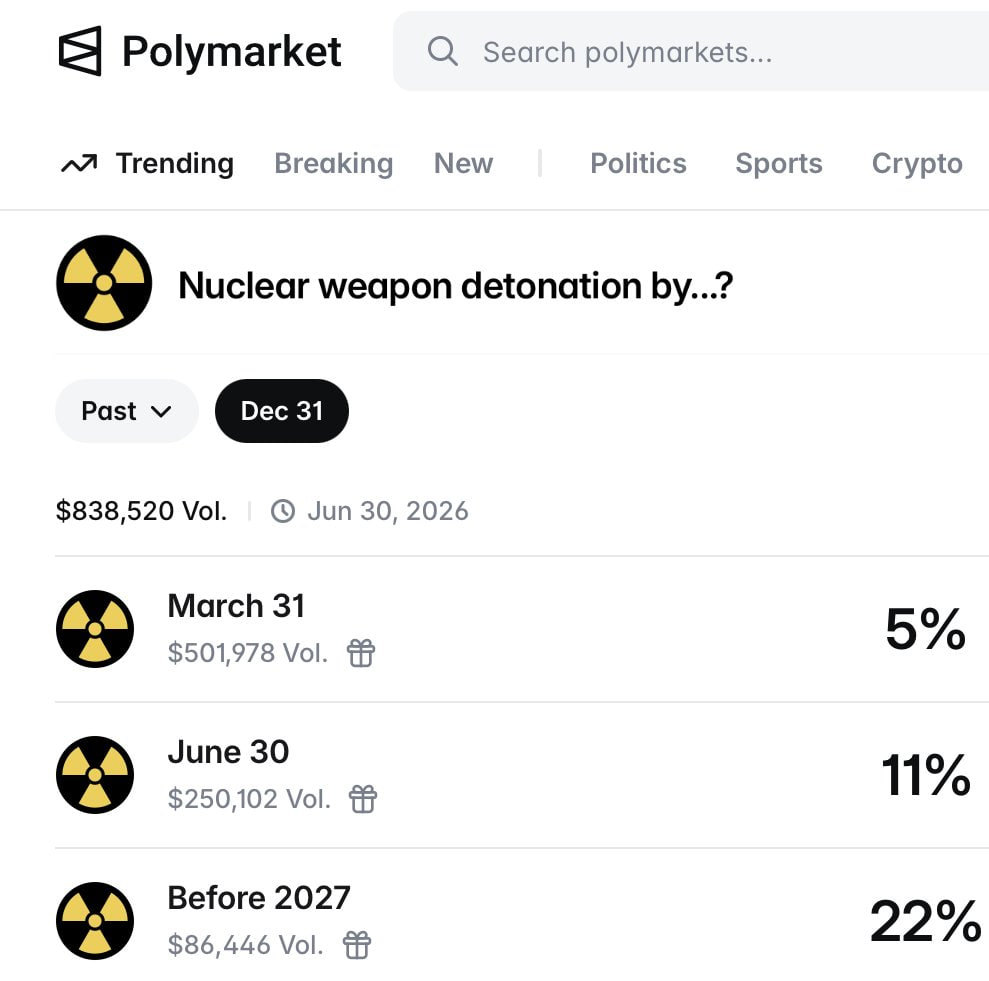
The market in question allowed users to place bets on the probability of an event involving the use of nuclear weapons, with various time frames. Among the resolution options were specific dates — March 31 and June 30 — as well as a longer-term horizon extending to 2027.
Before its removal, the total trading volume on this market amounted to at least $800,000. This indicates significant interest from platform participants and a high level of audience engagement with geopolitical topics.
Formally, such markets on prediction platforms operate on the principle of collective probability assessment. Participants purchase contracts reflecting their expectations regarding whether a particular event will or will not occur. The price of a contract at any given moment is interpreted as the market’s assessment of the probability of the outcome. However, in the case of potential nuclear escalation, the issue extended beyond a purely analytical model.
After probability estimates were published on the platform’s official page on the social network X, the public sharply criticized the project. Users argued that monetizing scenarios of global catastrophe appears morally questionable, especially amid rising international tensions.
Additional controversy arose in the context of a recent dispute surrounding the competing platform Kalshi, where sensitive geopolitical markets were also discussed. Critics noted that such instruments may create distorted incentives, foster unhealthy interest in tragic events, and contribute to speculative volatility during real crises.
Supporters of prediction markets traditionally argue that these mechanisms aggregate collective knowledge and provide more accurate probability estimates than expert surveys. Nevertheless, when topics involve mass casualties or global threats, questions arise regarding the boundaries of acceptability.
The closure of the market can be seen as an attempt by the platform to minimize reputational risks and demonstrate sensitivity to public reaction. For the decentralized and centralized prediction market industry, this episode may become an important precedent shaping future standards of content moderation and thematic admissibility.
Thus, the situation surrounding the removed market illustrates that as prediction platforms grow in popularity, they increasingly face a dilemma between the freedom of market mechanisms and social responsibility.
All content provided on this website (https://wildinwest.com/) -including attachments, links, or referenced materials — is for informative and entertainment purposes only and should not be considered as financial advice. Third-party materials remain the property of their respective owners.