

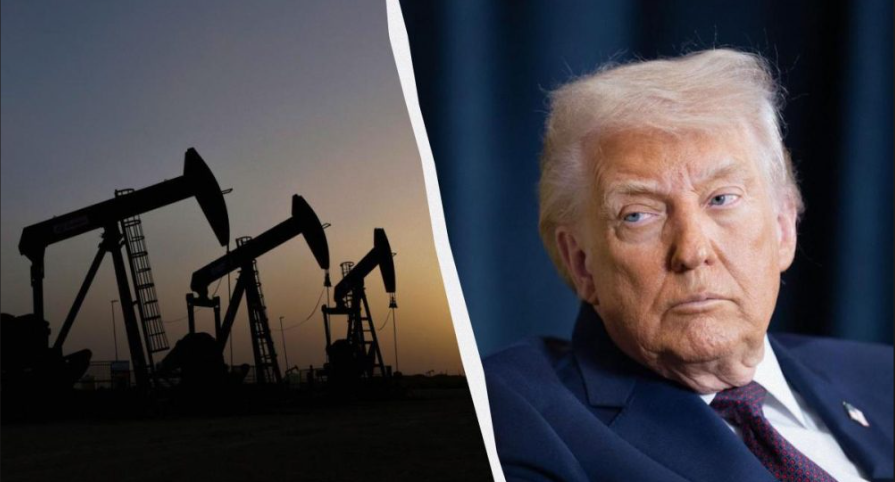
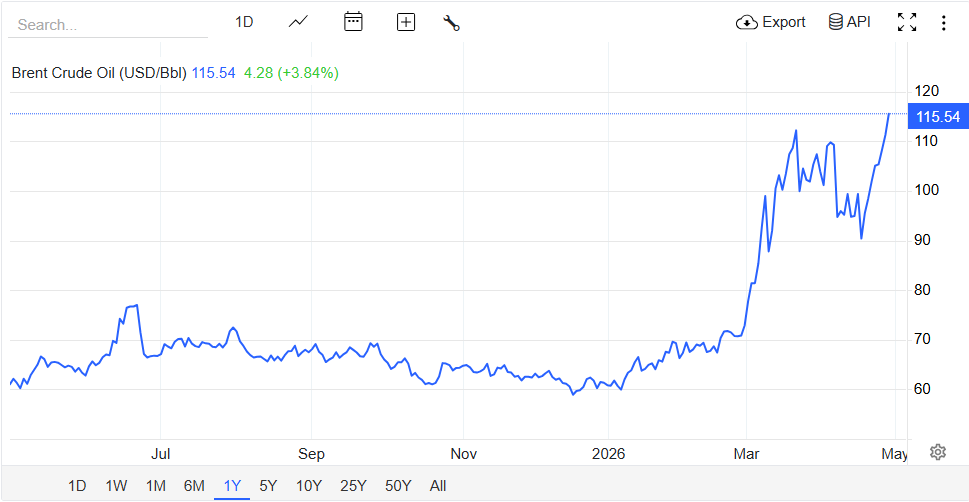
The price of Brent crude surged sharply to $108 per barrel — and this time the driver was not so much fundamental factors as politics in its most direct and aggressive form. The trigger was another sharp statement by Donald Trump, in which he effectively accused Iran of being unable to reach an agreement on its nuclear program and made it clear that pressure would only increase.
The phrase that “Iran should get smart quickly” translates quite clearly in market language: escalation risks remain, diplomacy is stalling, and therefore the likelihood of restrictions on oil supplies stays high. In such conditions, oil almost automatically gains a geopolitical risk premium, and that is exactly what is now being priced in.
It is important to understand the mechanics of what is happening. The oil market is driven not only by current supply but also by expectations. Even if oil continues to physically flow into the market, the mere risk of disruptions — for example, due to a potential blockade of the Strait of Hormuz or tighter sanctions — is already pushing prices higher. Traders hedge in advance, pricing in a shortage scenario.
That is why the reaction has been so rapid: the market has effectively started “buying fear.” And not just for a day or two, but with a horizon of weeks and months. This is no longer about a short-term spike, but about the possibility of prolonged tension.
It is also worth noting the psychological level around $110 per barrel. This is not just a round number — it is a zone where shifts in rhetoric and policy have occurred before. Historically, at such price levels the pressure begins to be felt not only in markets but across entire economies: inflation rises, business costs increase, and political pressure grows within importing countries. And it is often at these points that policymakers begin to “tone things down.”
Right now, the market seems to be testing this boundary. Another $10 increase — and we will once again be in a zone where geopolitics starts colliding with economic reality.
Brent plays a key role in this story because it is not just a type of oil, but a global benchmark. Although it is physically produced in the North Sea, a significant share of oil from Europe, Africa, and the Middle East is priced relative to it. Simply put, when Brent rises, almost everything becomes more expensive.
And this is already affecting more than just the oil market. Higher energy prices automatically put pressure on inflation, complicate the work of central banks, and influence equity markets. Companies begin to revise forecasts, investors rethink portfolio structures, and regulators reassess their rate plans.
At the same time, the current rally remains largely “news-driven.” It is based on expectations and rhetoric rather than confirmed supply shortages. This makes the situation both strong and fragile. Strong — because fear quickly drives prices higher. Fragile — because any easing in rhetoric or hint of negotiations could just as quickly reverse the move.
The market is now in a delicate balance. On one side — the risk of escalation and potential supply constraints. On the other — the understanding that excessively high oil prices start to hurt all participants in the system, including those driving the rally.
That is why the next moves will depend less on inventory data and more on headlines. In such an environment, oil stops being just a commodity and once again becomes a political instrument — with all the consequences this brings for the global economy.
All content provided on this website (https://wildinwest.com/) -including attachments, links, or referenced materials — is for informative and entertainment purposes only and should not be considered as financial advice. Third-party materials remain the property of their respective owners.