


Capital inflows into Bitcoin through spot ETFs over the past week have become one of the most notable signals of a shift in market sentiment since the beginning of the year. Net inflows of nearly $1 billion, specifically $996 million, look not just like a strong figure but like a marker of a phase shift: from caution to a selective return of risk. This is the best result in more than three months, second only to the January peak when inflows reached around $1.4 billion.
What matters is not only how much money came in, but also how exactly it was distributed. The week began with an outflow of $291 million – a classic sign that the market was not yet ready for a reversal. However, on April 14 investors added $411.5 million, on April 15 – $186 million, on April 16 – $26 million. The culmination came on April 17, when $663.9 million flowed into ETFs in a single day. This was not just the best day of the week – it was a concentrated impulse that effectively shaped the entire final result.
Such an inflow profile points to a reaction to a specific trigger rather than a gradual recovery of confidence. The history of the ETF market has already shown similar patterns: one strong news driver can “switch” capital flows almost overnight. In this case, that driver was geopolitics.
The total assets under management of spot Bitcoin ETFs exceeded $101 billion by the end of the week, highlighting the scale of this instrument as an institutional gateway to the crypto market. At the same time, daily trading volumes rose to $4.8 billion – a figure that usually reflects not just growing interest but active repositioning.
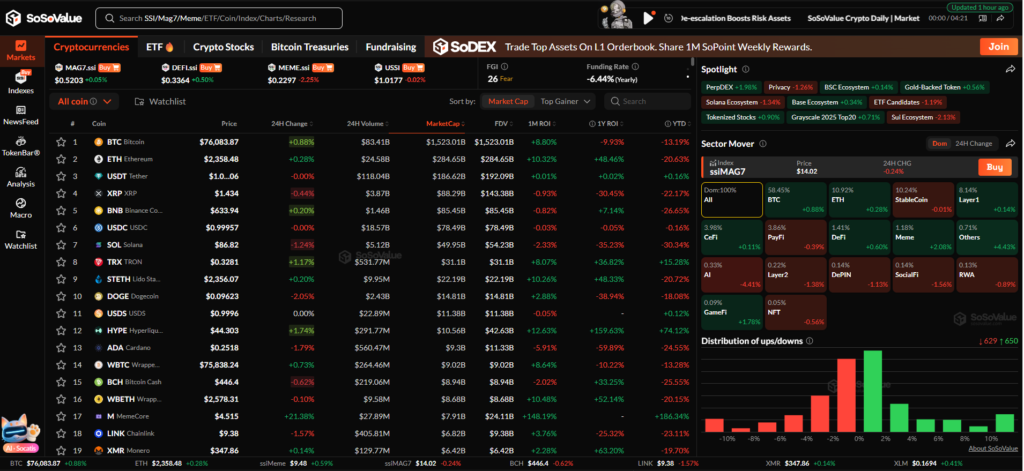
The key factor is a shift in risk perception. Markets are now reacting not so much to the fact of geopolitical tension itself, but to the probability of its escalation or de-escalation. Signals of easing tensions, particularly around the Strait of Hormuz, have gradually reduced the likelihood of extreme scenarios. This matters: markets always price in the worst-case scenario in advance, and any easing of these expectations frees up room for capital movement.
Against this backdrop, traditional safe-haven assets, including the US dollar, have begun to lose some of their appeal. At the same time, structural concerns have intensified: the high level of US government debt, rising bond yields, and the limited ability of the Federal Reserve to quickly ease policy. As a result, the “risk-free” segment no longer looks so risk-free – and part of the capital begins to search for alternatives.
Bitcoin finds itself in an interesting position within this framework. On the one hand, it remains a risk asset. On the other hand, amid weakening trust in the traditional financial system, it is increasingly perceived as an alternative reserve. It is precisely this duality that is currently working in its favor.
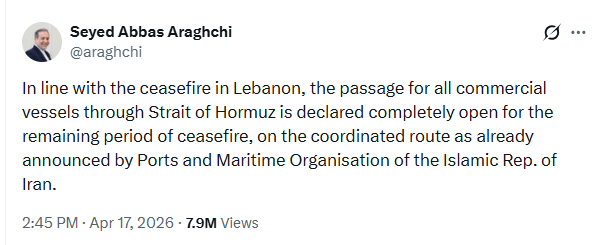
An additional boost to the market came from news about the reopening of the Strait of Hormuz. On April 17, Iranian authorities confirmed the resumption of commercial shipping as part of a temporary truce, and this signal was quickly picked up by global markets. The reaction was synchronized: Bitcoin rose above $78,000, while Brent crude oil fell by about 10% to around $85 per barrel. This is a classic scenario: a decline in the geopolitical premium in oil and a simultaneous increase in risk appetite.

However, behind the strong inflow figures lies an important nuance. The concentration of $663.9 million in a single day shows that the current trend is not yet sustainable. It is more of a reaction to an event than the formation of a long-term flow. A similar situation was already observed in November 2024, when record inflows were also tied to a specific political trigger.
This leads to a key conclusion: the dependence of the crypto market on external factors is increasing. Bitcoin is reacting more and more often not to internal network metrics or technological changes, but to macroeconomics and geopolitics. In the short term, this implies higher volatility. Capital can come in quickly – but it can leave just as quickly.
If the de-escalation scenario holds, ETF inflows may continue, albeit at a more moderate pace. But any sign of a reversal – for example, if tensions around the Strait of Hormuz rise again – could trigger an equally sharp reversal in flows.
This is the defining feature of the market right now: it has become faster, more sensitive, and far less forgiving of uncertainty. Which means every external event – from central bank decisions to geopolitical signals – directly influences where the next billion will go.
All content provided on this website (https://wildinwest.com/) -including attachments, links, or referenced materials — is for informative and entertainment purposes only and should not be considered as financial advice. Third-party materials remain the property of their respective owners.