


Bitcoin remains formally fully banned only in a limited number of countries, however this list cannot be considered static — it rather resembles a “moving target,” where rules are regularly revised, softened, or, on the contrary, tightened depending on the political and economic environment. At different times, countries traditionally included in the list with strict restrictions on cryptocurrencies are China, Algeria, Egypt, Bangladesh, Morocco, Iraq, and Qatar, although even within these jurisdictions the actual degree of prohibition may significantly differ from the formal legal norm.
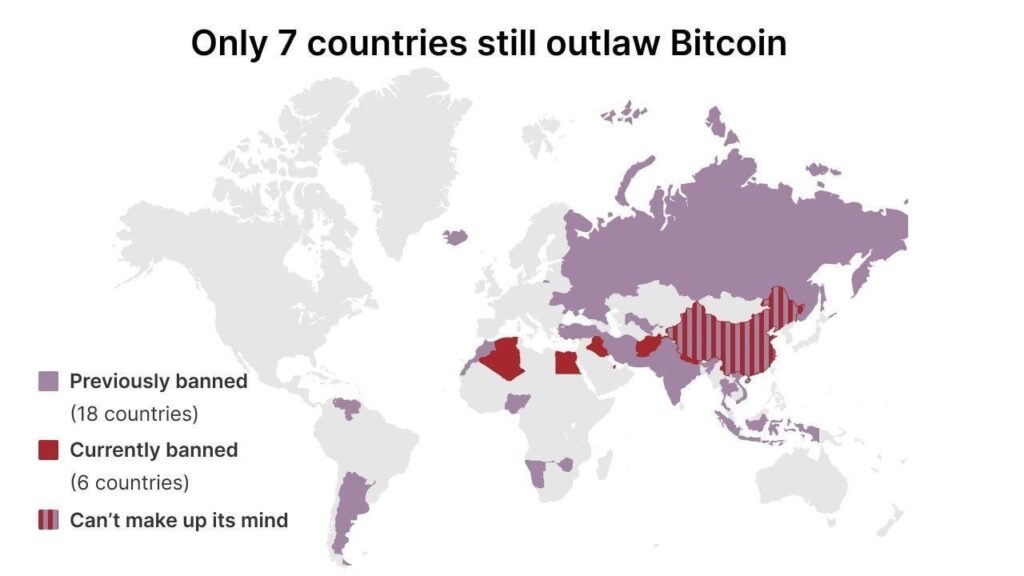
It is important to understand that a “Bitcoin ban” in different countries rarely means a complete technical impossibility of its use. Most often, it refers to restrictions on certain operations — primarily on the functioning of cryptocurrency exchanges, servicing bank accounts, conducting exchange transactions, and using digital assets as a means of payment within the country. At the same time, mere ownership of cryptocurrency in some cases may fall into a grey area: it is not encouraged formally, but not always explicitly criminalized. This creates a complex legal reality in which a user may simultaneously operate outside the legal infrastructure while not bearing direct criminal liability.
The reasons for introducing restrictions on cryptocurrencies are usually multi-layered and go far beyond simple “technological conservatism.” First of all, these are financial and macroeconomic motives. States, especially those with developing or unstable economies, seek to maintain control over capital flows and prevent uncontrolled capital outflow abroad. Cryptocurrency, due to its cross-border nature, effectively allows bypassing traditional banking channels, which regulators perceive as a potential risk to financial stability.
The second key block of reasons is related to monetary policy. For countries with high inflation, weak national currencies, or limited foreign exchange reserves, the spread of Bitcoin and other digital assets can undermine trust in the local monetary system. If the population begins to massively switch to cryptocurrency as a store of value, this reduces the effectiveness of the central bank’s monetary policy, weakens control over the money supply, and can increase pressure on the national currency exchange rate.
The third aspect is regulatory and legal. Cryptocurrencies initially developed in an environment without a unified international regulatory standard. This creates challenges for governments in terms of taxation, identification of market participants, and control over financial flows. In response, many countries choose a strategy of strict restrictions or outright bans until a clear legal framework is established. An additional factor is international pressure related to anti-money laundering (AML) and counter-terrorism financing (CFT), where cryptocurrencies are often viewed as higher-risk instruments due to the pseudo-anonymity of transactions.
The fourth layer of reasons is socio-political. In a number of states, restrictions on cryptocurrencies are linked not only to economics but also to control over the information and financial space. Decentralized assets reduce the role of the state as an intermediary in financial relations between citizens and the outside world. This is perceived as a challenge to the traditional governance model, especially in countries with a high degree of state control over the economy.
It is also important to note that even in countries with formal restrictions, real-world practice is often significantly softer than legislation. Citizens can use cryptocurrencies via foreign platforms, decentralized services, or peer-to-peer exchanges, while authorities over time often shift from outright bans to partial regulation models. In this sense, the global trend in recent years is not so much about tightening bans as about the gradual integration of cryptocurrencies into the regulated financial system.
Thus, bans on Bitcoin and other cryptocurrencies should not be seen as a single and final phenomenon. Rather, they reflect a stage of adaptation by states to a new financial reality, where digital assets have already become part of the global economy but are not yet fully integrated into it at the level of unified rules. And it is precisely this transitional phase that explains why cryptocurrency policies differ so significantly from country to country and continue to evolve rapidly.
All content provided on this website (https://wildinwest.com/) -including attachments, links, or referenced materials — is for informative and entertainment purposes only and should not be considered as financial advice. Third-party materials remain the property of their respective owners.