

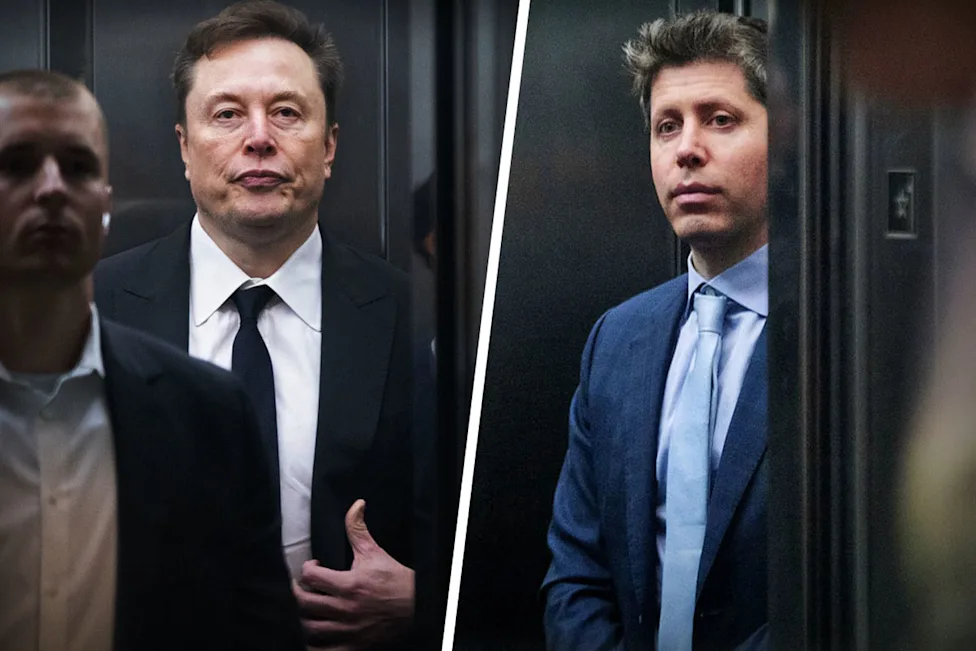
The conflict between Elon Musk and OpenAI has long ceased to be just a corporate dispute inside the artificial intelligence industry. Today, it has evolved into a full-scale battle for control over one of the most influential technologies of the 21st century – a struggle where ideology, money, reputation, competition, and the future ownership of AI infrastructure are all deeply intertwined.
The latest stage of this confrontation ended with a major defeat for Musk: a California court dismissed his lawsuit against OpenAI, Sam Altman, Greg Brockman, and partially Microsoft. The total claims were estimated at around $150 billion.
The ruling became a significant legal victory for OpenAI and personally for Sam Altman, who in recent years has transformed from a relatively unknown startup entrepreneur into one of the central figures of the global AI industry. The jury found OpenAI and the company’s leadership not guilty on all major counts. In addition, Musk’s claims against Microsoft were rejected. He had accused the corporation of helping OpenAI fully abandon its original non-profit mission.
Musk, however, has no intention of accepting defeat. Almost immediately after the ruling, he announced plans to appeal to the U.S. Ninth Circuit Court of Appeals. According to him, the case was dismissed not because the claims lacked merit, but because of a “technical calendar formality.”
Musk argues that the court never truly examined the substance of the allegations. In an emotional statement, he wrote that “anyone who followed the case closely has no doubt that Altman and Brockman enriched themselves by stealing a charity.” According to Musk, the only real question is when exactly that transformation from a non-profit mission to commercial profit extraction took place.
Behind this sharp rhetoric lies a much deeper conflict that has been building for years.
OpenAI was originally founded as a non-profit organization. The company was launched in 2015 by a group of entrepreneurs and researchers that included Elon Musk, Sam Altman, Greg Brockman, Ilya Sutskever, and other members of Silicon Valley’s technological elite. The original vision was almost idealistic: to build artificial intelligence for the benefit of humanity rather than for the profit of a handful of corporations.
At the time, there were already concerns inside the industry that advanced AI could eventually become concentrated in the hands of a few tech giants. OpenAI positioned itself as an alternative to that model – more open, research-oriented, and focused on the public good.
However, as AI systems became more complex, development costs exploded. Training advanced models required billions of dollars in computing infrastructure, data centers, GPUs, and engineering talent. That was the moment when OpenAI gradually began changing its organizational structure.
First came the capped-profit hybrid model, then the multibillion-dollar partnership with Microsoft, and eventually OpenAI became one of the dominant commercial players in the generative AI market. After the launch of ChatGPT, the company rapidly evolved into one of the most valuable and influential AI firms in the world.
It is precisely this transformation that Musk considers a betrayal of the organization’s original principles.
According to court documents, Musk argued that he supported and financed OpenAI specifically because it was supposed to remain a non-profit organization developing AI for the public interest. In his view, the company’s later commercialization directly contradicts its founding philosophy.
OpenAI and its legal team presented a very different narrative. They argued that without transitioning toward a commercial structure, the company simply could not have remained competitive in the AI race. Moreover, OpenAI representatives openly suggested that Musk’s claims are driven less by ideology and more by business rivalry following the launch of his own AI company, xAI, in 2023.
In many ways, the dispute increasingly resembles a clash between two competing power centers inside the emerging AI economy.
The trial also revealed several highly sensitive details about the industry. One of the most discussed moments was Musk’s admission that xAI’s Grok model had been trained, at least in part, through distillation from OpenAI models. Distillation is a technique where outputs from a more advanced model are used to train another system. The practice is widely debated in the AI world and often raises both legal and ethical questions.
The list of witnesses highlighted the importance of the case. Microsoft CEO Satya Nadella, OpenAI co-founder Ilya Sutskever, and former OpenAI board member Shivon Zilis all testified during the proceedings. Their involvement underscored how strategically important control over AI has become.
At the same time, Musk’s defeat was tied not only to the substance of the allegations but also to procedural timing. The court ruled that some claims had been filed too late. A two-year limitation applied to allegations involving improper profit extraction, while claims related to breaches of duties within the non-profit structure carried a three-year deadline. These procedural limits became one of the key reasons the lawsuit was dismissed.
Yet despite the court’s formal decision, the broader conflict is clearly far from over.
OpenAI has already filed a countersuit against Musk, accusing him of using unfair competitive tactics. At the same time, xAI remains involved in additional legal disputes involving OpenAI and Apple. As the AI industry grows at extraordinary speed, lawsuits are increasingly becoming another weapon in the battle for market dominance.
And this is where the broader context becomes especially important.
In many ways, Musk’s lawsuit against OpenAI has become the first major public case attempting to define the legal boundaries between “a mission for humanity” and the commercial exploitation of artificial intelligence. This is no longer just a corporate dispute – it is a debate about the future structure of the entire industry.
The central question is almost philosophical: can an organization created as a non-profit entity for the public good later evolve into a multibillion-dollar corporation while still preserving its original mission?
For now, the American court has effectively answered: yes, it can – or at least there is insufficient legal basis to punish it for doing so.
But the reputational and ideological debate is far from finished. To Musk’s supporters, OpenAI represents a cautionary example of how an idealistic project was gradually absorbed by the logic of capital, competition, and investors. To Altman’s supporters, it represents the maturation of a technology that simply could not have advanced at its current pace without massive commercial funding.
The irony is that both sides are partially correct.
Without Microsoft’s billions, OpenAI likely could not have built the infrastructure required for world-class GPT models. But at the same time, commercialization fundamentally changed the nature of a project that was originally designed as an alternative to the corporate AI race.
As a result, the current conflict has become a reflection of a much larger transformation: artificial intelligence has fully evolved from an experimental scientific field into a global arena of power, capital, and geopolitical influence.
And Musk’s battle with Altman today is no longer really about OpenAI’s past – it is about the future of the entire AI industry.
All content provided on this website (https://wildinwest.com/) -including attachments, links, or referenced materials — is for informative and entertainment purposes only and should not be considered as financial advice. Third-party materials remain the property of their respective owners.