

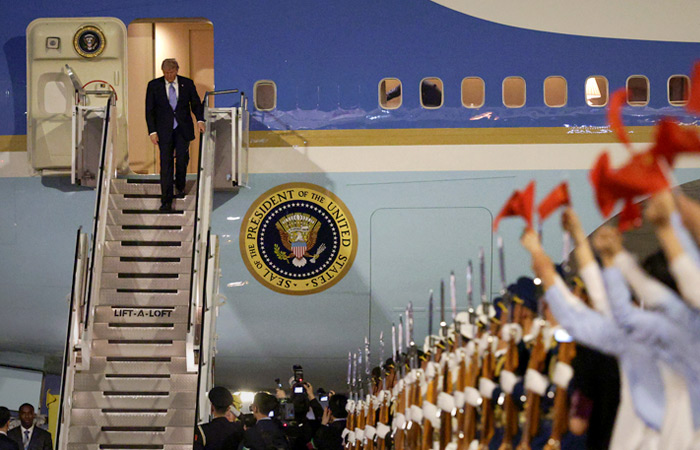
Donald Trump’s visit to China in May 2026 was not just another diplomatic tour, but a clear demonstration of how the world’s two largest economies negotiate – and, even more effectively, how differently they describe the same agreements. Over three days of talks with Xi Jinping, both sides released two sets of outcomes that do not formally contradict each other, yet differ so significantly in tone and detail that they almost read like reports from two separate meetings.
The American version is the language of numbers, contracts, and concrete concessions. The White House presented the results as something close to a ready-made roadmap for bilateral relations. According to the document, China agreed to purchase 200 Boeing aircraft, to buy at least $17 billion worth of US agricultural products annually from 2026 to 2028 on top of existing contracts, and to reopen its market to American beef and poultry, restoring access for more than 400 US companies.
A separate section focuses on rare earth elements and critical minerals – a core issue in US industrial policy. The American economy is heavily dependent on Chinese supplies of these materials, and any restriction immediately affects high-tech industries ranging from defense to electric vehicles. The White House statement notes that both sides agreed to “address supply issues,” a formulation that hides a much more complex negotiation. To institutionalize the process, two new bodies are being created: the US-China Trade Council and the US-China Investment Council.
The geopolitical section of the US statement is equally confident. Washington claims a consensus was reached: Iran must not obtain nuclear weapons, the Strait of Hormuz must remain open, North Korea’s denuclearization remains a shared goal, and unilateral tariffs are unacceptable. Trump also invited Xi Jinping for a reciprocal visit to the United States in autumn 2026 and emphasized mutual support within G20 and APEC leadership roles. The overall picture is coherent and polished: economics, security, and global politics aligned in a single framework.
The Chinese version shifts the tone almost entirely. Beijing’s official statements contain no specific numbers, no explicit commitments, and certainly no language that could be interpreted as concessions. There are no 200 aircraft, no $17 billion – instead, carefully calibrated phrases about “balanced and positive outcomes,” “mutual benefit,” and “equal consultations.” This is not an omission but a deliberate diplomatic strategy. China only confirms elements that cannot be framed as unilateral gains for the other side: the creation of trade and investment councils, gradual expansion of agricultural access, and a general push to increase trade while reducing tariff barriers. At the same time, the relationship is redefined as “constructive strategic stable relations” (中美建设性战略稳定关系).
Geopolitical issues in the Chinese readout are either absent or reduced to neutral references to “enhancing communication on international and regional matters.” Beijing avoids any public acknowledgment of hard positions, especially if they could be interpreted as alignment with US framing.
This divergence is not noise or mistranslation – it is classic diplomacy in its purest form. The United States speaks to its domestic audience, highlighting tangible wins. China speaks to its own audience and to the world, emphasizing equality and sovereignty. The same meeting becomes two distinct narratives serving different political purposes.
At the same time, the core elements do align: the meeting itself, the creation of new cooperation mechanisms, and the shared intention to stabilize relations are confirmed by both sides. Everything else is interpretation.
Historically, this is nothing new. The pattern echoes the 1972 Shanghai Communiqué between Richard Nixon and Mao Zedong, where deliberately ambiguous language allowed both sides to claim diplomatic success. Today, the mechanism remains the same – only the speed of information has changed.
However, behind the diplomatic language lie real risks, particularly around rare earth elements. This is not an abstract issue but a structural dependency: if agreements remain declarative while restrictions persist, the consequences could quickly spill over from politics into industry.
The final takeaway is pragmatic. The Trump–Xi meeting did not so much change the rules of the game as reveal how they actually work. Public statements are the surface layer; behind them lies a complex negotiation where both sides simultaneously cooperate and hedge against future conflict.
In simple terms: Washington says “we agreed and gained,” Beijing says “we discussed and balanced.” Reality, as usual, lies somewhere in between – and will become visible not through press releases, but through the movement of money, goods, and technology in the years ahead.
All content provided on this website (https://wildinwest.com/) -including attachments, links, or referenced materials — is for informative and entertainment purposes only and should not be considered as financial advice. Third-party materials remain the property of their respective owners.