


A high-profile case in the United States: French citizen Maximilien de Hoop Cartier was sentenced to eight years in prison for participating in a large-scale money laundering scheme using cryptocurrency infrastructure. The sentence was handed down by the federal court of the Southern District of New York — a jurisdiction that traditionally handles the most complex financial crimes with an international dimension.
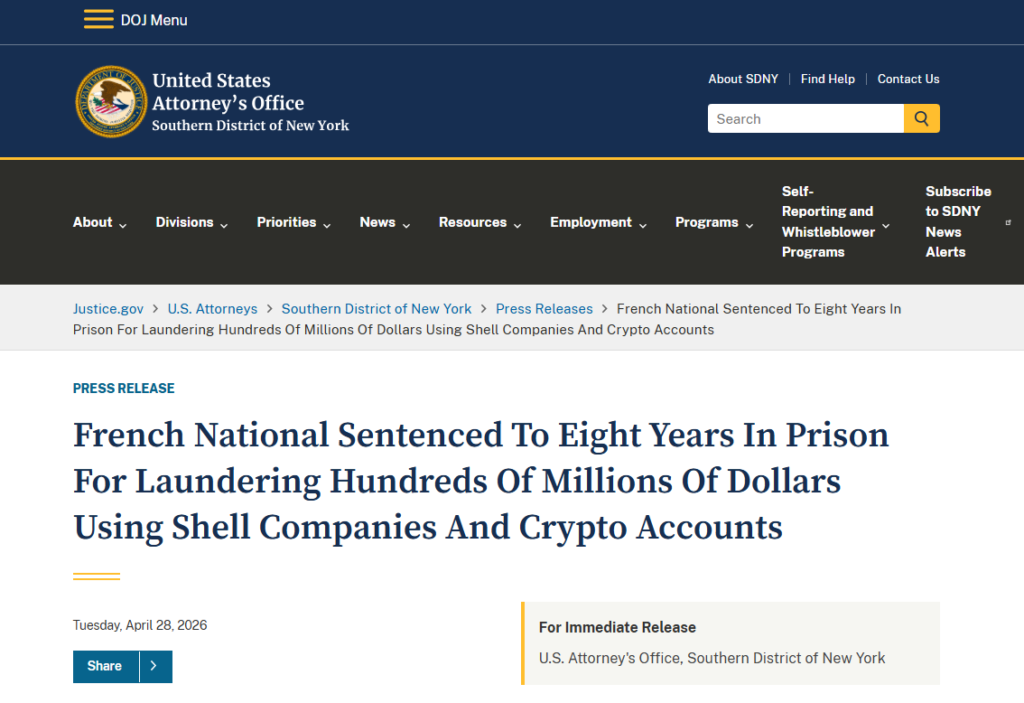
Cartier pleaded guilty to multiple charges, including operating an unlicensed money transmitting business and conspiracy to commit bank fraud. Formally, this concerns violations of regulatory requirements, but in substance it was the construction of a full-fledged shadow financial system operating outside state control.
The investigation showed that the scheme had been operating since at least 2018. At its center was an over-the-counter (OTC) crypto platform through which clients could convert digital assets into fiat — dollars and other currencies — without standard verification procedures. Such platforms are often used for large transactions because they allow participants to bypass traditional exchange restrictions and avoid leaving excessive traces.
However, in this case, it was not merely an exchange service but an entire infrastructure. Investigators found that Cartier built a network of shell companies in the United States. These companies opened bank accounts while providing false information about the nature of their business. Under the cover of supposedly legitimate operations, funds of criminal origin were moved.
To legitimize these flows, fictitious contracts and invoices were used. This is a classic money “laundering” scheme, where transactions are disguised as payments for goods or services. After that, cryptocurrency was converted into cash, which was then transferred خارج the United States. A significant portion of the funds, according to investigators, was directed to Colombia, indicating links to international drug cartels.
The total volume of funds that passed through this system exceeded $470 million. This elevates the case from the category of “individual violations” to that of systemic threats, as such operations directly affect financial security and the fight against organized crime.
A notable episode occurred in 2021, when law enforcement conducted an undercover operation. As part of this operation, approximately $937,000 was transferred to accounts linked to Cartier. The accounts were then frozen, effectively exposing the scheme.
Cartier’s behavior after his arrest only worsened his position. According to the court, he attempted to recover the frozen funds while simultaneously providing investigators with false information about the platform’s operations. He claimed to comply with KYC procedures, hold the necessary licenses, and run a legitimate business. To support these claims, he submitted forged documents, adding further fraud charges to the case.
In addition to the prison sentence, the court ordered Cartier to pay more than $2.3 million — the amount he earned in commissions from the transactions. Bank accounts registered under shell companies and used in the scheme were also forfeited to the state.
This case clearly demonstrates how cryptocurrencies are integrated into traditional money laundering schemes. It is important to understand that cryptocurrency itself is not the problem. The issue arises at the intersection of digital assets and the fiat system — where conversion takes place and where banks, companies, and legal structures are involved.
That is why regulators worldwide are increasingly focusing not only on crypto exchanges but also on OTC platforms, payment intermediaries, and fintech services. The main risk lies not in blockchain technology but in the infrastructure that enables the concealment of the origin of funds.
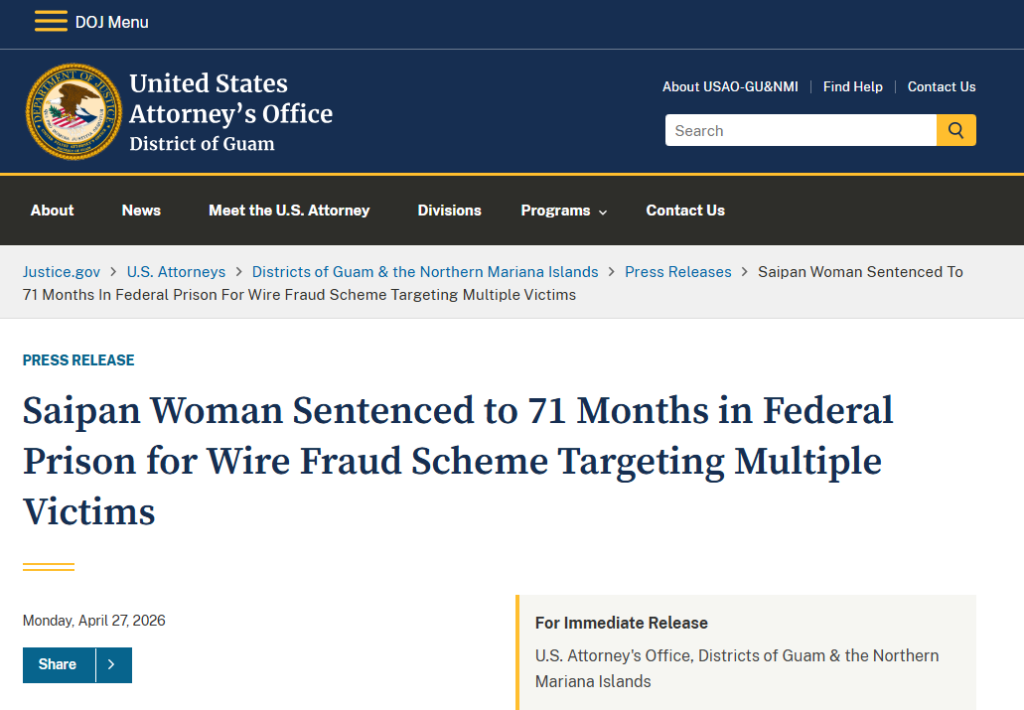
The broader context reinforces the seriousness of the situation. Other crypto-related sentences are being handed down in the United States. In one case, a court in the Northern Mariana Islands sentenced Sze Man Yu Inos to nearly six years in prison for fraud totaling around $769,000. In another, a federal court in Washington sentenced 22-year-old Evan Tangeman to 70 months for participating in a scheme to launder funds obtained through cryptocurrency theft.
Together, these cases form a clear trend: the crypto market is no longer a “gray zone” where one can act with impunity. Law enforcement is becoming stricter, and international cooperation more effective.
Cartier’s story is not just another conviction. It is a signal to the market that the era of anonymous schemes using cryptocurrencies is gradually coming to an end. Any attempt to integrate digital assets into traditional money laundering schemes eventually runs into the same barrier — the need to interact with the real financial system, where rules are long established and actively enforced. What once seemed like exceptions is increasingly becoming the new normal of regulation.
All content provided on this website (https://wildinwest.com/) -including attachments, links, or referenced materials — is for informative and entertainment purposes only and should not be considered as financial advice. Third-party materials remain the property of their respective owners.