

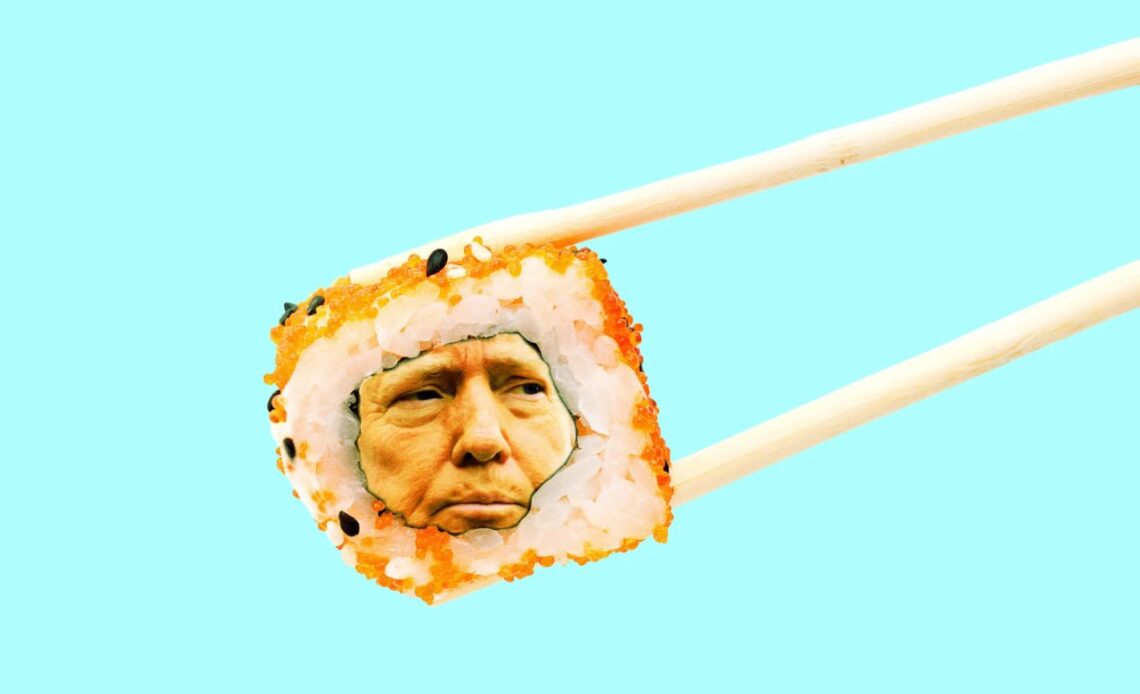
A story that sounds like both an internet joke and a real Wall Street episode has sparked widespread discussion in Japan and among investors this week. According to Japanese media reports, Donald Trump may have purchased shares in Kura Sushi USA worth between $1 million and $5 million – unexpectedly triggering what some are calling a “sushi rally.”
Formally, this is a standard investment in a publicly traded company. Kura Sushi USA is the American arm of a Japanese conveyor-belt sushi restaurant chain operating dozens of locations across the United States. However, the market interpreted this purchase not just as a trade, but as a potential mistake worthy of a behavioral finance case study.
According to Yomiuri Shimbun, the transaction was disclosed in recent tax filings. The documents show that Trump’s equity investments include not only tech giants such as Nvidia, Apple, and Dell, but also an unexpected participant – a sushi restaurant business.
And this is where things get interesting.
After the disclosure, an alternative narrative quickly emerged in the Japanese internet community. Users speculated that the investment might not have been a strategic decision, but rather the result of confusion.
According to this theory, the team managing Trump’s assets may have confused Kura Sushi with Fujikura – a major Japanese company operating in fiber optics, cable infrastructure, and technology-related industrial solutions. Fujikura has benefited in recent years from the AI-driven boom in data center infrastructure. The name “Kura” does sound somewhat similar to part of “Fujikura,” and given that Trump’s recent investments are heavily focused on AI supply chain companies, the confusion theory, while humorous, does not seem entirely implausible.
In other words, one company is sushi restaurants, the other is digital infrastructure. Yet the similarity in names was enough to spark widespread debate.
Japanese forums and financial comment sections quickly filled with sarcastic reactions. Users questioned whether “food and fiber optics” had been mixed up in the investment process, and whether millions of dollars could have unintentionally flowed into a restaurant chain instead of the AI sector. Some even joked that the president is unlikely to be a fan of raw fish, making the choice even more puzzling.
As often happens in financial markets, even rumors and interpretations can move prices faster than official statements.
Following the news, Kura Sushi USA shares rose by around 5.4%. For a restaurant chain, this is a notable move, especially given that no fundamental changes occurred in the business.
Meanwhile, Fujikura shares moved in the opposite direction, falling by roughly 45% over the past week. Analysts, however, note that this decline is unlikely to be directly related to the “investment confusion,” and is more likely driven by broader market dynamics and profit-taking after a strong AI-driven rally.
Still, the apparent correlation has fueled discussion about how sensitive markets remain to information noise and narrative-driven trading.
Looking more broadly, Trump’s reported portfolio structure actually fits the current market cycle. It includes large technology companies benefiting from artificial intelligence, cloud computing, and growing demand for data infrastructure.
Against this backdrop, an investment in a restaurant chain stands out as an anomaly – which is precisely why it attracted so much attention.
However, there is no official confirmation that the purchase was a mistake. It is also unclear who exactly executed the trade – Trump himself or a trust or family office structure managing his assets.
Trump and his representatives have not commented, leaving room for speculation.
From a behavioral finance perspective, the story is notable for several reasons.
First, investors and media tend to prefer simple explanations for complex market movements. The idea of “mistaken stock selection” is far more viral than analyzing capital flows or macroeconomic trends.
Second, similarly named companies across different sectors create fertile ground for narrative distortions, especially in an era of algorithmic trading where news flow can quickly impact prices.
Third, Trump’s public profile amplifies the effect: any of his investment activity becomes a media event, even if it is simply portfolio diversification.
Interestingly, the story also reflects a broader trend – the blurring boundaries between technology and traditional consumer sectors.
On one hand, markets are driven by expectations around AI and infrastructure growth. On the other, capital continues to flow into familiar businesses such as restaurants, retail, and services.
In that sense, the Kura Sushi episode – even if it turns out to be a misunderstanding – has already achieved something: it highlighted how quickly markets react to intersections of names, narratives, and expectations.
As of now, there is no confirmation whether the investment was intentional or the result of confusion with Fujikura. But the market reaction was clear: shares moved, noise increased, and the internet gained another story at the intersection of politics, finance, and Japanese sushi.
And as often happens in markets, sometimes what matters more is not what actually happened – but what investors believe happened.
All content provided on this website (https://wildinwest.com/) -including attachments, links, or referenced materials — is for informative and entertainment purposes only and should not be considered as financial advice. Third-party materials remain the property of their respective owners.