
Disruptive technologyNewsStock research & analytics

Musk and wordless telepathy

Join our Trading Community on Telegram


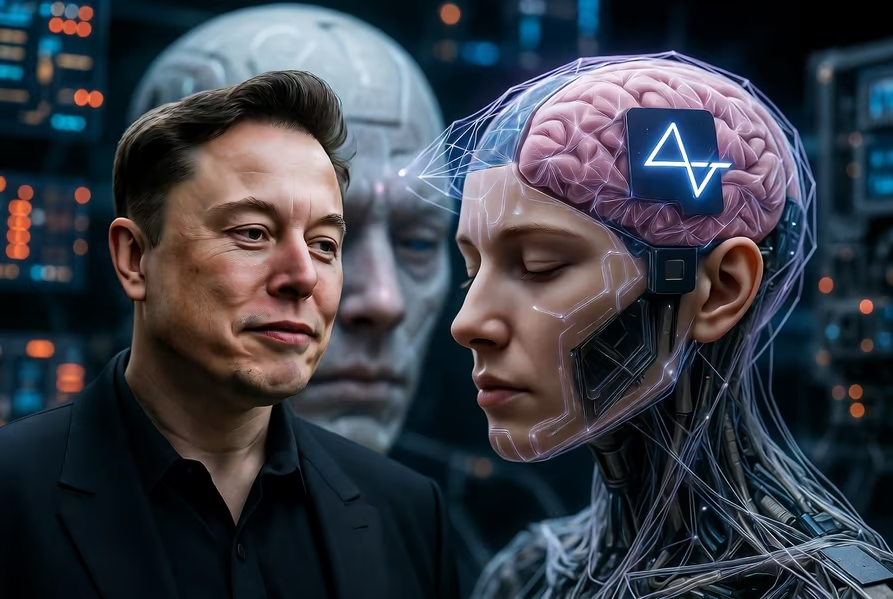
What until recently sounded like pure science fiction is gradually moving into experimental reality. Elon Musk has stated that Neuralink could demonstrate as early as this year a technology enabling direct information transfer from one human brain to another. If successful, it would mark the first step toward so-called digital telepathy – communication without words, messages, voice, or screens.

The statement followed a discussion on the social platform X, where Tesla engineer Youn-Ta Tsai argued that human communication is limited by the “bandwidth” of language: we think faster than we speak or type. Musk responded, suggesting that the first attempt at a brain-to-brain interface at Neuralink could “possibly happen this year”.

Neuralink’s core product today is the N1 implant, roughly the size of a coin. It is placed in the motor cortex of the brain, where it reads neural signals and enables users to control computers or external devices using thought alone. The system is already undergoing clinical trials, and early patients with paralysis have been able to move cursors, type, and use digital tools without physical assistance.

However, the long-term goal is broader. Musk has repeatedly described a full brain-computer-brain interface that would allow information to be exchanged directly between humans. In theory, this could include not only text, but also images, emotions, and complex concepts transmitted almost instantly.

Additional attention was drawn by Neuralink’s registration of the trademarks “Telepathy” and “Telekinesis”, which many interpret as hints at future directions. Founded in 2016, the company has invested around $100 million of Musk’s personal funds and developed the R1 surgical robot capable of implanting electrodes with micron-level precision.

Experts, however, emphasize that current brain-computer interfaces are still at an early stage. Direct transmission of complex thoughts remains a major scientific challenge, while issues of privacy, security, and neural data protection are becoming as important as the engineering itself.

Still, progress in neurotechnology is accelerating rapidly. If such a demonstration does take place this year, it could become one of the defining technological milestones of the decade and the beginning of a new era in human-machine communication.

0
0
Disclaimer

All content provided on this website (https://wildinwest.com/) -including attachments, links, or referenced materials — is for informative and entertainment purposes only and should not be considered as financial advice. Third-party materials remain the property of their respective owners.

Leave a Reply

Your email address will not be published. Required fields are marked *

Related posts
Disruptive technologyNewsStock brokersStock research & analytics

Drones Are Flying to the Moon?

While the broader U.S. defense sector showed relatively muted dynamics awaiting new budget…
Read more
CryptocurrencyDisruptive technologyNewsStock research & analytics

A Ukrainian Call Center, a Turkish Base, and Cryptocurrency

Ukrainian and Czech law enforcement authorities have uncovered an international fraud network that…
Read more
ArticlesCryptocurrencyPrecious MetalsStock research & analytics

Gold, Real Estate or Bitcoin?

Over the past decade, global financial markets have experienced a pandemic, a surge in inflation…
Read more
Telegram
Subscribe to our Telegram channel

To stay up-to-date with the latest news from the financial world

Subscribe now!