

Not long ago, the idea of building cities on the Moon and Mars seemed like the plot of a science fiction movie. Today, Elon Musk speaks about it not as a distant dream, but as a concrete engineering project with clearly defined stages.
According to Musk’s latest statements, the first cargo missions to the Moon and Mars could launch before the end of 2026. Their mission will not be to transport people, but to deliver equipment, construction materials, and technologies needed to establish the first autonomous extraterrestrial bases.
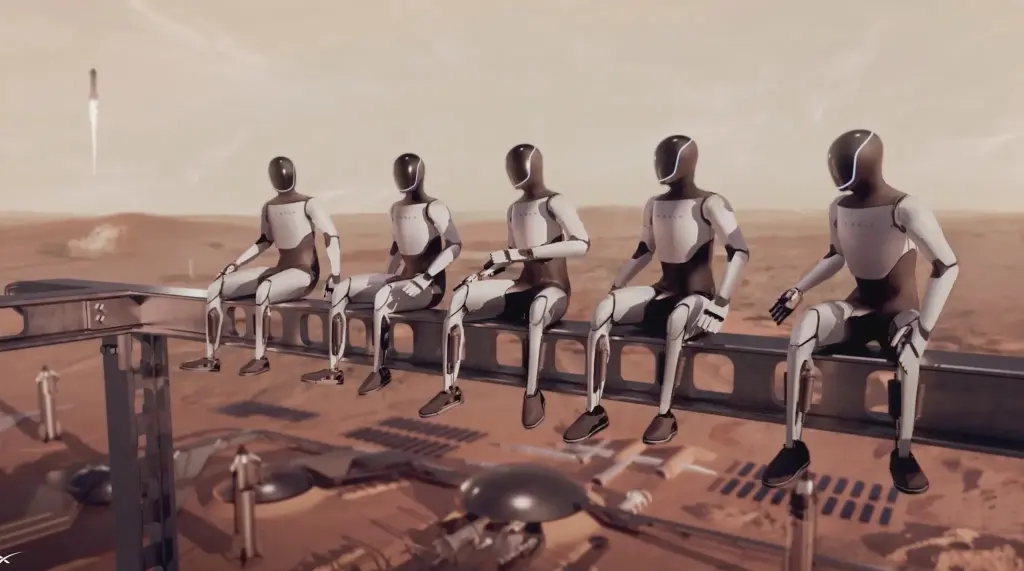
The most remarkable part of the plan, however, is this: the first “residents” of future colonies will not be astronauts, but Tesla Optimus humanoid robots.
Robots Will Build Cities Before Humans
Musk believes that space colonization should follow the same logic as building a new city on Earth.
Before humans arrive, the infrastructure must be prepared by:
- unloading equipment;
- assembling habitat modules;
- installing solar panels;
- connecting power systems;
- establishing water extraction;
- producing oxygen;
- preparing landing sites for future missions.
According to SpaceX, Optimus robots will be capable of performing these tasks. They do not require oxygen, food, comfortable living conditions, or psychological support. They only need energy, maintenance, and access to computing power.
SpaceX engineers argue that sending hundreds of robots first is far easier than sending even a small group of humans whose lives would have to be sustained in extremely harsh conditions.
The Moon Will Be Mars’ Dress Rehearsal
Although Mars remains Musk’s ultimate destination, the first stage of the program will take place on the Moon.
The reason is simple.
A trip to the Moon takes only about three days, while reaching Mars with current technology requires roughly six months.
If something goes wrong, equipment can be replaced quickly and the crew can safely return to Earth.
For this reason, the Moon is viewed as a massive testing ground where technologies for extraterrestrial construction can be developed and refined.
Experts believe that nearly every successful solution tested on the Moon can later be adapted for Mars.
Artificial Intelligence Will Become the Chief Builder
Over the past several years, Musk has been developing multiple technologies simultaneously.
Tesla is building Optimus humanoid robots.
xAI is developing the Grok artificial intelligence system.
SpaceX is creating a next-generation transportation network.
These projects are gradually evolving into a single integrated ecosystem.
According to reports, Musk is combining his AI initiatives into a unified structure referred to as SpaceXAI, where artificial intelligence will serve as the “brain” of future space infrastructure.
The heavy computing will not necessarily take place inside every individual robot.
Instead, thousands of machines could connect to centralized computing systems through a next-generation satellite network.
To support this vision, SpaceX has already submitted plans for the next phase of its satellite infrastructure – a massive constellation that could eventually include up to 100,000 satellites.
Such a network would provide high-speed communications between Earth, the Moon, Mars, and spacecraft while also supplying computing resources for billions of AI-powered devices.
The Biggest Transportation Challenge
Despite these ambitious plans, engineers still face one of the greatest technical challenges.
Starship has already demonstrated reusable capabilities along with successful launches and recovery of key hardware.
However, true colonization requires much more.
Engineers must learn how to:
- launch thousands of tons of cargo into space on a regular basis;
- refuel spacecraft directly in orbit;
- dramatically reduce launch costs;
- achieve airline-level reliability.
Musk has previously stated that he ultimately wants Starship launches to occur every few days.
He has also mentioned the possibility of developing an even larger and more capable transportation system beyond today’s Starship.
When Will the First City Appear on Mars?
According to Musk’s current projections, the first self-sustaining settlements on Mars could emerge sometime between 2045 and 2055.
Before that happens, several critical milestones must be achieved:
- constructing residential habitats;
- building energy infrastructure;
- extracting water from underground ice;
- producing oxygen;
- manufacturing rocket fuel directly on Mars;
- creating a fully autonomous life-support system.
Only then will permanent human settlers be able to arrive.
What Do Investors Think?
From the perspective of current financial performance, the project appears far from ideal.
As discussed previously, Starlink remains the most profitable business within Musk’s space ecosystem.
Meanwhile, many other initiatives involving space technology and artificial intelligence still require enormous investments and have yet to generate consistent profits.
At first glance, this may appear highly risky.
However, history shows that markets do not always value companies solely based on present-day financial metrics.
Why Do Investors Continue to Believe in Musk?
Tesla provides a good example.
If the company were valued only as an automobile manufacturer, its market capitalization would have seemed excessively high for many years.
Yet investors no longer see Tesla as simply a car company.
Today, the market values it as a leader in artificial intelligence, robotics, autonomous transportation, energy technologies, and software.
In other words, investors are buying expectations of future technological leadership rather than today’s vehicle sales.
A similar story is beginning to unfold around Musk’s broader space ecosystem.
Space Is Becoming the Next Major Investment Trend
If even part of the program succeeds, multiple industries could benefit simultaneously:
- space transportation;
- satellite communications;
- artificial intelligence;
- robotics;
- space infrastructure manufacturing;
- energy technologies;
- autonomous computing systems.
The discussion is no longer about launching individual rockets, but about creating an entirely new economy beyond Earth.
Conclusion
For now, the project remains extraordinarily ambitious, and many of its milestones are still engineering challenges for the future rather than present-day reality.
Yet reusable rockets, mass-market electric vehicles, and Starlink satellite internet once seemed equally unrealistic.
Has Musk fulfilled every promise? Not always, and often not within the originally announced timelines.
Nevertheless, history suggests that many ideas initially dismissed as science fiction eventually became reality.
Perhaps a few decades from now, cities on the Moon and Mars will seem as ordinary as reusable rockets or global satellite internet do today. And the first bricks of those extraterrestrial settlements may indeed be laid not by humans, but by AI-powered robots.
All content provided on this website (https://wildinwest.com/) -including attachments, links, or referenced materials — is for informative and entertainment purposes only and should not be considered as financial advice. Third-party materials remain the property of their respective owners.