

The latest report from QCP Capital looks like an attempt to capture a rare market state – when uncertainty does not disappear, but participants get used to it. This is no longer classic panic and not full optimism, but an intermediate phase in which market participants learn to live with risk rather than react to it as something extraordinary every time.
The analysts’ main conclusion sounds quite harsh: the market is stuck in a constant reassessment mode. Every new headline related to Iran effectively resets the previous narrative. Yesterday – hopes for de-escalation, today – accusations of violations, tomorrow – new negotiations. As a result, the market does not form a stable trend but constantly “rebuilds” expectations.
This was clearly reflected in price dynamics. After attempts to price in a scenario of easing tensions, everything reversed sharply. WTI Crude quickly recovered previous losses and gained about 8%, returning to growth. The crypto market, on the contrary, reacted with a decline: Bitcoin pulled back to $74,000, Ethereum to $2,300. This is a classic reaction: when geopolitical risk rises, capital partially leaves more volatile assets.
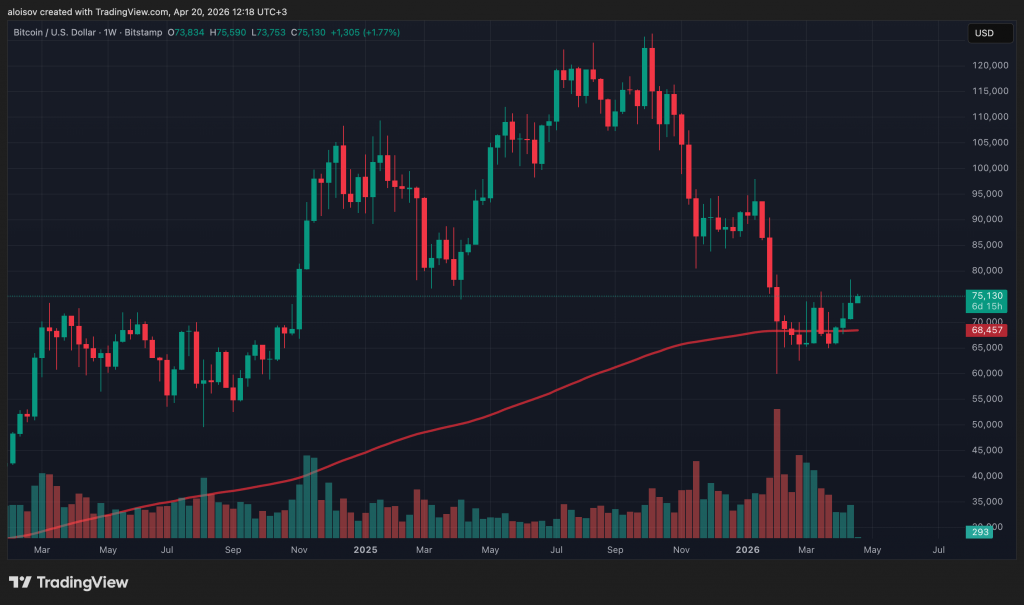
1-week BTC/USD chart and 200EMA. Source: Bitstamp
An additional factor of uncertainty remains the situation around the Strait of Hormuz. This is not just a geographical point, but a critically important hub of global energy, through which about 20% of seaborne oil supplies pass. Its actual blockage or restriction of shipping automatically raises the stakes for all markets. But the key point is that the market no longer reacts linearly. It no longer fully prices in a “catastrophe,” but it does not ignore the risk either – it distributes it over time.
Here one of the most interesting paradoxes of the current phase emerges. Despite renewed tensions, volatility remains surprisingly low – near its lowest levels since the beginning of the year. This seems almost illogical: risk exists, news flows, prices move, yet the market is not “buying fear” in the usual volumes.
QCP explains this by a shift in perception. Investors are beginning to view the conflict not as an acute crisis requiring immediate reaction, but as a prolonged process with periodic spikes. This fundamentally changes behavior. If previously the focus was on the intensity of the event, now it is on its duration. The market seems to say: “Yes, this is a problem, but it will be with us for a long time, so there is no point in reacting to every headline.”
www.cryptometer.io
This logic is also confirmed by the risk reversals indicator – the difference in pricing between call and put options, reflecting market sentiment. Its weak dynamics show that the market is not forming a clear bias either to the upside or downside. This is a state of indecision, where participants are observing rather than acting aggressively.
However, the calm is more superficial. QCP notes the first signs that demand for volatility is beginning to return. There are two reasons. The first is the same geopolitics, which has not disappeared and can again become a trigger at any moment. The second is a macro factor related to US monetary policy.
The speech of Kevin Warsh, a candidate for the position of head of the Federal Reserve, becomes an important focal point. Markets will look for signals in his rhetoric regarding future rate policy. If hints of easing appear amid geopolitical instability, this could support risk assets. If the tone remains hawkish, pressure on the market will increase.
Against this backdrop, QCP proposes a rather pragmatic trading approach. The base scenario is continued range-bound movement. That is, the market does not enter a stable trend but continues to “digest” information within defined boundaries.
From this follows the first strategy – a bet on volatility. When implied volatility is low and the event backdrop remains rich, options become relatively cheap. This creates asymmetry: the potential profit from a strong move can significantly exceed the risk of losing the premium.
In practice, this means buying options – both for upward and downward moves. If the market reacts sharply to geopolitics or macro factors, the value of such positions can increase rapidly. The main risk is obvious: if the market remains in a range, the premium “decays.”
The second strategy is the opposite. If an investor believes the market will continue to consolidate, it is possible to earn by selling options and collecting premium. However, this requires strict risk management, as any breakout from the range can lead to significant losses.
QCP Capital suggests paying particular attention to the dynamics of risk reversals. Although this indicator currently appears neutral, a sharp shift may serve as an early signal of trend formation. In conditions where the market remains indecisive for a long time, such moves often occur quickly and unexpectedly.
Interestingly, the current situation is not unique. QCP draws parallels with events in June 2025. At that time, the first strike on Iran caused a sharp but short-term drop in Bitcoin, after which the market not only recovered but reached new highs. This is an important observation: the market has already faced this type of shock and developed a certain immunity.
As a result, a fairly clear picture emerges. The market does not ignore risk, but it does not overestimate it either. It adapts. Geopolitics remains a factor, but ceases to be the sole driver. Volatility is compressing, but this is more of a pause than a final state.
And perhaps the main conclusion is that the market changes not only through prices, but through perception. When participants stop reacting to the same events in the same way as before, it means the system is entering a new phase. And in this phase, those who understand not only “what is happening,” but also “how the market now reacts to it,” are the ones who win.
All content provided on this website (https://wildinwest.com/) -including attachments, links, or referenced materials — is for informative and entertainment purposes only and should not be considered as financial advice. Third-party materials remain the property of their respective owners.