

Artificial intelligence has learned to model the birth of gold in the Universe: a breakthrough that could change astrophysics
Imagine an event so powerful that in just a few seconds it releases more energy than billions of Suns produce over a long period of time. It is precisely in such cosmic catastrophes that the heaviest elements of the periodic table are created – gold, platinum, uranium, thorium, and many other metals without which modern civilization would be impossible to imagine.
Today, an international group of scientists from the GSI/FAIR research center has taken a major step toward understanding this process. Using artificial intelligence, researchers created a new RHINE model that makes it possible to simulate the formation of heavy elements with a level of accuracy previously impossible due to limitations in computing technology. The results of the study were published in one of the world’s leading scientific journals – Physical Review D.
Where did gold actually come from?
Every atom of gold in your ring, watch, or electronic device appeared long before the birth of Earth.
Most familiar chemical elements are indeed synthesized inside stars. This is where carbon, oxygen, silicon, iron, and many other substances are created. However, there is a limit.
After iron is formed, an ordinary star can no longer produce heavier elements while releasing energy. Creating gold, platinum, or uranium requires such extreme conditions that these elements appear in the Universe only during the rarest and most catastrophic events.
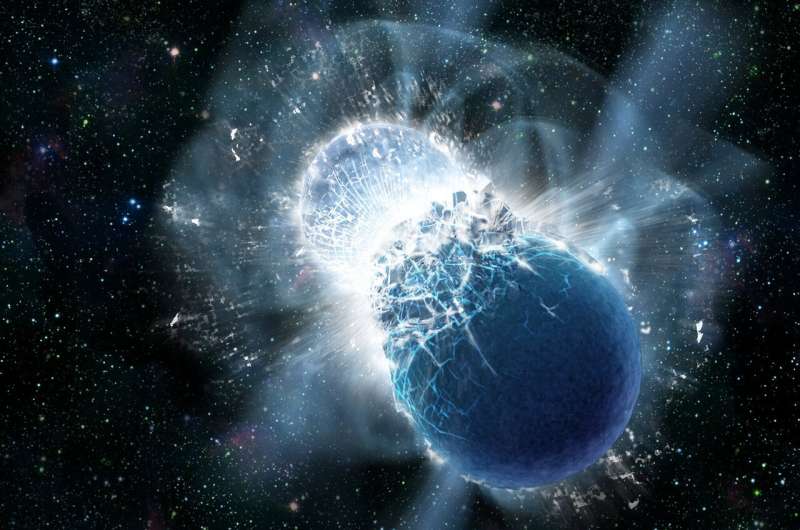
One such event is the collision of two neutron stars.
What is a neutron star?
A neutron star is the remnant of a giant star that ended its life in a supernova explosion.
Despite being only about 20 kilometers in diameter, such a star can have a mass greater than the Sun. One cubic centimeter of neutron star material would weigh hundreds of millions of tons on Earth.
If two such stars orbit each other for millions of years, they gradually begin moving closer together. Eventually, a collision of unimaginable power occurs.
At that moment, a phenomenon known as a kilonova is born.
Kilonova – one of the most powerful explosions in the Universe
A kilonova is a short but extremely bright explosion that occurs after the merger of neutron stars. Its brightness can exceed the luminosity of billions of Suns.
During the collision, enormous amounts of ultra-dense matter filled with free neutrons are ejected into space. This is where one of the most important processes in modern nuclear astrophysics begins.
The r-process – the cosmic factory of heavy elements
Scientists call it the rapid neutron-capture process, or simply the r-process. Its principle is relatively simple, although the underlying physics is incredibly complex.
Atomic nuclei begin rapidly capturing huge numbers of free neutrons. The process happens so quickly that the nuclei do not have time to decay between successive captures. Then some of these neutrons transform into protons through beta decay. Gradually, the nuclei become heavier and heavier.
This is how the following elements are created:
- gold;
- platinum;
- uranium;
- thorium;
- rare-earth elements;
- dozens of other heavy isotopes.
In fact, most of the gold on Earth was once created in precisely these kinds of cosmic catastrophes.
Why is this process so difficult for scientists to model?
At first glance, it may seem simple: just write a program and calculate the collision of two stars.
In reality, the problem is far more complicated.
During the r-process, thousands of different nuclear reactions occur simultaneously.
Each of them:
- releases heat;
- changes the composition of matter;
- affects the speed at which material spreads out;
- changes the brightness of the kilonova;
- influences the radiation spectrum.
All these processes are interconnected. At the same time, a hydrodynamic model must calculate the movement of matter literally at every moment in time.
If the complete network of all nuclear reactions is used, the computational costs become astronomical. Even the most powerful supercomputers must spend enormous amounts of time performing a single such calculation.
Therefore, for decades researchers have been forced to make compromises.
To complete simulations within a reasonable time, they had to:
- simplify the physics;
- reduce the number of reactions;
- use approximate models;
- sacrifice calculation accuracy.
Artificial intelligence instead of millions of calculations
This is where machine learning came to the rescue.
The GSI/FAIR team developed the RHINE model (r-process Heating Implementation in hydrodynamic simulations with Neural networks).
Instead of recalculating thousands of reactions every time, scientists chose a different approach.
First, they performed a huge number of highly accurate reference calculations using the complete network of nuclear reactions. These results became a kind of “training library.”
Then, a neural network was trained to identify relationships between process parameters and the amount of heat released.
After training, RHINE no longer needs to perform the full calculation from scratch. It can predict the rate of heat release almost instantly with very high accuracy.
Essentially, artificial intelligence learned to replace an extremely expensive computational stage with almost no loss of quality.
Why is heat so important?
It may seem that the issue is simply the temperature of the material. But the amount of heat determines the future fate of the ejected matter.
Additional heating affects:
- the expansion speed of the cloud;
- the distribution of matter;
- the chemical composition of the ejecta;
- the brightness of the kilonova;
- the duration of its glow;
- the spectrum of electromagnetic radiation.
It is through this radiation that modern telescopes try to determine which elements were created after stellar collisions.
The more accurately heating is calculated, the better computer models match real observations.
Testing the new model
After training, researchers conducted a series of comparisons between RHINE and full physical calculations.
The results were impressive. The neural network almost perfectly reproduced the results of traditional modeling while requiring only a small fraction of the computational resources.
According to one of the study authors, Dr. Oliver Just, using RHINE makes it possible to significantly reduce calculation time without noticeable loss of accuracy.
Dr. Zewen Xiong, who participated in developing the model, noted that such a high level of agreement confirms the potential of machine learning for solving the most complex problems in modern astrophysics.
The scientists also concluded that the impact of heat release during the r-process was probably underestimated in previous studies and should be included in future research.
Why this work is much more important than it seems
At first glance, it may appear that this is simply a new computer program.
In reality, it is an example of how scientific artificial intelligence is developing today.
Many people imagine AI as a system that independently makes discoveries or replaces scientists. But reality is much more interesting.
AI is increasingly being used as an intelligent computational accelerator.
It does not discover new laws of physics. It does not invent new theories.
Instead, it makes possible calculations that were previously practically impossible even for supercomputers.
This is becoming one of the main directions of scientific development in 2026.
What happens next?
The new RHINE model opens the possibility of conducting much more detailed hydrodynamic simulations of neutron star mergers.
In the future, this could allow scientists to:
- significantly accelerate kilonova modeling;
- improve the accuracy of heavy-element formation calculations;
- better interpret observations from space telescopes;
- directly compare computer simulations with experiments at the future FAIR accelerator complex in Germany;
- gain a deeper understanding of the origin of the matter that makes up our planet and ourselves.
Artificial intelligence becomes a new tool of fundamental science
Just a few years ago, AI was mainly associated with generating images, texts, or computer code.
Today, the situation is changing rapidly.
Neural networks help discover new medicines, calculate climate models, analyze data from the Large Hadron Collider, design future materials, and even study the origin of chemical elements in the Universe.
The RHINE story perfectly demonstrates the new role of artificial intelligence.
It does not replace physicists. It does not make discoveries instead of humans.
It removes one of the biggest limitations of modern science – enormous computational complexity.
Thanks to this, scientists can investigate processes that previously existed only in theory and move closer to answering one of humanity’s oldest questions:
Where did gold and other heavy elements in the Universe come from – the very elements that make up the world around us and ourselves?
All content provided on this website (https://wildinwest.com/) -including attachments, links, or referenced materials — is for informative and entertainment purposes only and should not be considered as financial advice. Third-party materials remain the property of their respective owners.