


At first glance, Bhutan’s reduction of its Bitcoin reserve may look like simple profit-taking, but in reality it represents a notable strategic shift by a small state that was among the first to integrate cryptocurrency into its national financial model.
At its peak in October 2024, the country held around 13,000 BTC. This was no longer an experimental allocation but a fully-fledged sovereign asset, comparable in logic to foreign exchange reserves. For Bhutan, Bitcoin was originally part of a pragmatic strategy: using surplus hydroelectric power for mining and converting a natural energy advantage into digital capital.
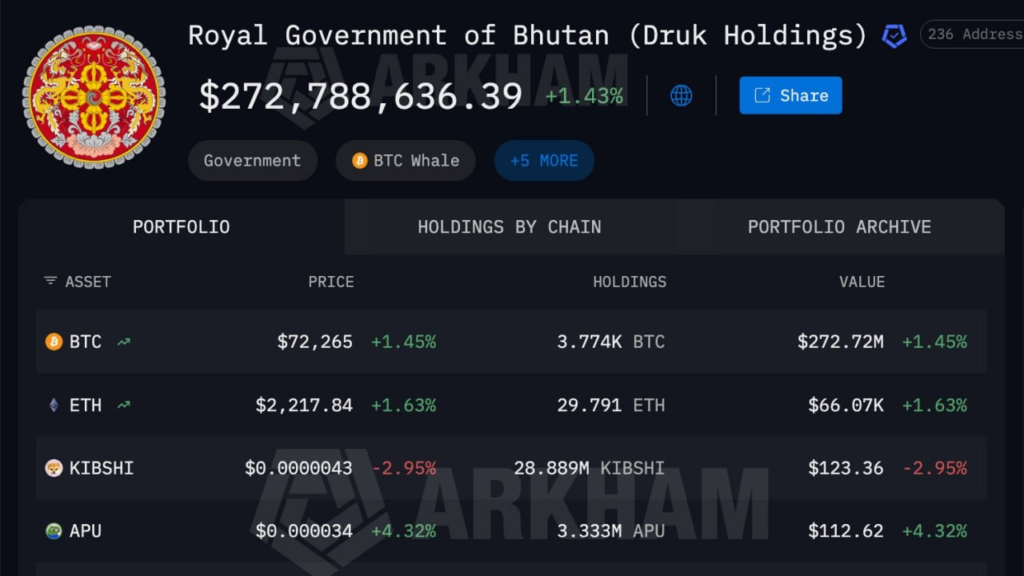
Over the past 18 months, however, this structure has gradually contracted. Around 71% of the reserve has been liquidated, leaving approximately 3,774 BTC on the balance sheet today. This was not a single decision but a sequence of sales, including roughly $180 million worth of disposals since the beginning of 2026.


The key driver here is mining economics. The model of “cheap hydropower + BTC mining” works well in theory, but becomes far less attractive when market conditions shift. In 2025, network difficulty increased, competition intensified, and overall mining profitability declined. For smaller-scale infrastructure, this is particularly critical: margins compress faster than for large industrial players.
Against this backdrop, an alternative scenario becomes more attractive for the state — direct electricity exports. According to estimates, selling energy to neighboring markets, including India, has started to generate more stable and predictable revenue than Bitcoin mining, which is exposed to significant price volatility.
In essence, Bhutan faced a classic trade-off between a “high-return, high-risk digital asset strategy” and a “lower-return but stable cash-flow energy monetization model.” Increasingly, the balance is shifting toward the latter.
Risk management is another important layer. For a small economy, holding 13,000 BTC implies significant exposure to a single highly volatile asset. Reducing the position is therefore not a rejection of crypto, but rather a way to lower concentration risk and lock in part of the gains in a more stable form.
It is also notable that mining inflows into the national wallet effectively stopped by late 2024. This indirectly suggests that active mining operations were either significantly reduced or fully halted. At that point, the strategy gradually shifted from “accumulating via mining” to “managing an already accumulated asset base.”
Importantly, this is not a complete exit from Bitcoin. Even the remaining few thousand BTC still represent a meaningful position. However, the logic of ownership has changed: from aggressive accumulation toward more conservative portfolio management.
More broadly, this case reflects the growing maturity of the crypto market. Even sovereign participants do not maintain strategies based solely on early conviction or narrative advantage. Ultimately, simple economics take over: what is more efficient, stable, and controllable over the long term.
In this sense, Bhutan has not “lost faith” in Bitcoin. It has simply moved from experimentation to rational portfolio management.
All content provided on this website (https://wildinwest.com/) -including attachments, links, or referenced materials — is for informative and entertainment purposes only and should not be considered as financial advice. Third-party materials remain the property of their respective owners.