

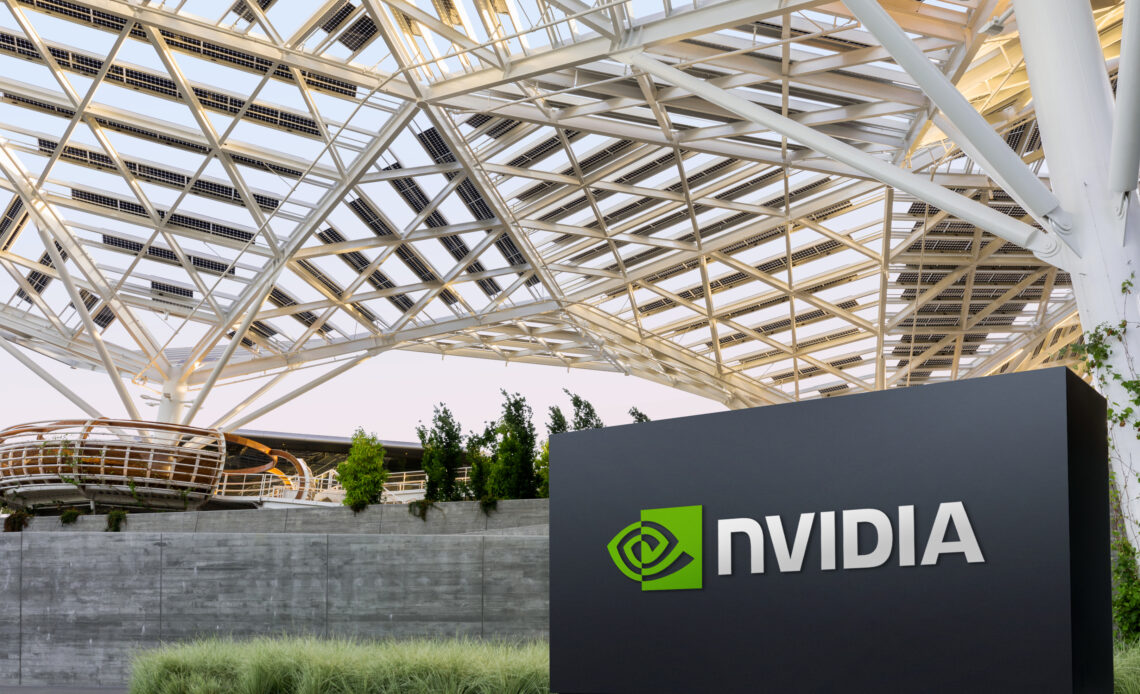
The American technology giant NVIDIA published its financial results for the fourth quarter of 2025 (fiscal year 2026), which not only exceeded analysts’ expectations but once again set the pace for the entire AI infrastructure market. In after-hours trading, the company’s market capitalization increased by approximately $190 billion, marking one of the largest single-day gains in the history of the technology sector.

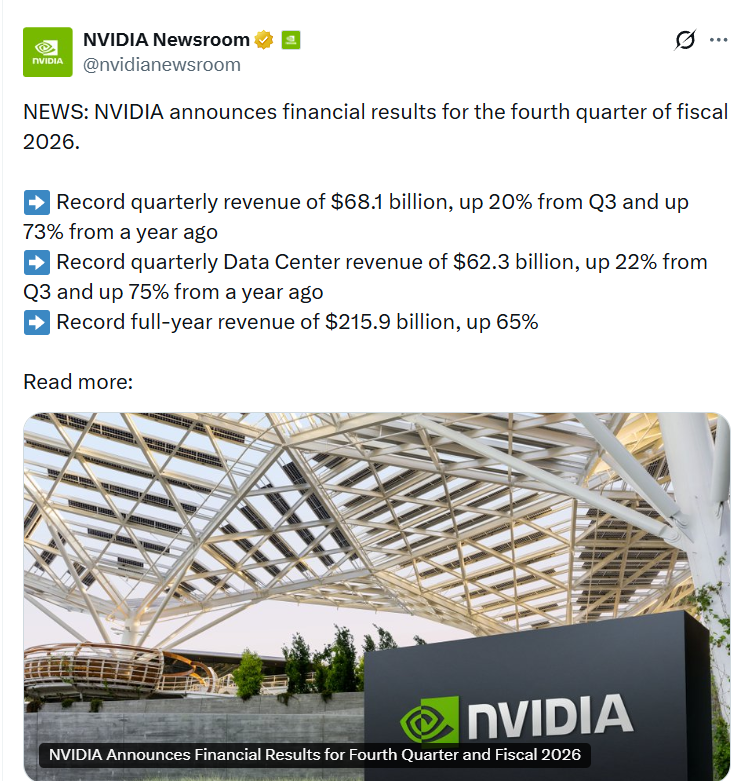
Quarterly earnings per share came in at $1,62 compared to a forecast of $1,53. Revenue reached $68,1 billion versus the expected $66,2 billion. However, the main driver of growth was not just the actual figures but the outlook: for the first quarter of the new fiscal year, the company expects revenue in the range of $76,44–79,56 billion, while market expectations were around $72,78 billion. In effect, this signals continued accelerated expansion even on top of an already record base.
On an annual basis, revenue grew by 65% to $215,9 billion. The data center segment — the key revenue source in the AI era — is expanding particularly rapidly. The segment generated $62,3 billion for the quarter (+75% year-over-year) and $193,7 billion for the year (+68%). These figures confirm that global demand for AI computing infrastructure is not slowing down but rather entering a scaling phase.
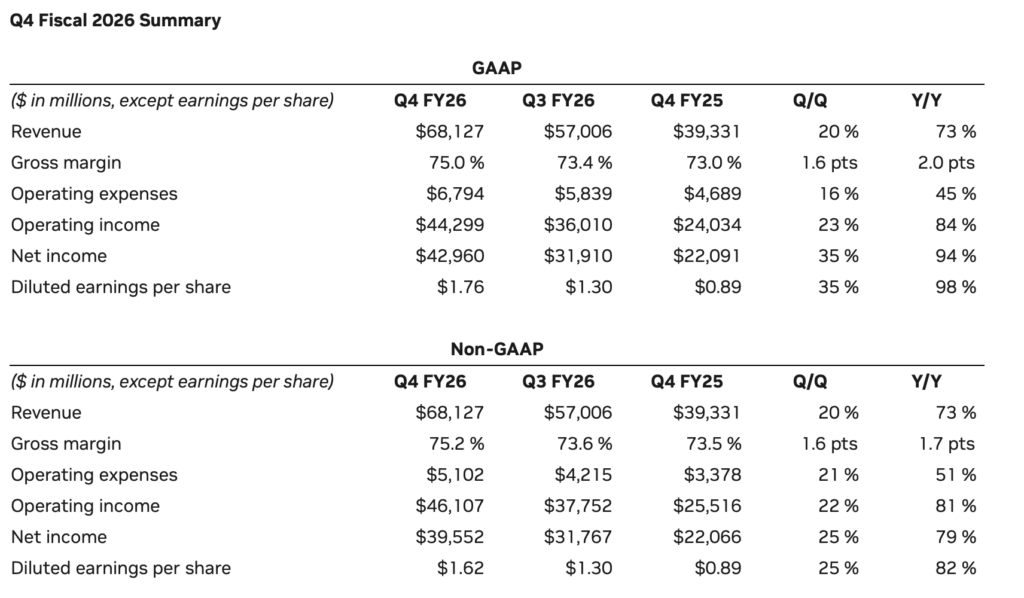
Financial results of NVIDIA for Q4 2025. Source: NVIDIA.
Founder and CEO Jensen Huang stated that “computing demand is growing exponentially,” and that the market is experiencing a turning point in the development of agentic AI. According to him, the Grace Blackwell architecture with NVLink has become a leader in inference, delivering an order-of-magnitude lower cost per token, while the upcoming Rubin platform will further strengthen the company’s technological advantage. He also emphasized that corporate clients are actively investing in AI factories — infrastructure that is effectively shaping a new industrial revolution.
Financial metrics highlight the scale of growth. Net income for the quarter increased by 94% year-over-year to $42,96 billion, gross margin remains around 75%, and GAAP earnings per share reached $1,76. At the same time, the company returned $41,1 billion to shareholders through dividends and share buybacks, reinforcing the positive investor response.
The forecast for the next quarter includes revenue of around $78 billion and further expansion of AI development investments. Notably, the company does not include potential data center revenue from China in its projections, making the outlook conservative amid strong global demand.
Ecosystem expansion is taking place across multiple fronts. The new Rubin platform with updated chips promises to reduce inference costs by up to ten times. Collaboration with major cloud providers — Amazon Web Services, Google Cloud, Microsoft Azure, and Oracle Cloud Infrastructure — strengthens NVIDIA’s presence in global AI infrastructure. A strategic partnership with Meta aims to scale computing capacity, investments in Anthropic expand its footprint in advanced language models, and joint projects with CoreWeave accelerate the development of specialized AI factories.

The company is also active in open-source initiatives, introducing solutions such as Nemotron 3 and Earth-2, and previously announced the Alpamayo family of models for autonomous transport. These developments enable autonomous systems to analyze complex road scenarios and explain their decisions, which is critical for regulatory approval and scaling of autonomous technologies.
Meanwhile, the financial ecosystem around AI infrastructure is also expanding. In December last year, NVIDIA completed a $20 billion deal involving Groq assets. Investment firm Apollo Global Management is preparing $3,4 billion in financing to purchase NVIDIA chips for subsequent leasing to xAI. The compute-leasing model is gaining popularity, allowing AI startups to scale quickly without massive upfront capital expenditures, effectively turning computing into a service.
Amid this technology rally, the crypto market also showed renewed momentum: Bitcoin climbed back above the $68 000 mark, strengthening its correlation with the high-tech sector. The surge in NVIDIA’s market cap and the recovery of BTC reflect a broader trend — markets are betting on accelerated AI development and digital infrastructure as key drivers of the next economic cycle.
Thus, NVIDIA’s latest report not only reaffirmed its leadership in AI chips but also highlighted the scale of transformation across the entire technology industry. Investors see not a short-term spike, but a structural shift — which explains the magnitude of the market reaction.
All content provided on this website (https://wildinwest.com/) -including attachments, links, or referenced materials — is for informative and entertainment purposes only and should not be considered as financial advice. Third-party materials remain the property of their respective owners.