


The company Anthropic, developer of the Claude chatbot, presented a large-scale study on how artificial intelligence technologies are beginning to impact the labor market. The central goal of the work was to answer several key questions: which tasks can already be automated, which professions are at the highest risk, and whether mass displacement of workers by AI should be expected in the coming years.
Researchers concluded that the influence of artificial intelligence is indeed growing; however, real-world implementation is still far behind the theoretical capabilities of current models.
New AI Impact Metric
Anthropic published the results of a study measuring AI’s impact on the labor market. In its report, the company proposed a new analytical concept — “observed exposure.” This metric reflects not just the potential for AI application, but the actual contact of specific work tasks with AI tools in the real economy.
In other words, while most previous studies assessed only the theoretical automatability of professions, the new approach seeks to understand where AI is actually used in practice.
The study is based on a combination of two types of data:
- Theoretical capabilities of large language models (LLMs)
- Real statistics of AI use in work processes
Thus, experts attempted to match the potential effect of the technology with how it is applied in the real economy. According to Anthropic representatives, this approach allows for a more accurate understanding of AI’s actual impact on the labor market.
Research Methodology
For analysis, researchers used several major data sources.
First, the O*NET database — the largest U.S. occupational classification system. It contains detailed descriptions of job tasks for more than 800 different occupations in the U.S.
Second, data from the company’s proprietary index — the Anthropic Economic Index. This tool analyzes how actively users employ the Claude model to solve work tasks. The index considers AI usage frequency, types of tasks completed with its help, and industries where the technology is applied most often.
The third element of the analysis was the AI potential impact metric developed by researcher Tina Eloundou and colleagues in 2023, published in Science. This metric evaluates tasks according to the potential impact of language models.
The chart below shows that 97% of tasks previously listed in the Anthropic Economic Index reports fall into categories “1” and “0.5.” If AI can accelerate a task by approximately half, it receives a score of 1. If a task requires collaboration between a human and AI-based specialized software, it is assigned 0.5. If the technology has almost no effect on task completion, the score is 0.
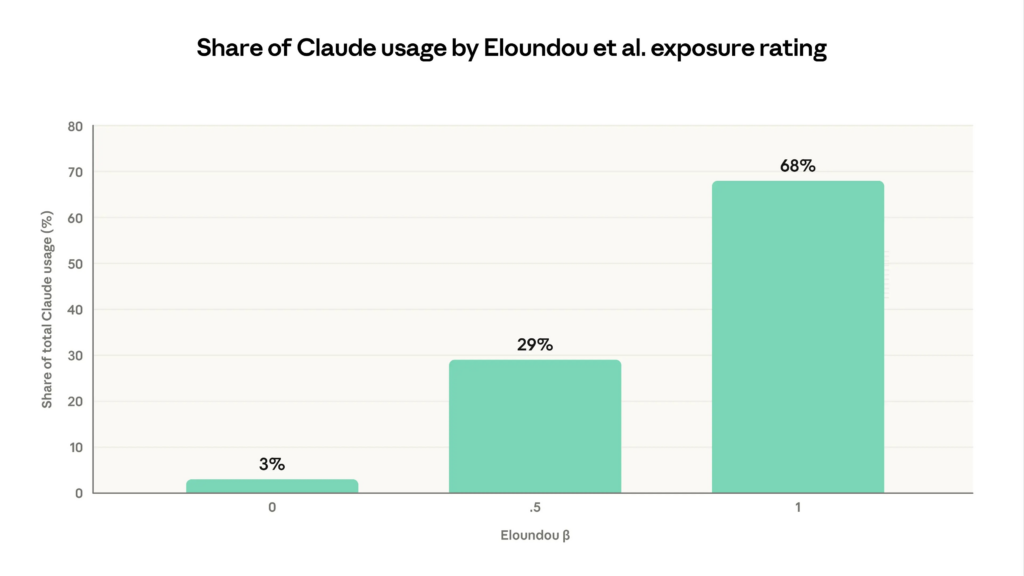
Assessment of Claude usage for performing specific tasks based on the Eloundou metric. Source: Anthropic.
However, researchers emphasize that this score reflects only theoretical potential. In reality, many tasks that could be automated are not yet performed by AI due to technical limitations or lack of infrastructure.
Gap Between Theory and Practice
One key finding of the study is the large gap between AI’s theoretical capabilities and its actual use. According to the analysis, about 97% of tasks in the Anthropic Economic Index data fall into categories with high or medium potential automation (scores 1 and 0.5 on the Eloundou scale). However, this does not mean AI actually performs most of these tasks.
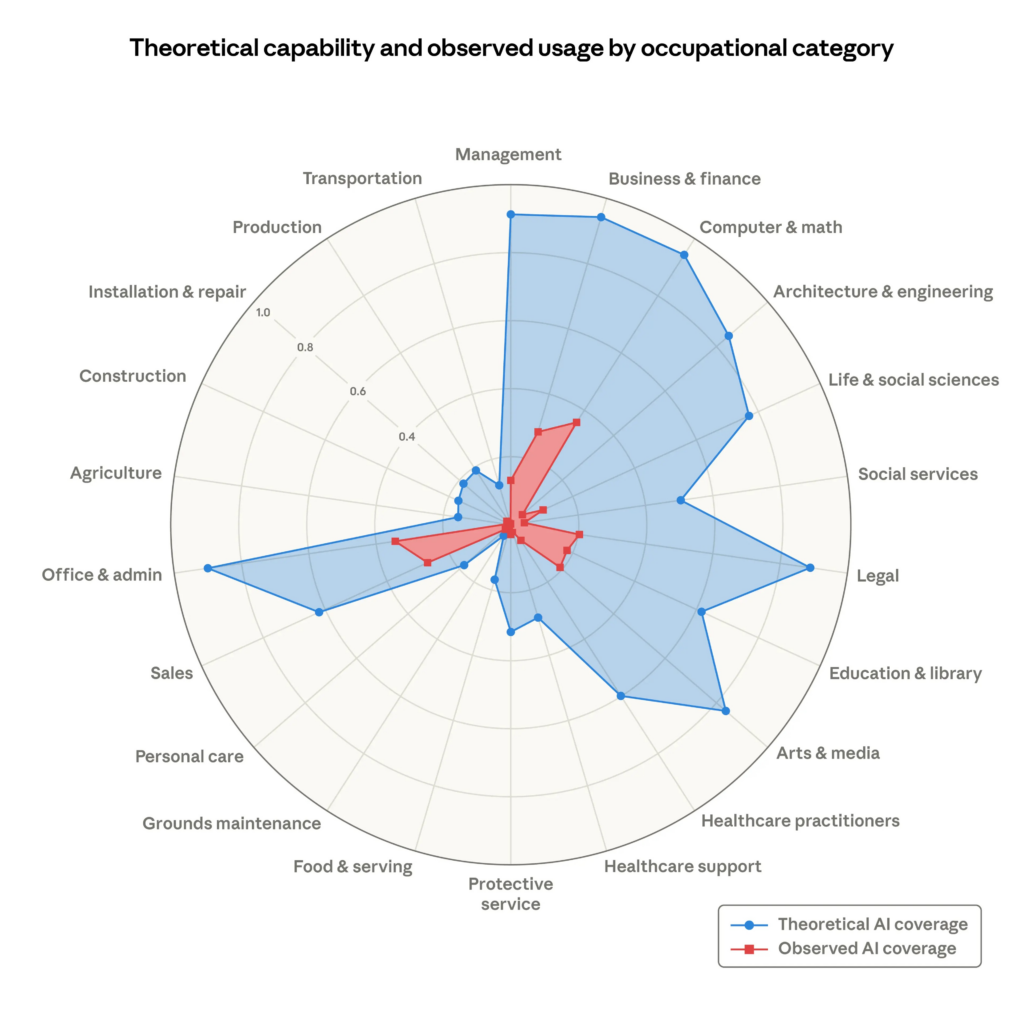
Real and theoretical levels of AI involvement in performing various tasks. Source: Anthropic.
The “observed exposure” metric shows a much more modest picture. For example, in the “computer technology and mathematics” field, the theoretical degree of task automation reaches around 94%, but in practice, AI participates in only about 33% of workflows. This means real-world adoption still lags significantly behind its potential.
As infrastructure and tools develop, the share of automation may increase. However, some sectors remain almost outside the influence of modern language models, such as:
- Agriculture
- Manufacturing occupations
- Physical labor
Most Vulnerable Professions
Based on the analysis, the company identified ten professional areas where AI’s potential impact could be highest. These are primarily professions related to information processing and digital tasks, including:
- Programmers
- Data analysts
- Information specialists
- Financial analysts
- Customer support staff
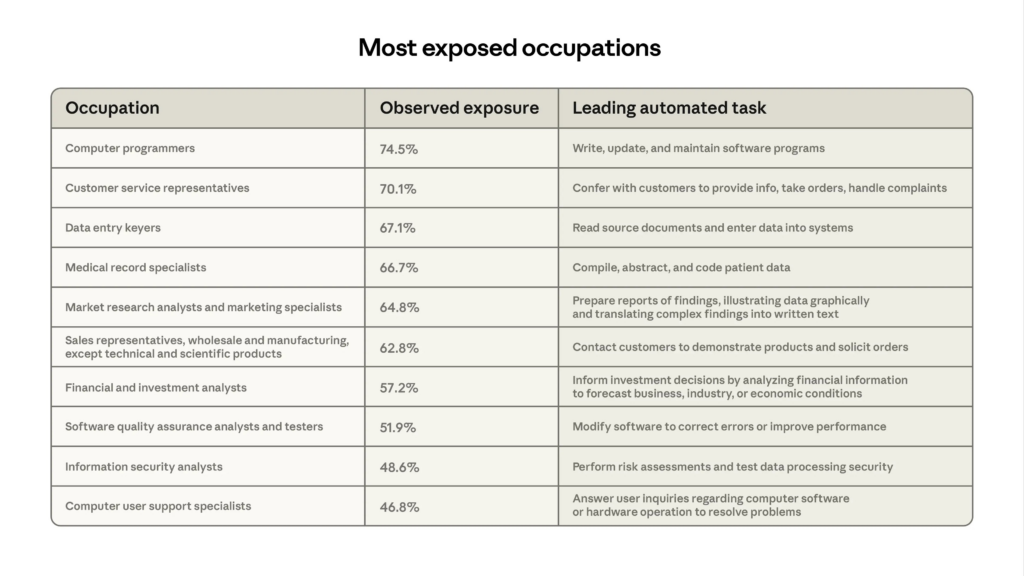
Occupations with the highest potential level of AI involvement. Source: Anthropic.
The common feature of these professions is a significant portion of work with text, data, or digital systems. At the same time, many professions were practically excluded from the analysis because their tasks rarely appear in digital systems and are almost absent from the O*NET database. Examples include:
- Cooks
- Mechanics
- Rescuers
- Bartenders
- Dishwashers
- Cloakroom attendants
The work of these specialists still requires physical presence and practical skills that modern language models cannot replicate.
AI and Employment
Researchers also compared AI usage data with employment projections published by the U.S. Department of Labor. Results were unexpected: AI is more often applied in professions where employment is projected to grow through 2034. Thus, automation does not necessarily mean job loss. In many cases, AI is used as a tool to increase efficiency rather than replace employees.
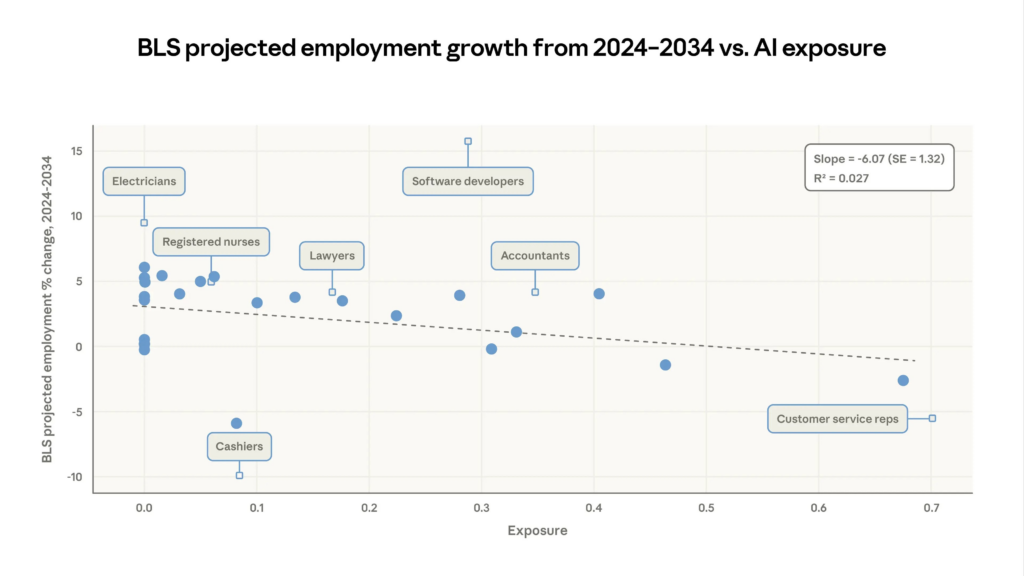
Comparison of occupations in vulnerable categories with projected job growth. Source: Anthropic.
Social Aspects of Impact
The study revealed interesting demographic patterns. In professions most affected by AI, women are 15.5 percentage points more likely, white men 10.6 points, and Asians 4.4 points more likely to be present.
Moreover, individuals in these professions earn on average 47% higher salaries and have higher education levels. This suggests that AI adoption currently affects primarily highly skilled and relatively well-paid occupations.
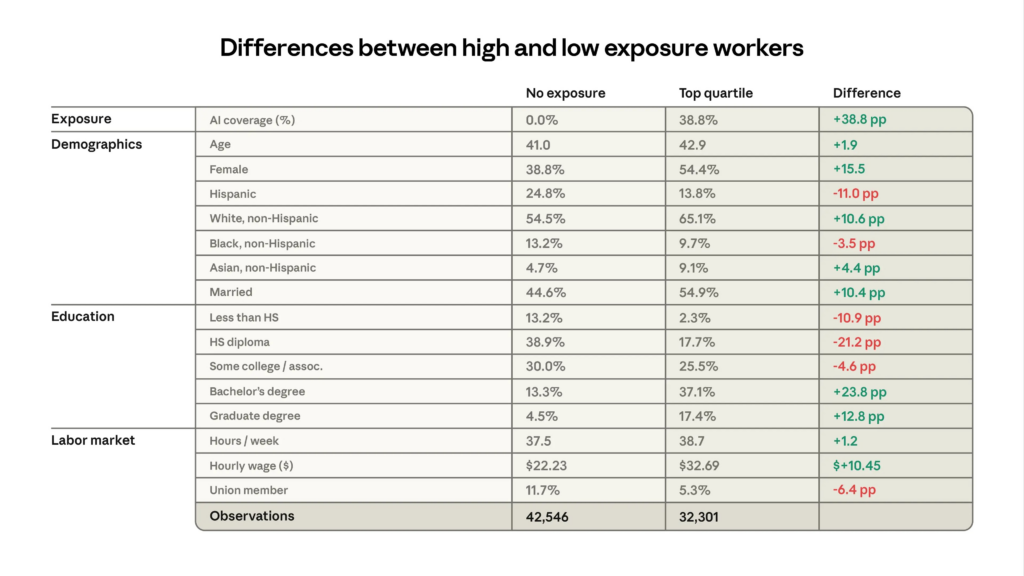
Difference between occupations more and less exposed to AI impact. Source: Anthropic.
Impact on Unemployment
A key question was whether AI adoption increases unemployment. Experts compared unemployment levels in two groups: professions with high potential AI exposure and those with low exposure.
The analysis covered 2016–2025, including the period after ChatGPT’s emergence. Results show no significant increase in unemployment. Among high-exposure professions, unemployment was slightly higher, but the difference was minimal and statistically near zero.
However, the study found one notable signal. Among young workers aged 22–25, employment in high-automation-risk professions declined by 6–16%, suggesting slower hiring of young specialists in these areas. After ChatGPT, average hiring decline in high-AI-use professions is around 14%. Researchers emphasize these changes are not yet statistically significant.
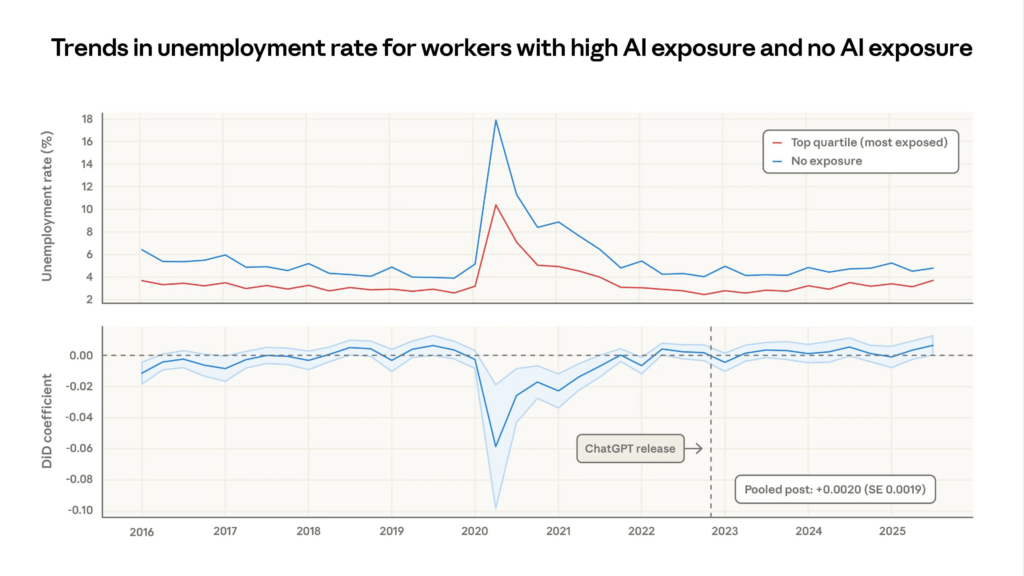
Comparison of unemployment growth rates between two categories of workers. Source: Anthropic.
Implications for the Labor Market
According to Anthropic experts, current data do not support a scenario of mass worker displacement by AI. Even in professions where the technology is actively used — such as programmers, support specialists, and financial analysts — significant unemployment increases have not been observed. However, signs of structural changes in the labor market are already emerging, including:
- Slower hiring of young specialists
- Increased AI use in knowledge-intensive professions
- Growing role of technology as a productivity-enhancing tool
В Anthropic підкреслюють, що запропонований підхід до вимірювання впливу штучного інтелекту — лише перший крок до більш точної оцінки впливу технології на економіку. Методологія буде доопрацьовуватися, а нові дослідження компанії враховуватимуть додаткові фактори та змінні.
У міру розвитку ШІ та його інтеграції в робочі процеси картина може значно змінитися, проте наразі штучний інтелект скоріше трансформує ринок праці, ніж призводить до його радикального скорочення.
All content provided on this website (https://wildinwest.com/) -including attachments, links, or referenced materials — is for informative and entertainment purposes only and should not be considered as financial advice. Third-party materials remain the property of their respective owners.