

The sharp rise in diesel prices amid the conflict around Iran has become one of the clearest indicators of how geopolitics instantly impacts the real economy. However, the picture turned out to be uneven: some countries experienced a near shock, while others barely felt any change.
Looking at the numbers, the absolute leader is Philippines, where diesel prices surged by 81.6%. It is followed by Nigeria with an increase of 78.3%. These two figures already set the tone: this is not just fluctuation, but a full-scale price shock directly affecting transport, logistics, and cost of living.
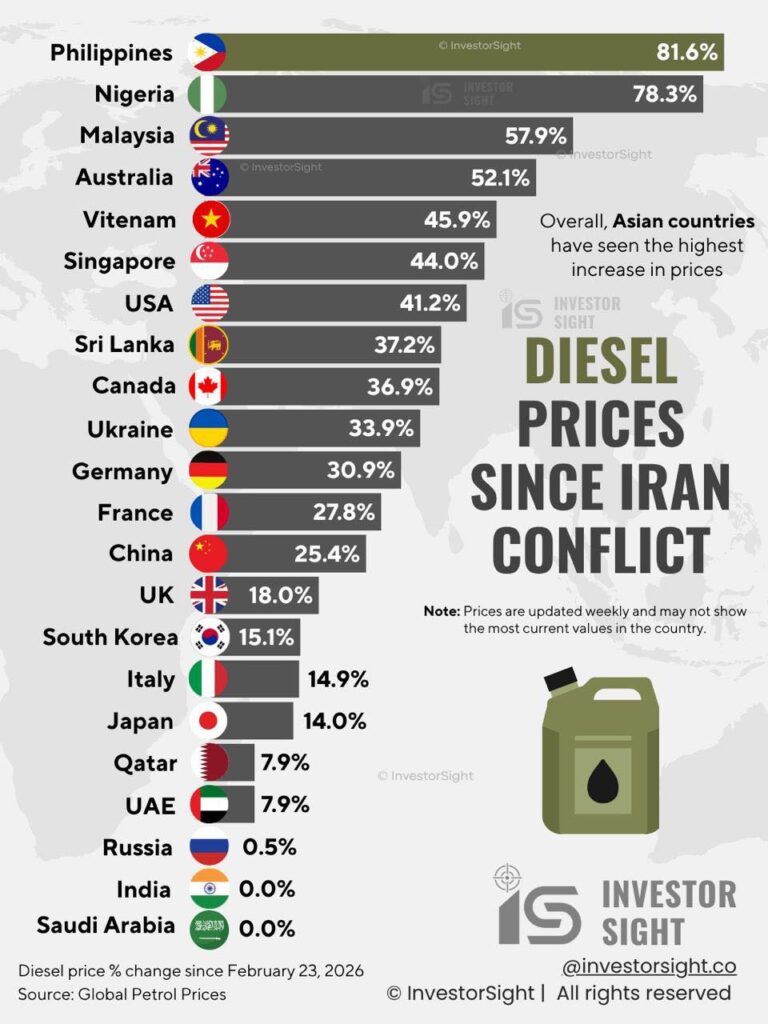
The rest of the list is mostly Asia. Malaysia (+57.9%), Vietnam (+45.9%), Singapore (+44%). Even developed economies in the region, such as Australia (+52.1%), came under significant pressure. This confirms a key point: Asia is more dependent than others on energy imports and shipping routes through the Middle East.
For comparison, in United States the increase was 41.2% – still significant, but without panic dynamics. In Canada it was 36.9%, and in Ukraine 33.9%. Europe appears relatively restrained: Germany (+30.9%), France (+27.8%), United Kingdom (+18%).
But the most interesting part comes next. In Qatar and United Arab Emirates, the increase was only 7.9%, while in Saudi Arabia and India it was 0%. In other words, countries that either produce oil themselves or strictly regulate prices effectively insulated their domestic markets from the external shock.
Why Asia pays the most
The reason is quite straightforward, without conspiracy theories. Most Asian countries are heavily dependent on fuel imports and maritime routes, including the Strait of Hormuz. Any risk in this region is immediately reflected in prices through insurance premiums, logistics costs, and expectations of shortages.
The second issue is weak subsidy systems. Unlike Gulf countries, where governments can absorb price increases, many Asian economies simply pass them on to consumers.
Why oil-producing countries barely felt the crisis
For producers, the situation is the opposite. Saudi Arabia, United Arab Emirates, and Qatar control both production and domestic pricing. This allows them to smooth out external shocks.
In simple terms: when oil prices rise, they earn more – and can afford not to pass the increase on to their citizens.
What this means for the economy
The rise in diesel prices is not just about fuel stations. It means:
- higher logistics costs
- higher food prices
- inflationary pressure
- lower business margins
Diesel is the backbone of freight transport. If it rises by 50-80%, prices across almost all goods increase accordingly.
The market once again showed a simple but uncomfortable truth: in geopolitics, it is not the producer who pays, but the one who depends. And if the conflict drags on, current numbers may not represent a peak, but only the beginning of a new price reality, where energy once again becomes the main driver of economic pressure.
All content provided on this website (https://wildinwest.com/) -including attachments, links, or referenced materials — is for informative and entertainment purposes only and should not be considered as financial advice. Third-party materials remain the property of their respective owners.