

A platform for selling products to AI agents has been launched
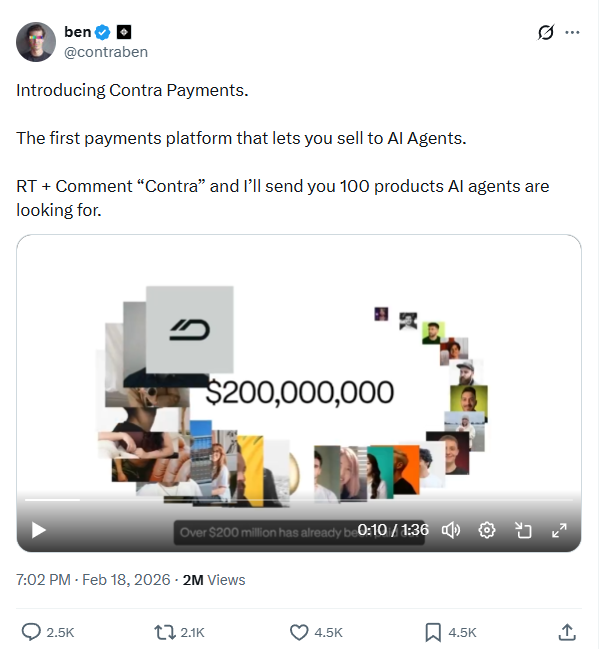
It seems that artificial intelligence has finally stepped out of the role of a tool and begun to assume the role of a customer. The Contra Payments platform has been introduced — the first payment service that allows selling digital products directly to AI agents.
Until recently, AI agents mainly generated text, images, and code. Now they are becoming participants in the economy: independently searching for the products they need, paying for access, and integrating purchased content into their workflows. This includes specialized datasets, API access, templates, automation tools, models, scripts, digital assets, and other products that can be used by machines without human involvement.
According to the developers, the platform’s turnover has already exceeded 200 million dollars. This means that transactions between algorithms and creators of digital products have moved beyond experimentation and are turning into a sustainable market.

In effect, a new economic model is emerging: a human produces a digital asset, and the buyer is not another person or a company in the traditional sense, but an autonomous AI agent acting on behalf of a business or user. In this framework, algorithms receive budgets, make purchasing decisions, and manage spending within predefined parameters.
The platform’s creators state that Contra Payments is the first infrastructure layer specifically designed for sales to AI agents. In other words, it is not just a marketplace, but a system adapted for machine-driven transactions: automated payments, programmable limits, and integration with agent-based systems.
An additional marketing move is the offer to send a list of 100 products that AI agents are currently “looking for” to anyone who reposts and leaves a comment. This reinforces the project’s main thesis: demand is being shaped not directly by humans, but by algorithms that continuously analyze tasks and acquire the necessary tools.
Against this backdrop, a logical question arises. If AI agents can already spend money independently, enter into transactions, and participate in hundreds of millions of dollars in turnover, where is the line between a tool and an economic entity? And if algorithms become active market participants, will we eventually need to discuss separate rules for their regulation, reporting, and possibly taxation?
For now, it sounds ironic. But history shows that technologies first appear as toys or curiosities, then become services, and eventually evolve into full-fledged infrastructure. A platform for selling to AI agents is another step toward an economy in which algorithms not only create value, but also purchase it independently.
A video fragment demonstrating the platform can be viewed on our Telegram channel.
All content provided on this website (https://wildinwest.com/) -including attachments, links, or referenced materials — is for informative and entertainment purposes only and should not be considered as financial advice. Third-party materials remain the property of their respective owners.