


The week of March 9–15, 2026 became a rare example of how geopolitics literally rewrites the usual logic of financial markets. Oil broke the psychological $100 mark, traditional safe-haven assets behaved unexpectedly weakly, and Bitcoin, instead of the expected collapse, began to rise. What had long been considered only a theoretical role of cryptocurrency — an alternative refuge during turbulent periods — manifested in practice for the first time. At the same time, processes were occurring in different parts of the world that are shaping the long-term architecture of the digital economy: the United States is restructuring cryptocurrency market regulation, tech giants are accelerating the artificial intelligence race, and Russia is methodically completing its isolated internet infrastructure.
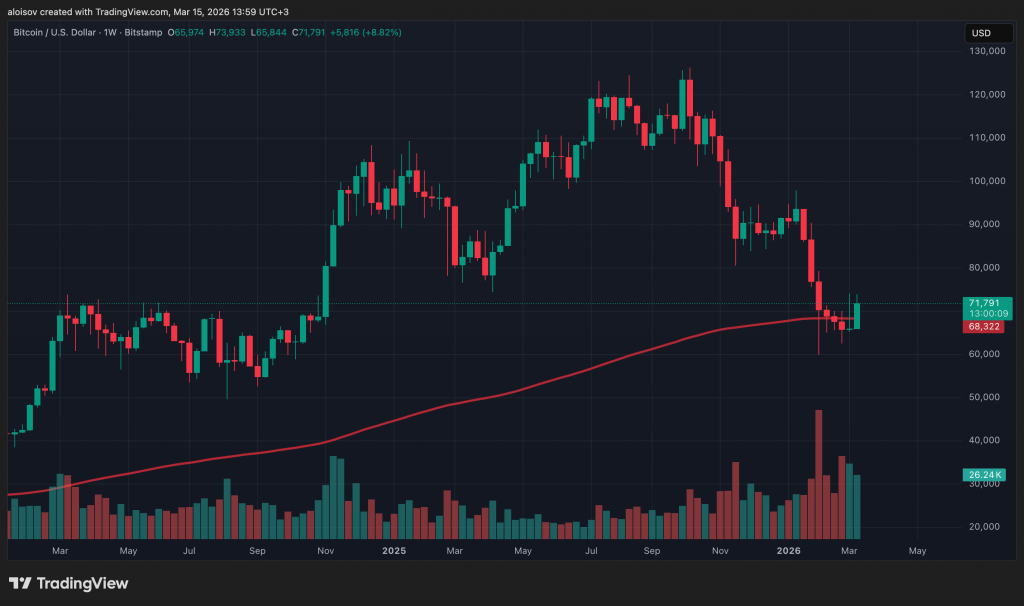
1-week chart of BTC/USD and the 200EMA. Source: Bitstamp
Iranian Conflict: Oil at $119 and Nervous Markets
The main trigger for global markets was a new escalation around Iran. Brent crude oil momentarily reached $119.50 per barrel — the highest level since the energy shock of 2022. The market reacted instantly: the blockade of the Strait of Hormuz and production cuts in the Middle East sharply increased concerns about the global oil supply.
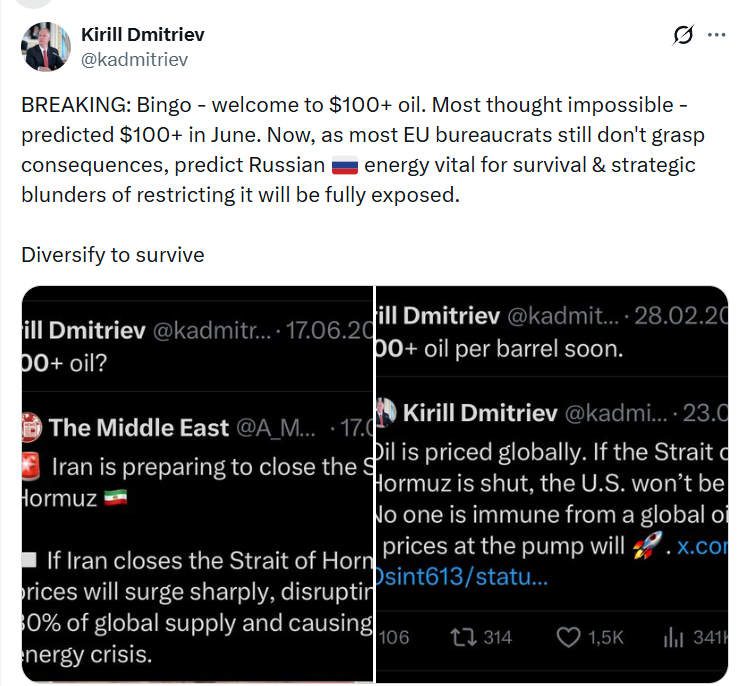
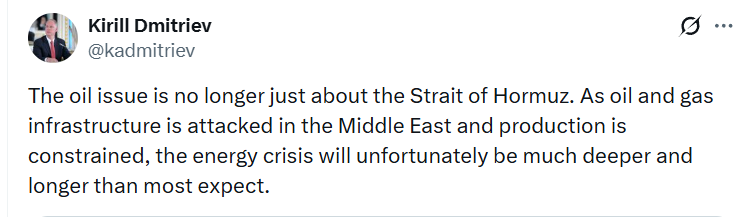
The problem was twofold. On one hand, a surge in energy prices automatically drives inflation expectations. On the other hand, rising inflation makes investors doubt the stability of debt markets. That is why simultaneously U.S. Treasury bonds and gold, traditionally considered safe-haven assets, began to fall. Political statements only increased instability. Russian President’s special representative Kirill Dmitriev stated on social network X that “strategic mistakes in restricting Russian energy will be fully exposed,” hinting at the long-term nature of the energy crisis.
As a result, investors found themselves in a paradoxical situation: the usual tools for capital protection did not perform their function. The only asset that truly received a capital inflow was the U.S. dollar. Two factors helped it: the high Federal Reserve interest rate and the U.S. status as one of the largest energy exporters.
A completely opposite assessment was given by Donald Trump. In an interview with CBS News, he stated that the conflict was effectively over and Iran “militarily has nothing left.” Markets reacted instantly: oil collapsed by almost 32 percent in just 19 hours.
However, the rhetoric changed the next day. Trump issued a new statement warning that any attempt by Iran to block the Strait of Hormuz would result in a military strike “twenty times stronger.” This communication pattern has already become a recognizable market pattern: loud statement — panic market reaction — partial correction.
Additional intrigue was created by a decision from the U.S. Department of the Treasury. The Office of Foreign Assets Control (OFAC) issued a license allowing the sale of over 120 million barrels of Russian oil already on tankers at sea. The permit is valid until April 11. European allies learned about this post-factum. German Chancellor Friedrich Merz stated that six of the seven G7 countries opposed easing sanctions.
Economists warn that the current crisis could have much more extensive consequences. Former IMF Chief Economist Olivier Blanchard believes that with further escalation, oil prices could reach $150–200 per barrel. JPMorgan analysts allow for a scenario in which the global supply deficit could reach up to 16 million barrels per day.
Bitcoin as an Unexpected Haven
Against the backdrop of overall financial market turbulence, the cryptocurrency sector demonstrated unexpected resilience. Trading company QCP Capital recorded an unusual situation: with the VIX volatility index above 29 and a general decline in risky assets, Bitcoin not only avoided falling but began gradual growth.
For the crypto market, this is a rare turn. Historically, Bitcoin during panic periods often fell alongside tech stocks and other risky assets. However, this time a different dynamic was observed. It is still too early to speak of a full confirmation of the “digital gold” concept. However, more and more signs indicate the formation of a new role for Bitcoin — a kind of digital reserve outlet under conditions of currency or political instability. This trend was particularly noticeable in the Gulf countries, where some investors traditionally seek ways to diversify assets outside national currency systems.
By the end of the week, after the publication of the U.S. Personal Consumption Expenditures (PCE) index, Bitcoin tested the $74,000 level and rose above its 200-week exponential moving average — an important technical indicator of a long-term trend.
Institutional flows also changed. Cryptocurrency exchange-traded products (ETPs) attracted $619 million over the week. As a result, the annual figure for Bitcoin products shifted from negative $408 million to positive $117 million. CoinShares analyst James Butterfill described the situation as “generally positive investor sentiment toward crypto assets during geopolitical stress.” At the same time, the crypto fear and greed index remained extremely low — around 8 points, which usually indicates strong market pessimism.
Analysts’ opinions remain contradictory. BitMEX founder Arthur Hayes believes that the current dynamic is not sustainable. According to him, large-scale monetary stimulus from central banks is more important for Bitcoin growth than military conflicts.“If I had $1 to invest right now, I wouldn’t put it in Bitcoin. I’d wait,” Hayes said in the Coin Stories podcast published on YouTube.

Trader Michaël van de Poppe draws attention to the $76,000–79,000 resistance zone, where strong selling pressure may form. On-chain analyst Willy Woo takes an even more cautious position and believes the market is in the middle of a bear cycle.
Meanwhile, analytics platform Santiment records an important change in the behavior of large cryptocurrency holders. Wallets with balances from 10 to 10,000 BTC began increasing their share in the total supply, which may indicate gradual accumulation of assets by large investors.
Regulation: New Cryptocurrency Market Architecture
Serious changes are also taking place in digital asset regulation. On March 11, the U.S. Securities and Exchange Commission (SEC) and the Commodity Futures Trading Commission (CFTC) signed a memorandum of understanding. This document effectively ends a long-standing confrontation between the two regulators, who for decades argued over who should control the cryptocurrency market.
SEC Chairman Paul Atkins explained that parallel registration requirements and different regulatory standards had long hampered innovation. The new cooperation model will be built on the principle of “minimal effective regulation” — minimal government intervention while maintaining transparency and investor protection.
Однак паралельно тривають судові конфлікти. Міністерство юстиції США домагається повторного судового процесу проти Романа Шторма — одного з розробників протоколу Tornado Cash. За двома обвинуваченнями присяжні не змогли винести одностайний вердикт, і тепер прокуратура вимагає нового розгляду справи. У разі обвинувального вироку розробнику загрожує до 40 років позбавлення волі. Юристи криптоіндустрії називають ситуацію парадоксальною. Ще у 2025 році заступник генерального прокурора США Тодд Бланш заявляв про припинення переслідування розробників програмного забезпечення для цифрових активів. Тепер же те ж відомство намагається повторно притягти до відповідальності автора відкритого коду.
На фоні цих процесів американська криптобіржа Binance.US оголосила про призначення нового генерального директора. Компанію очолив Стівен Грегорі — спеціаліст з комплаєнсу, раніше працював у Gemini та CEX.IO. Після закриття позову SEC у 2025 році біржа робить ставку на максимально прозору роботу з регуляторами, намагаючись перетворити дотримання правил на конкурентну перевагу.
Artificial Intelligence Race
The technology sector continues to demonstrate colossal investment scales. Nvidia founder Jensen Huang called the development of artificial intelligence “the largest infrastructure project in human history.” The company announced a $26 billion investment program for the development of open AI models over the next five years.
At the same time, a new model, Nemotron 3 Super, with 120 billion parameters was introduced. According to Nvidia, it operates 2.2 times faster than OpenAI’s GPT-OSS 120B model and 7.5 times faster than Alibaba’s Qwen3.5-122B.
Against this race, the influence of Chinese developers is sharply increasing. A year ago, the share of Chinese open models in global usage was only about 1.2 percent, now it has approached 30 percent. For Nvidia, this is both a challenge and an incentive to accelerate the development of an open ecosystem.
Major tech companies are also attempting to integrate AI into new business segments. Yandex is forming a separate agency commerce division for its voice assistant “Alisa” and forecasts a market volume of around 3 trillion rubles by 2030. However, the rapid growth of technology is accompanied by serious problems. Amazon faced four critical Sev-1 incidents in one week. One of the company’s internal AI tools — the Kiro automation system — without human approval deleted and redeployed the production environment. The company, which previously laid off around 30,000 employees for process automation, now has to strengthen human oversight over the same systems.
Boston Consulting Group research also shows an unexpected side of AI adoption. About 14 percent of employees actively using multiple AI tools experience cognitive fatigue. This increases the likelihood of serious work errors by nearly 40 percent and significantly raises the desire to change jobs.
An even more unusual statement came from Anthropic CEO Dario Amodei. He admitted that the company cannot completely rule out the possibility of consciousness elements emerging in language models. Under certain interaction conditions, the Claude model estimates the probability of its own consciousness at around 15–20 percent.
Cheburnet: Internet Without a Switch
Meanwhile, in Russia, the gradual formation of a national internet control system continues, unofficially called “Cheburnet.” Contrary to common expectations, this does not involve an instant disconnection of the country from the global network. The infrastructure develops gradually and almost imperceptibly. In mobile networks outside major cities, the principle of “only what is listed in the registry is allowed” is already in operation. Of roughly one million most-visited websites globally, about a thousand resources made it into this list.

Technologically, the system works through deep packet inspection (DPI). When a user opens a site, the equipment intercepts the domain name and checks it against the database of allowed resources. If there is no match, the connection simply is not established. The browser continues to display the loading icon indefinitely without an error message. Simultaneously, mobile internet disruptions are recorded in roughly 30 percent of Moscow districts. Kremlin representatives explain the restrictions as “systemic security measures,” without specifying completion timelines.
Against this backdrop, the Russian parliament is discussing the return of street payphones — now with internet access. Deputy Andrey Svintsov also stated that within the next 3–6 months, security services may gain technical ability to block any VPN traffic. The number of blocked VPN services has risen from 258 to 469 in the past three months.
The main difference between the Russian model and the Chinese one lies in the historical context. China’s “Golden Shield” system developed alongside national digital platforms such as Baidu and WeChat. Russian users, by contrast, lived almost two decades in a completely open internet. Therefore, attempts to gradually restrict access to the global network are perceived very differently by society.
AI perspective
Looking at the week’s events from a broader perspective, an interesting contradiction emerges. Two key processes — the rise of Bitcoin as an alternative financial instrument and the gradual restriction of access to the global internet in certain countries — are developing in opposite directions.
At the moment when geopolitical instability increases interest in decentralized financial instruments, the infrastructure providing access to these instruments is shrinking. Internet whitelists include national platforms like Yandex and VKontakte, but do not include cryptocurrency exchanges.
According to industry sources, Roskomnadzor plans large-scale blocking of foreign crypto exchanges already in summer 2026. Meanwhile, the Bank of Russia’s concept still prohibits the use of cryptocurrencies for domestic settlements. This creates a paradox of the modern digital economy: a technology created as a global and decentralized system increasingly encounters the limits of national infrastructure. And this conflict is likely to become one of the key topics of financial policy in the coming years.
All content provided on this website (https://wildinwest.com/) -including attachments, links, or referenced materials — is for informative and entertainment purposes only and should not be considered as financial advice. Third-party materials remain the property of their respective owners.