


? Moxie Marlinspike is known first of all as the creator of the secure messenger Signal, which has become the gold standard of safe communication. He is considered one of the main ideologists of privacy in the digital world, a person who demonstrates in practice how technologies can protect personal data and freedom of speech.
At the same time Marlinspike actively criticizes Web3, cryptocurrencies and NFTs. He believes that the decentralized future that enthusiasts love to talk about is in reality an illusion that hides old centralized control schemes, only more complex and opaque.
Who is Moxie Marlinspike?
Moxie Marlinspike (real name — Matthew Rosenfeld) is a key figure in the world of cryptography, information security, systems for bypassing censorship and ensuring anonymity online.
In 2013 he founded Open Whisper Systems, which later transformed into the nonprofit Signal Foundation. Its main product is the Signal messenger, which uses the end-to-end encryption protocol Signal Protocol, now applied in messengers such as WhatsApp and Google Messages.
Marlinspike approaches technology pragmatically: he values not ideological purity but the user result — simplicity, reliability and real privacy. This approach became the basis of his skeptical stance toward Web3, which he first detailed in his personal blog in 2022.
Main criticism of Web3
1. People don’t want to run their own servers
Marlinspike’s main thesis is that Web3 does not solve the key problem of the internet — dependence on providers. Most users are not ready and will not run their own servers to work with applications. Convenience is more important than ideology.
Web3 applications position themselves as decentralized, but in practice almost all interact with the blockchain through centralized services. For example, wallets like MetaMask or Phantom by default use Infura or Alchemy to work with the Ethereum or Solana networks.
This creates a classic architecture with a centralized point of failure. If providers shut down or impose censorship, most applications will stop working. According to Marlinspike, Web3 merely replaces one form of centralization with another, more complex and less transparent.
2. Illusion of ownership: NFT
To demonstrate the weakness of non-fungible tokens, Marlinspike conducted an experiment with his own NFT. He created a token whose image changed depending on the platform where it was viewed: OpenSea, Rarible or the user’s wallet.
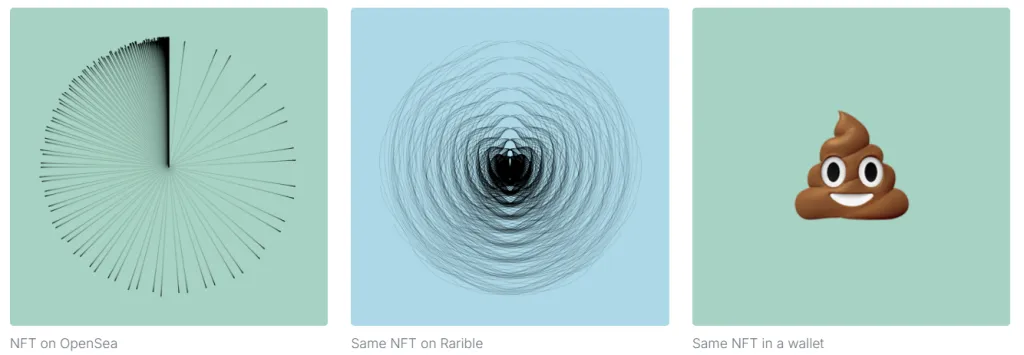
Source: Marlinspike’s blog
The experiment demonstrated that NFTs do not store the media file on the blockchain. The blockchain contains only a token with a link to a file stored on a regular server controlled by a third party. At any moment the server owner can modify or delete the content.
Conclusion: the NFT buyer acquires not the digital object itself but only a record in the distributed ledger that points to it. True control of the asset remains with the creator or the server owner, which undermines the idea of immutable ownership promoted by NFT supporters.
3. Centralized points of failure
Marlinspike’s criticism received practical confirmation in August 2022, when the United States imposed sanctions on Tornado Cash. After that Infura and Alchemy blocked access to the service’s smart contracts. As a result many Web3 applications using their APIs lost the ability to interact with the mixer.
This case showed that the decentralized ecosystem still depends on centralized providers who must comply with regulatory demands.
Ethereum cofounder Vitalik Buterin partly agreed with the criticism, acknowledging the dependency problem on centralized APIs, but noted that the development of “light” clients that do not require full blockchain downloading will eventually allow users to interact with the network directly.
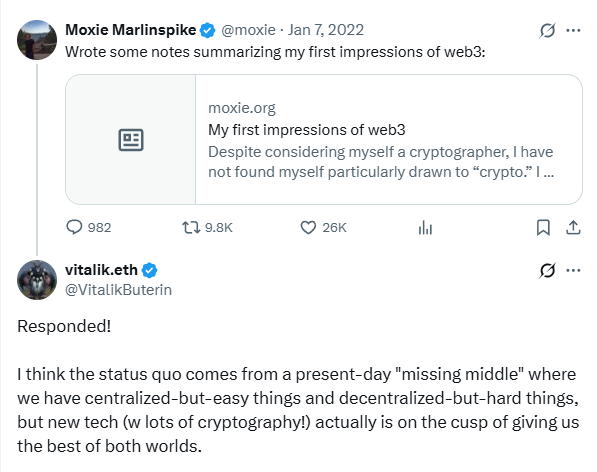
It seems to me that the current situation is explained by the “missing link” of modernity: we have either centralized but simple solutions, or decentralized but complex ones. But new technologies (with lots of cryptography!) are already on the verge of giving us the best of both worlds.
The MobileCoin paradox
Marlinspike’s position may seem contradictory, since Signal integrated the cryptocurrency MobileCoin (MOB). But there is no direct conflict:
- Marlinspike criticizes Web3 and its false claims of decentralization, not cryptography itself.
- MobileCoin is a cryptocurrency focused on transaction privacy, which aligns with Signal’s philosophy.
In other words, technology and marketing packaging are different things. Marlinspike uses cryptographic tools where they make sense but rejects the idea that current Web3 can radically transform the internet.
? Conclusions and Marlinspike’s position
At the beginning of 2022 Marlinspike left his position as CEO of Signal to focus on his own research. He urges the industry to:
- Evaluate the real state of affairs rather than marketing slogans
- Focus on fundamental infrastructure problems
- Create systems that truly give the user control, privacy and independence rather than the illusion of decentralization
His criticism emphasizes the importance of pragmatism in technology, especially concerning security and privacy in the digital world.
All content provided on this website (https://wildinwest.com/) -including attachments, links, or referenced materials — is for informative and entertainment purposes only and should not be considered as financial advice. Third-party materials remain the property of their respective owners.