


Senator Elizabeth Warren effectively opened a new front in the discussion about cryptocurrencies — and this time the focus was not on an exchange giant or a DeFi protocol, but on one of the most influential media figures in the world, MrBeast. The reason was his involvement in the fintech project Step, aimed at teenagers, and potential plans for implementing crypto and DeFi tools.
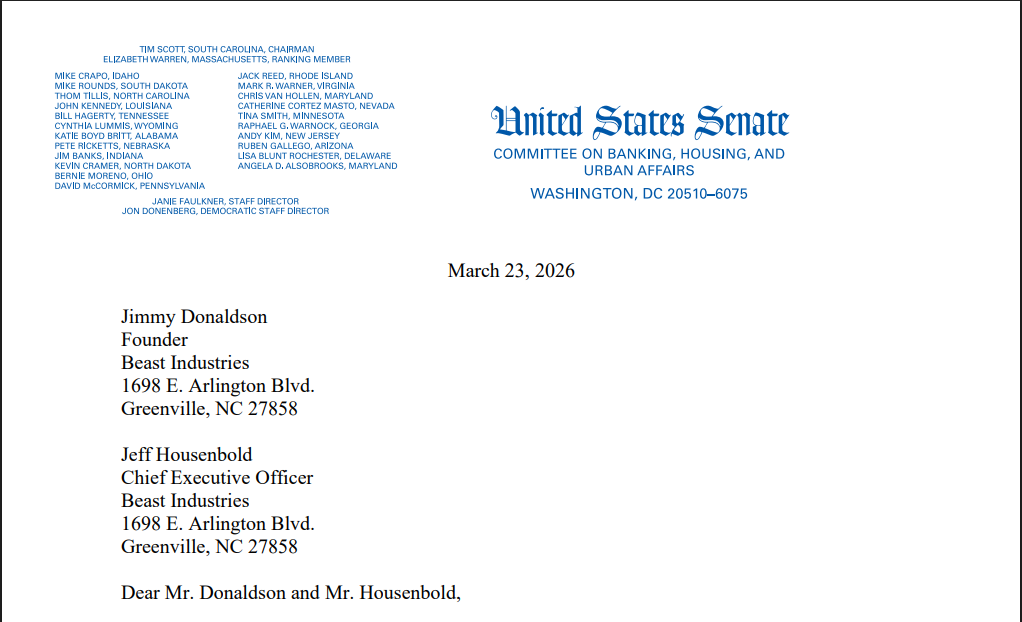
The story began with an official letter from Warren to Donaldson and CEO of Beast Industries, Jeff Hausenbold. Formally — it is a request for clarification. Essentially — a signal to the market and industry: any attempts to combine cryptocurrencies and a young audience will now be under close regulatory scrutiny. Especially if it concerns products for minors.
At the center of criticism is the Step app — a fintech platform originally positioned as “the first banking experience” for teenagers. Previously, the company actively promoted the idea of early exposure to investments, including cryptocurrencies. By 2022, Step stated that it became one of the first platforms allowing teenagers to buy and sell Bitcoin with parental consent.
At first glance — a step toward financial literacy. But, as Warren emphasizes, the problem is not access itself, but how this access was presented. According to the senator, the platform not only provided the technical ability to invest but actively generated interest in high-risk assets through marketing.
The content effectively taught teenagers to persuade their parents to invest in crypto, compared Bitcoin with large company stocks, creating the illusion of comparable risk. At the same time, the company acknowledged in other materials that crypto assets and NFTs are “extremely risky” and “speculative.” This dissonance became one of the key claims: the market can be taught, but education cannot be replaced with marketing.
A separate block of questions is related to security and risk management. Warren reminded about Step’s partnership with Evolve Bank & Trust, which was previously at the center of a scandal with up to $96 million of missing client funds. Add the 2024 data breach and regulators’ complaints about internal processes — and it becomes clear why the senator questions the platform’s readiness to expand functionality.
The situation is complicated by the fact that Step has already changed owners. In 2026, it was acquired by Beast Industries — a structure associated with MrBeast, which previously raised about $200 million in investments from crypto-oriented players, including BitMine. This automatically increased expectations that the platform could move again toward crypto, but now at a new level — with DeFi integration and expanded financial services.

Indirect confirmation of these plans was the filing of the MrBeast Financial trademark. The description mentions crypto trading, crypto payments, and integration with decentralized financial instruments. If these plans are realized, it will no longer be just an app for teenagers, but a full financial ecosystem with a crypto component. This is where Warren makes the key emphasis. In her opinion, the combination of three factors — young audience, aggressive marketing, and high-risk assets — creates a potentially dangerous combination. Especially when the crypto industry itself is still in the stage of forming rules and standards.
In her letter, the senator asked the company 11 specific questions, which effectively outline the future regulatory agenda. Among them — plans to return crypto functions, mechanisms for protecting user funds, approach to creating educational content, and compliance with regulations. This is not just a formality, but an attempt to pre-establish the framework in which such projects can develop.
It is important to understand that this case goes far beyond one company. It reflects a broader trend: regulators are increasingly shifting focus from crypto infrastructure to its interaction with end users, especially when the audience is teenagers.
For MrBeast himself, the situation is also ambiguous. On one hand, his brand is built on audience trust and mass reach. On the other hand, this scale makes any financial initiatives potentially sensitive from a regulatory perspective. Unlike classic fintech companies, here it is not only about the product, but about influencing the behavior of millions of users.
As a result, a demonstrative picture forms. Cryptocurrencies gradually penetrate new segments — from institutional investors to teenage apps. But along with this, pressure from the state increases. And if previously questions were asked to exchanges and funds, now they are increasingly addressed to those who generate demand — platforms, media, and influencers.
The story with Step and MrBeast is not so much a scandal as a signal. The market again reminds: the closer crypto is to the mass user, the less room it has for experimentation without rules. And especially — when it comes to money that is just learning what risk is.
All content provided on this website (https://wildinwest.com/) -including attachments, links, or referenced materials — is for informative and entertainment purposes only and should not be considered as financial advice. Third-party materials remain the property of their respective owners.