


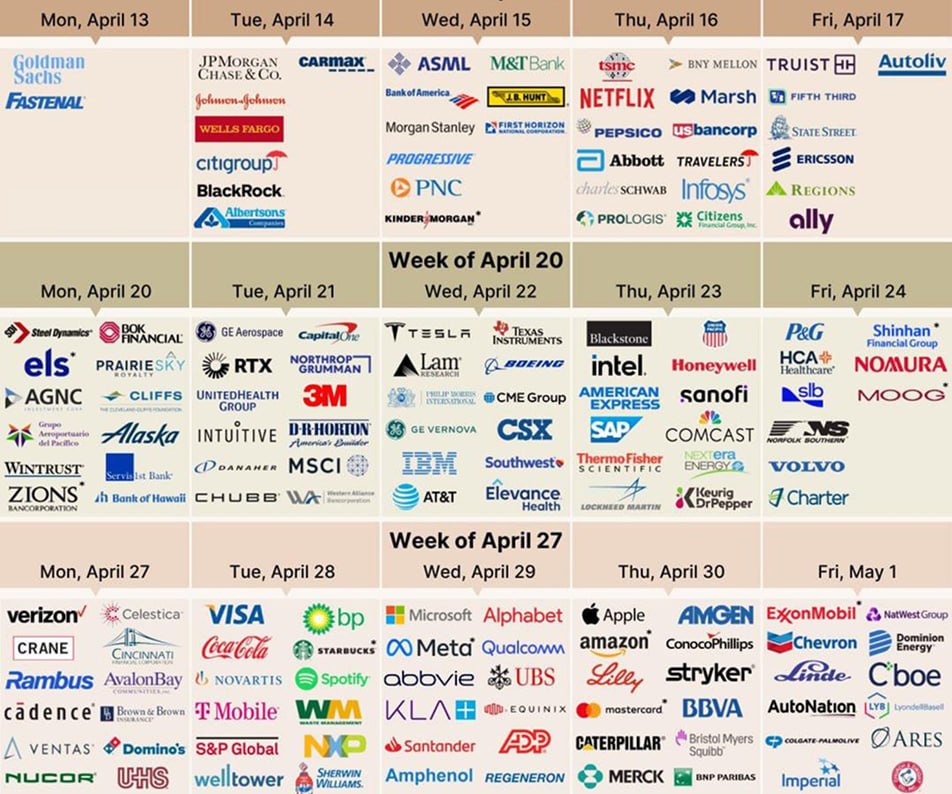
Starting Monday, April 13, the earnings season for companies in the S&P 500 index begins — and this is the period when markets take off their rose-colored glasses and move from expectations to facts. This is exactly when it becomes clear how closely the real economy matches the optimistic scenarios that have been priced into assets over the past months.
At first glance, it looks like a standard corporate routine: companies publish reports, analysts compare numbers with forecasts, and investors draw conclusions. But in practice, these weeks shape the overall market mood. This is the moment when it becomes clear whether growth has a real foundation or is driven mainly by expectations and liquidity. Importantly, the impact of this process has long gone beyond equities — it directly affects crypto assets as well.
The consensus forecast for this season looks fairly strong. Earnings are expected to grow by about 13% year over year, while revenue is projected to increase by 9%. For a mature market, these are solid figures that can support current valuations. However, some major players are even more optimistic. Deutsche Bank suggests that, under favorable conditions for key companies, earnings growth could approach 19%. That would be a scenario where the market receives an additional upward impulse.
Goldman Sachs focuses less on the current quarter’s numbers and more on structural drivers. These include investments in artificial intelligence and a gradual recovery in mergers and acquisitions activity. These factors matter because they create not a one-off effect, but a longer-term trend. If companies indeed increase investment and expansion, this could support the market well beyond a single earnings season.
But as always, the market is not driven only by positive expectations. JPMorgan Chase highlights a set of risks that could quickly change the picture. These include persistent inflation, high oil prices, and the tight monetary policy of the Federal Reserve System. These factors can pressure business margins and limit earnings growth, even if revenue remains stable.
An additional signal of caution comes from UBS, which has already started adjusting long-term expectations. The 2026 index target was lowered from 7,700 to 7,500 points. On the surface, this does not look dramatic, but in market terms it is an important nuance — large players are gradually pricing in a more conservative scenario.
Now the key question — why this directly matters for crypto.
The link between equity markets and cryptocurrencies today is much stronger than it was a few years ago. Bitcoin increasingly behaves like a classic risk asset. It reacts to liquidity, interest rate expectations, and overall risk appetite. As a result, dynamics have become synchronized: when investors are willing to take risk, both stocks and crypto rise; when sentiment shifts, pressure hits all segments.
The logic of movement is quite straightforward. Strong earnings boost confidence, increase risk appetite, and support both equities and crypto markets. Weak results, on the other hand, push investors to reduce exposure and move into safer assets, pressuring all risk instruments at once.
That is why earnings season is not just about corporate news. It is a period when liquidity is redistributed, expectations are recalibrated, and short-term trends are formed across a wide range of assets. Crypto is no longer separate in this process — it is embedded in the same system.
During such periods, volatility becomes almost inevitable. The market starts reacting to every detail: management commentary, forward guidance, even wording in reports. Estimates can be revised within hours, creating an environment where moves become sharp and often disproportionate.
If viewed objectively, earnings season is a kind of stress test for the market. It is not ideas or narratives that are tested, but actual financial results. And whether they match expectations will determine not only the trajectory of the S&P 500, but also the behavior of the crypto market in the coming weeks.
In simple terms, the pattern is clear. First come the numbers — then sentiment changes — and only after that does the money move.
All content provided on this website (https://wildinwest.com/) -including attachments, links, or referenced materials — is for informative and entertainment purposes only and should not be considered as financial advice. Third-party materials remain the property of their respective owners.