

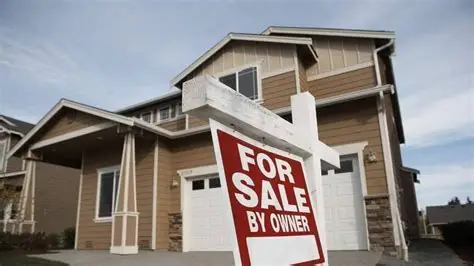
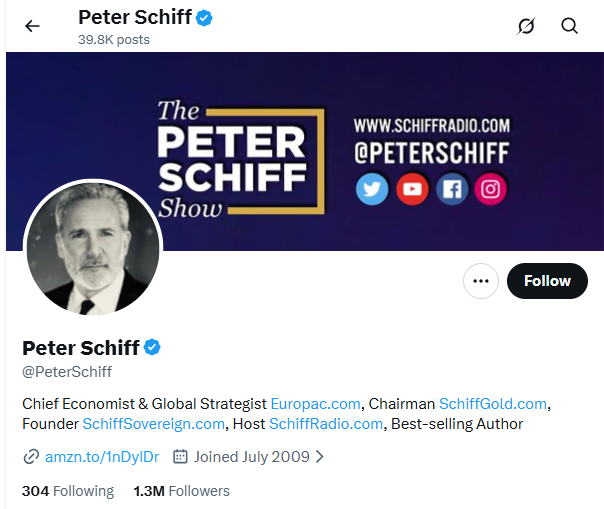
American economist Peter Schiff has once again issued a sharp warning regarding the future of the U.S. real estate market, stating that the country may face a crisis deeper and more painful than the 2008 collapse. His assessment is based not on a single factor, but on a combination of processes which, in his view, have already been set in motion and are gradually intensifying.
On March 25, 2026, Schiff publicly stated that housing affordability in the United States is being systematically eroded by inflation. He draws attention not only to rising mortgage interest rates but also to the entire range of costs borne by property owners.
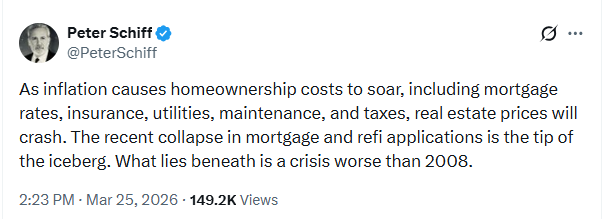
These include insurance, utilities, taxes, and maintenance expenses. All of these elements are increasing simultaneously, creating a cumulative pressure effect. As a result, purchasing real estate is becoming increasingly unaffordable even for the middle class, which has traditionally been the backbone of market demand.
According to Schiff, the decline in mortgage applications and refinancing is only the tip of the iceberg. Formally, the market has not yet shown a sharp collapse in prices, but fundamental indicators already point to a deep imbalance. When demand contracts and ownership costs rise, the market inevitably reaches a correction point. This time, in his view, it could be significantly more severe than in previous cycles.
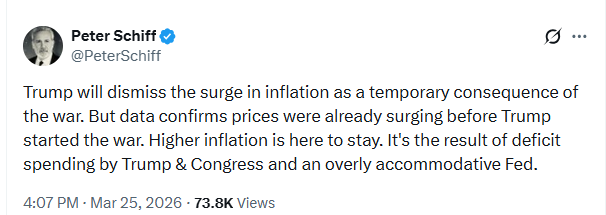
The economist also pays special attention to the geopolitical factor, particularly the conflict surrounding Iran. He emphasizes that inflationary pressure in the United States had already been building before the escalation, but military actions are accelerating this process. Rising energy prices caused by tensions in the Middle East directly affect the economy: transportation costs increase, production becomes more expensive, and prices for goods and services rise.
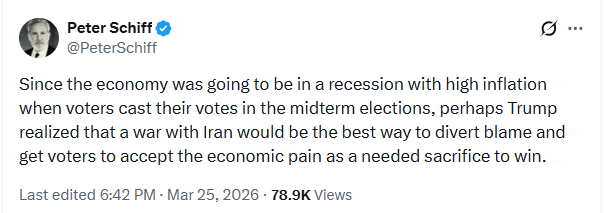
Schiff believes that even if the conflict ends, it will not lead to a rapid decline in inflation. The reason lies in structural problems of the U.S. economy, including the budget deficit and the policy of the Federal Reserve System. In his view, the combination of past loose monetary policy and current tightening efforts creates an unstable environment in which debt burdens become increasingly heavy for the economy.
In his comments, he also suggests that the foreign policy agenda may partially distract public attention from domestic economic problems. At the same time, he analyzes the situation more broadly, considering the impact of the conflict on the oil market, stock indices, and the overall state of the U.S. economy. Rising oil prices, in his logic, act as a catalyst for inflation and therefore increase pressure on all rate-sensitive sectors, primarily real estate.
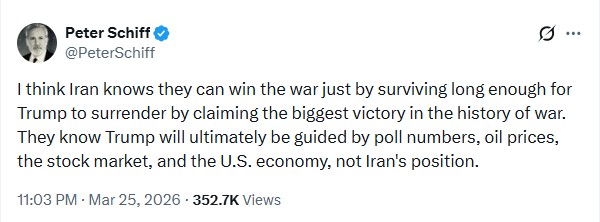
Schiff consistently emphasizes that the current situation is not merely a cyclical cooling of the market but a manifestation of a systemic crisis. Inflation, rising borrowing costs, high debt levels, and geopolitical instability are forming a single knot. In this framework, the real estate market becomes one of the first sectors where accumulated imbalances become visible.
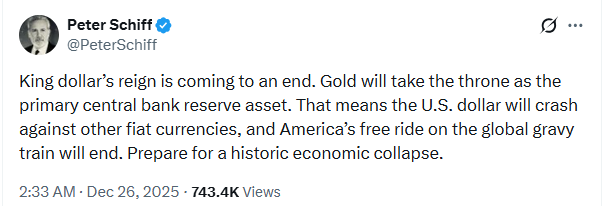
His position on the dollar also remains unchanged. As early as January 2026, he stated that the global financial system is gradually moving toward reducing dependence on the U.S. currency, while central banks are increasing their interest in alternative reserves, primarily gold. In his view, this is another element of a global restructuring that increases instability in traditional markets.
Looking more broadly, parallels can be found in other countries. For example, China’s real estate market has experienced a sharp decline in value in recent years — about 80% in certain segments. There, the cause was a deflationary spiral and a debt crisis among developers. In the United States, the situation is unfolding differently: not through falling prices amid weak demand, but through rising living and borrowing costs that gradually undermine buyers’ purchasing power.
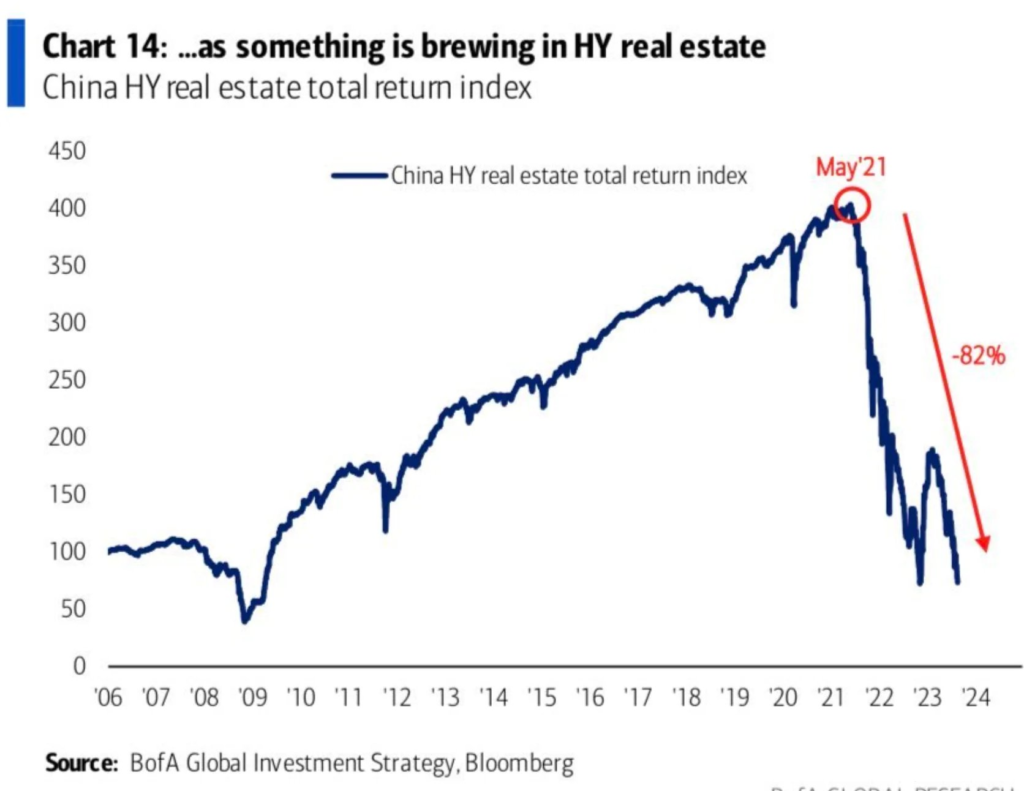
Decline of the real estate sector in China. Source: The Kobeissi Letter
Thus, the world’s two largest economies are moving toward a similar point — reduced stability in the housing market — but via different paths. This points to a deeper issue: the real estate market becomes vulnerable both in inflationary and deflationary environments when monetary policy moves out of balance.
The geopolitical factor, including the conflict around Iran, adds another layer of uncertainty. An oil shock can simultaneously accelerate inflation and undermine consumer confidence. This combination is particularly dangerous for the real estate market, which depends on long-term expectations and the financial stability of households.
Ultimately, according to Schiff, this is not about a local correction but a potential beginning of a broader repricing of assets. If his forecasts prove accurate, the U.S. real estate market could become one of the first areas where global economic contradictions fully manifest.
All content provided on this website (https://wildinwest.com/) -including attachments, links, or referenced materials — is for informative and entertainment purposes only and should not be considered as financial advice. Third-party materials remain the property of their respective owners.