

The co-founder of Ethereum, Vitalik Buterin, has put forward an initiative aimed at increasing the security of user funds within the Ethereum ecosystem. It concerns the broader and more systematic use of transaction simulation — a tool that allows users to calculate the consequences of an action in advance before it is actually sent to the blockchain.

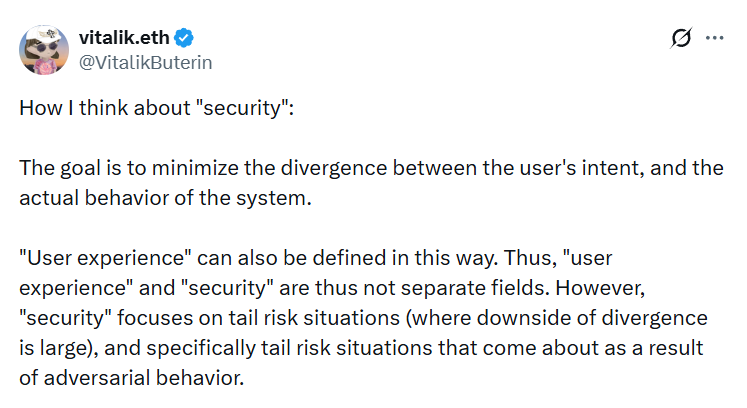
At first glance, the idea seems simple: before a user confirms a transfer, interacts with a smart contract, or signs a complex operation, the system should show exactly what will happen — which tokens will be deducted, what permissions will be granted, which contracts will be called, and what potential risks may arise. However, behind this simplicity lies a deeper security philosophy that Buterin formulates around the concept of “user intent.”
According to him, the problem of security is not about imperfect machines or developer mistakes. The key difficulty is that user intent is an extremely complex and multi-layered object. Users themselves cannot always clearly articulate what they want to achieve, especially when dealing with complex DeFi protocols, cross-chain bridges, or unfamiliar contracts.
Buterin emphasizes that an effective security system should analyze intent through several independent signals simultaneously. Only when these signals align should the action be executed. Otherwise, the system should either warn the user or require additional confirmation. This approach reduces the likelihood of both technical errors and abuse by malicious contracts or phishing interfaces.
In this model, transaction simulation acts as a kind of “preview of the future.” The user first specifies the intended action — for example, a token swap, granting asset management permissions, or transferring funds — and then receives a clear visualization of the consequences: balance changes, fees, permission updates, and potential interactions with other contracts. After reviewing this, the user makes an informed decision by clicking “OK” or “Cancel.”
During the discussion, one participant noted that excessive checks may protect the system from technical failures, but they cannot prevent situations where the user consciously makes a risky decision. This raises a fundamental question: should security aim for максимально accurate modeling of intent, or for strict limitation of potential damage regardless of user motivation?


In response, Buterin stated that it is impossible to fully limit losses independently of user intent. If a system attempts to eliminate all risk, it would effectively restrict the user’s freedom to manage their funds. In the extreme case, this would lead to a complete freezing of assets — which, in his view, is the worst possible outcome, as it contradicts the very idea of decentralization and financial sovereignty.
Thus, the discussion is not about banning risks, but about designing them intelligently. Buterin proposes building security as a multi-layered system that incorporates various confirmation mechanisms. Among the possible tools he mentions spending limits, multisignature approvals, time delays for large transactions, additional checks for unusual actions, and behavioral analysis.
This approach makes everyday low-risk operations fast and convenient, while making potentially dangerous actions more complex and requiring additional steps. As a result, users retain control over their funds but gain a clearer understanding of what is happening “under the hood” of the protocol.
Buterin also notes that similar principles can be applied not only to crypto wallets, but also to smart contracts, operating systems, and even hardware solutions. Wherever there is interaction between humans and complex digital infrastructure, the correct interpretation of intent becomes the key element.
At the same time, he acknowledges that there is no universal or perfect solution. User intent can be contradictory, incomplete, or change over time. Moreover, attackers may attempt to manipulate interfaces so that a transaction appears formally safe while in fact leading to loss of funds.
Nevertheless, the development of transaction simulation as a mandatory interface element could significantly increase the overall level of security within the Ethereum ecosystem. It represents a step toward a more “human-centered” architecture, where the protocol does not merely execute code, but helps users make informed decisions.
Ultimately, Buterin’s initiative reflects a broader trend in the development of Web3: the transition from abstract technical security to security based on understanding the behavior and intentions of real people. And as decentralized applications become more complex, the ability of a system to show users not only what they are doing, but also what consequences it will lead to, becomes increasingly important.
All content provided on this website (https://wildinwest.com/) -including attachments, links, or referenced materials — is for informative and entertainment purposes only and should not be considered as financial advice. Third-party materials remain the property of their respective owners.