

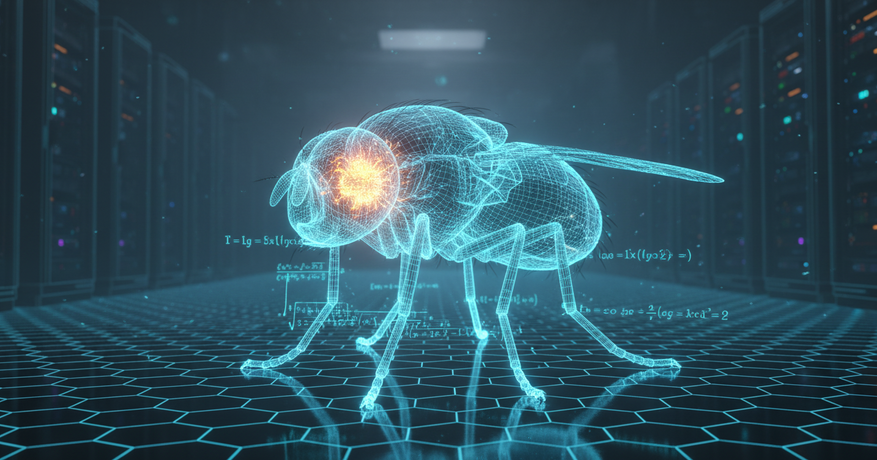
Digital immortality, which until recently seemed like science fiction, is gradually taking on real contours. A group of researchers presented a project in which they managed to create a detailed digital model of the brain of a fruit fly (Drosophila) and run it in a computer environment. As a result, a so-called “digital fly” appeared — a system capable of existing in a virtual space, responding to the environment, and controlling the virtual body of the insect.
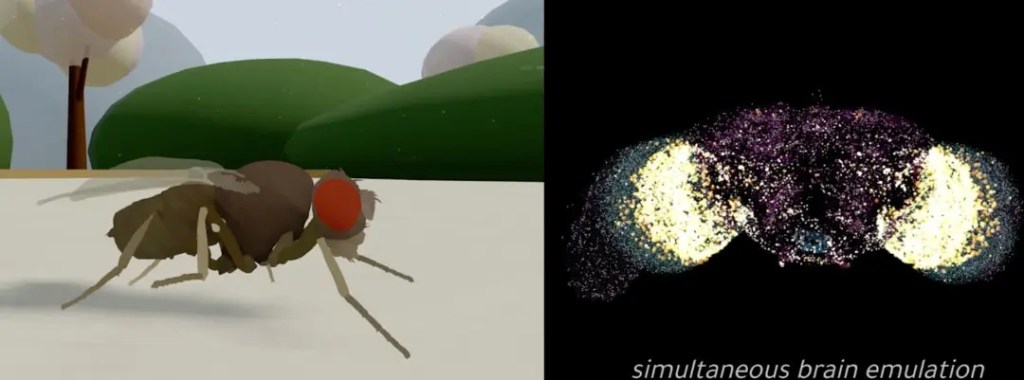
Translating the static connectome into dynamic behavior. Authors: Dr Alex Wissner-Gross. Source: theinnermostloop.substack.com.
The main feature of the project is that the scientists did not simply create an abstract neural network inspired by biological principles. Instead, they transferred into the computer the most accurate structure of the brain of a real organism. The simulation reproduces approximately 125,000 neurons and about 50 million synaptic connections between them. This means that the model replicates not only the general principle of how the nervous system works but also its specific architecture — a complex network of connections formed through evolution.
The project is called EON Systems. Its developers believe that this approach opens a new direction in brain research and may eventually change the understanding of the boundaries between biological and digital forms of life.
To understand the significance of this achievement, it is important to distinguish between two fundamentally different approaches to creating artificial behavior systems. Modern artificial intelligence systems that control robots or virtual characters mostly use the reinforcement learning method. In this case, researchers create a neural network without a pre-defined behavioral structure and give it a specific goal — for example, to learn to walk or move forward. The system begins to perform random actions, and the algorithm evaluates the results. If an action produces the desired outcome, the program receives positive reinforcement. After millions or even billions of repetitions, the neural network gradually finds the optimal behavior strategy.
This approach allows for effectively modeling external actions. For example, virtual animals can learn to move in a simulator or perform complex motor tasks. However, their behavior is the result of mathematical optimization rather than a reflection of the real biological structure of the nervous system.
The EON Systems system is fundamentally different. It was not trained to walk and did not undergo a long training process in a virtual environment. Instead, the scientists reproduced the very architecture of the fruit fly brain. The scheme of neural connections formed through biological evolution was transferred into the computer model. After receiving input signals, the system began to function according to its internal structure. In other words, the behavior of the digital model is a consequence of the organization of its neural network itself, not a result of mathematical training.
This approach is called brain emulation. Unlike artificial intelligence, which imitates behavior, emulation attempts to reproduce the nervous system of an organism with all its connections and operational dynamics.
Until recently, such experiments were possible only for extremely simple organisms. The most famous example is the OpenWorm project, in which researchers attempted to fully model the nervous system of the roundworm Caenorhabditis elegans. This organism is widely used in scientific research because its nervous system is very simple and fully mapped.
The C. elegans brain consists of only 302 neurons. Thanks to this simplicity, scientists were able to describe all neural connections relatively in detail and create a computer model of the worm’s nervous system. However, the behavioral repertoire of this organism is extremely limited: it can perform only simple movements and basic reactions.
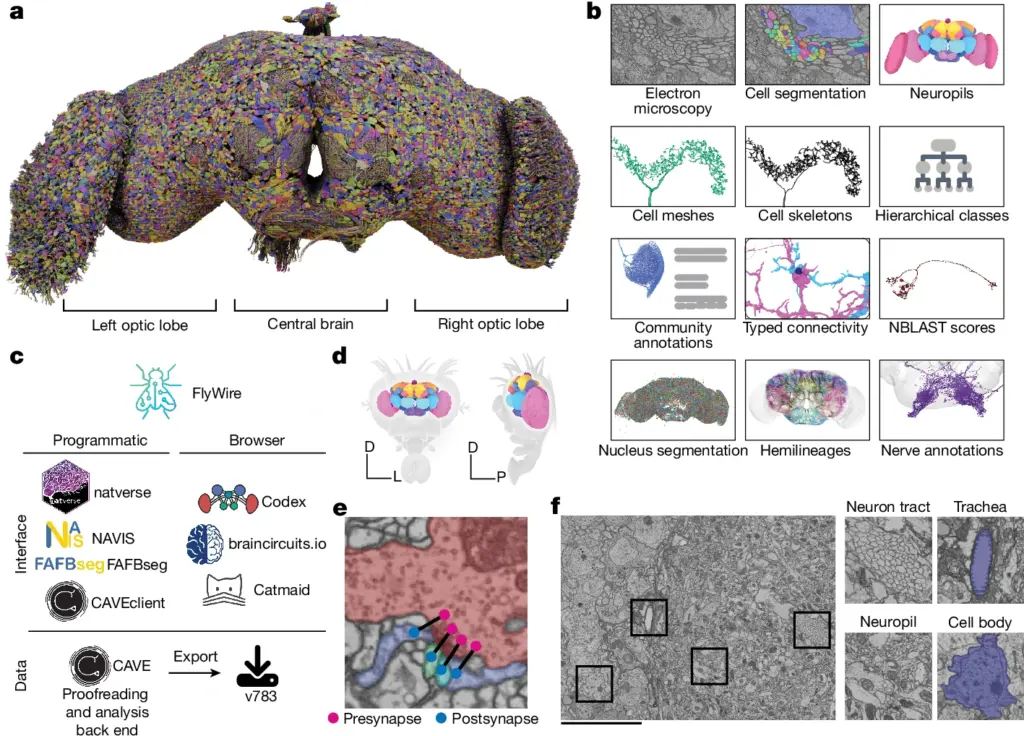
Authors: Shiu P.K., Sterne G.R., Spiller N. et al.
Source: nature.com
a. Full reconstruction of neuron morphology using the FlyWire platform. In the project, all neurons of the central brain and both visual lobes were segmented and manually verified. It is important to note that the presented images and corresponding dataset are mirrored relative to the real fly brain.
b. FlyWire ecosystem overview. The project is based on electron microscopy data obtained in the work of Zheng et al., synaptic connection maps published by Buhmann and Heinrich, and neurotransmitter type prediction models proposed by Eckstein and colleagues. Additional annotations, including hemilineages, neural structures, and hierarchical classifications, are described in detail in the accompanying scientific publication.
c. Technological infrastructure. FlyWire uses the CAVE platform for verification, management, and analysis of large neuron datasets. Access is available programmatically via CAVEclient, navis, fafbseg, and natverse, as well as through web interfaces — Codex, Catmaid Spaces, and braincircuits.io. In addition, static data downloads are available for independent analysis.
d. Spatial organization of the Drosophila brain. The fruit fly brain is divided into separate anatomical regions based on the structure of neuropils, as shown in supplementary diagrams (Extended Data Fig. 1). Lamina neuropils are not displayed in this visualization. Axis labels: D — dorsal, L — lateral, P — posterior.
e. Synapse architecture. Synaptic boutons in Drosophila often have a polyadic structure, where one presynaptic element connects to multiple postsynaptic partners. Each connection between an input and output element is treated as a separate synapse in the data analysis.
f. Raw electron microscopy data. In the microscope images obtained in the study by Zheng et al., neural tracts, tracheae, neuropil regions, and cell bodies are clearly visible. The image scale bar is 10 micrometers.
Creating a digital model of the fruit fly brain represents a huge step forward compared to the OpenWorm project. The Drosophila nervous system includes approximately 125,000 neurons — hundreds of times more than the roundworm. In addition, the number of synaptic connections between neurons reaches tens of millions. This scale increase greatly complicates the modeling task.
Besides structural complexity, fruit flies have much more diverse behavior. They can navigate in space, respond to odors and visual cues, interact with other individuals, and perform complex motor actions. That is why this organism has been one of the key models in neurobiology for decades.
Interestingly, other research groups had previously attempted to create virtual flies capable of moving in a simulation. Among them were projects associated with DeepMind and the Janelia research campus. However, those works used classical machine learning methods.
In such systems, the virtual creature learned to move using reinforcement learning algorithms. The computer model performed random movements, and the algorithm gradually found the most effective strategy for controlling limbs. This created a behavioral imitation but had no direct relation to the real structure of the insect brain.
The EON Systems project is fundamentally different because it aims to reproduce the nervous system itself rather than just teaching a program to imitate behavior.
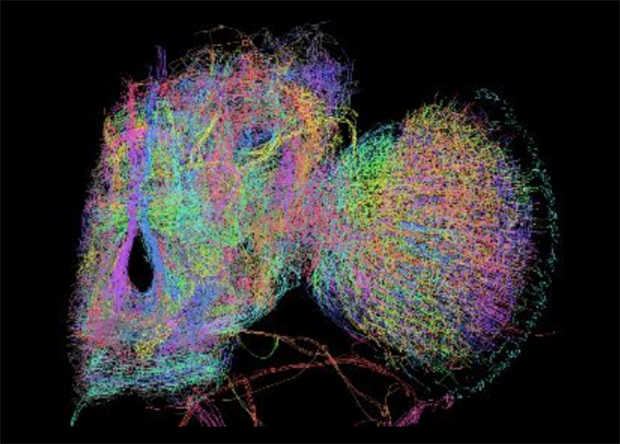
Researchers believe that such experiments may have far-reaching consequences for science. Brain emulation allows studying nervous system function at a new level of detail. Scientists can observe how signals propagate between neurons, how behavioral responses are formed, and how system activity changes in response to different stimuli.
In addition, such technologies can help better understand the fundamental mechanisms of consciousness and intelligence. If accurate digital models of more complex brains are created, it will allow researchers to study processes that are practically impossible to observe directly in a living organism.
The next stage in the development of such projects may be creating a digital mouse brain. The nervous system of this animal is much more complex than that of insects and contains tens of millions of neurons. Such a project will require colossal computational resources and even more detailed mapping of neural connections.
In the long term, some scientists consider the possibility of creating digital models of the human brain. This task is extremely complex, as the human brain contains about 86 billion neurons and hundreds of trillions of synapses. Nevertheless, advances in brain scanning technologies, computing systems, and neurobiology gradually bring researchers closer to a deeper understanding of human consciousness.
Although a full digital copy of the human brain is still far off, creating a virtual fruit fly brain model shows that the first steps in this direction have already been taken. For science, this may mark the beginning of a new era in which the boundary between biological and digital forms of life gradually blurs.
A video clip “from the life of a fly” can be viewed on our Telegram channel
All content provided on this website (https://wildinwest.com/) -including attachments, links, or referenced materials — is for informative and entertainment purposes only and should not be considered as financial advice. Third-party materials remain the property of their respective owners.