

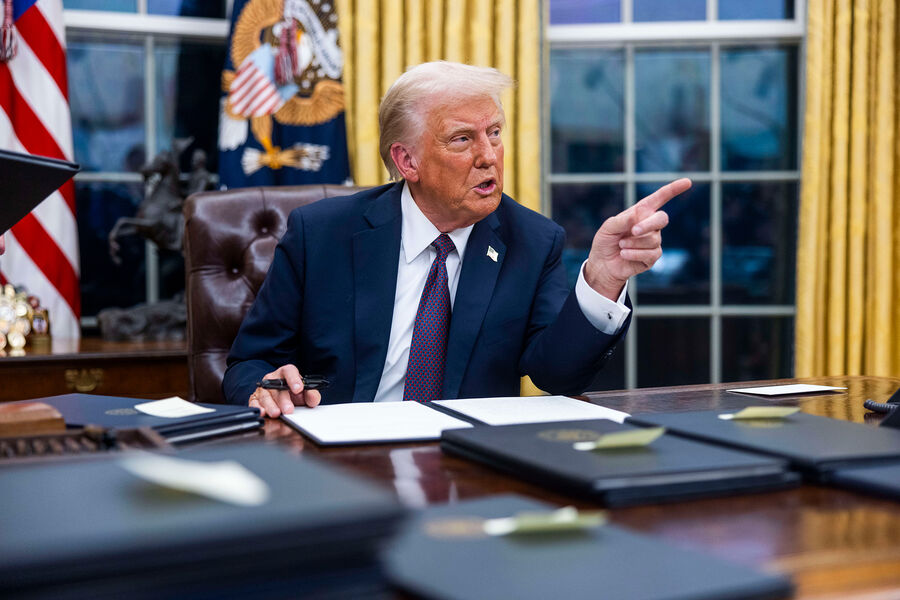
Today, January 3, Donald Trump publicly reaffirmed his role in the development of the cryptocurrency industry, stating: “I am a big supporter of cryptocurrencies; I am the one who has helped cryptocurrencies more than anyone else because I believe in them.” According to the president, it was his political course and personal stance that allowed cryptocurrencies to gain a more prominent place in the U.S. financial system. However, a closer analysis of actual data during his presidency reveals a far more complex and nuanced picture. The speech was broadcast by Fox News.
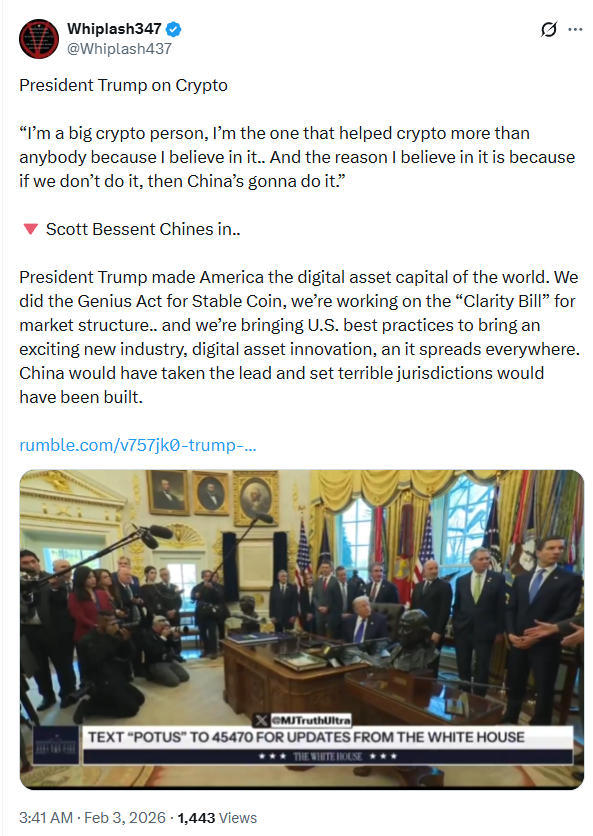
Statements vs. Reality Trump explained his support for cryptocurrencies primarily on geopolitical grounds. In his view, the U.S. failure to actively engage in digital asset development would automatically cede leadership to China: “If we don’t do it, China will.” Treasury Secretary Scott Bessent echoed this logic, emphasizing that digital assets and blockchain infrastructure are becoming part of the global competition for technological and financial dominance.
Under Trump, steps were taken that previously seemed impossible. In March 2025, the U.S. officially established a strategic bitcoin reserve, formed from approximately 200,000 BTC seized in criminal investigations. In parallel, a separate federal digital asset repository for other cryptocurrencies was created. The administration emphasized that these measures required no direct taxpayer expenditure. Essentially, the government recognized cryptocurrencies as a strategic asset for the first time, albeit in a specific form.
Trade Wars as a Source of Market Volatility Economic and trade policies under Trump became a primary source of pressure on the crypto market. His administration waged large-scale trade wars not only with China but also with key U.S. allies. In April 2025, base tariffs of 10% were imposed on all imports, along with special duties up to 54% for China and around 20% for EU countries.
China faced particularly harsh pressure. After Beijing’s countermeasures, tariffs on Chinese goods rose to 125%. Trump justified this as protection of national security and economic sovereignty, stating: “Without tariffs, we would be defenseless.” At the same time, financial markets, including crypto, viewed these statements as signals of rising global risk.
Cryptocurrencies effectively became pawns in a geopolitical confrontation. Bitcoin miners faced tariffs of 57.6% on equipment from China and 21.6% on shipments from other Asian countries. Each new announcement of tariffs or threats of expansion triggered immediate market reactions, including sell-offs and sharp spikes in volatility.
Experts note the dual effect of the tariff policy: in the long term, it could stimulate demand for cryptocurrencies as alternatives to national currencies weakened by inflation and debt. In the short term, however, fear of a global recession dominated. Any attempts to ease rhetoric or negotiate provided only temporary relief—agreements were revisited or broken within months, returning the market to uncertainty.
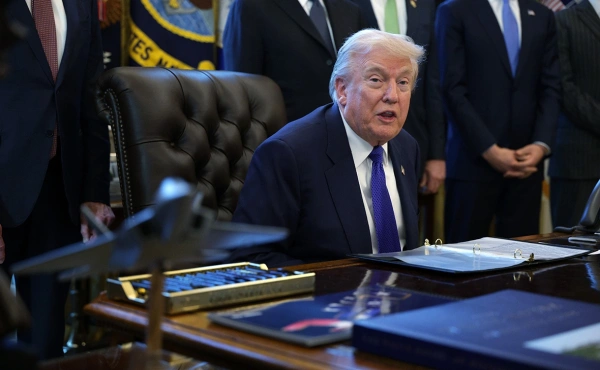
FOTO: Alex Wong / Getty Images
The Black Day: October 10 The culmination of the trade war occurred on October 10, 2025. Trump announced an additional 100% tariff on Chinese goods in response to Beijing tightening export controls over rare earth metals. The crypto market’s reaction was immediate and devastating: Bitcoin fell from $126,272 to $102,173, losing about 19% from its historical peak within hours.
Total cryptocurrency market capitalization dropped roughly $900 billion from peak to intraday low, with around $500 billion disappearing in just ten minutes. Daily liquidations reached a record $19.31 billion—more than ten times the losses during the COVID-19 market crash and the FTX collapse.
BitMEX analysts called the day “the most destructive event for experienced market makers in crypto history.” The market, loaded with leverage in anticipation of further growth, had low volatility, creating an illusion of stability. The tariff news triggered mass capitulation.
Mass Liquidations and Strategy Failures At the end of January 2026, the market again experienced a wave of liquidations. Eight major crypto traders suffered massive losses. One prominent account, BitcoinOG, had previously shown unrealized gains of $142 million but ultimately lost $128.87 million, wiping the account completely. Total market liquidations exceeded $522 million.
From January 30 to 31 alone, long positions lost $1.56 billion, with total trader losses exceeding $1.68 billion. In some 30-minute periods, positions worth up to $780 million were liquidated. These events highlight the market’s extreme sensitivity to macroeconomic and political signals.
Presidential Period Statistics
Looking at the numbers, the picture is mixed. From Trump’s inauguration on January 20, 2025, to February 3, 2026, Bitcoin fell from $92,000 to $82,000, a decline of roughly 10%. Altcoins fared significantly worse. Total market capitalization excluding Bitcoin dropped from $1.5 trillion to $1.2 trillion, while BTC dominance rose to 55%.
Ethereum fell from $3,500 to $2,800. Volatility spiked during tariff escalations, with Bitcoin briefly dropping to around $100,000.
Regulatory Achievements and Political Opposition Nonetheless, the administration achieved notable regulatory milestones. In December 2025, Trump signed the GENIUS Act to regulate stablecoins—the first major cryptocurrency legislation in U.S. history. It mandated full reserve backing for stablecoins and laid the foundation for federal oversight.
The legislative path was contentious. By July 2025, at least 13 Republicans voted against the initiative despite presidential support. Democrats responded with a “Cryptocurrency Corruption Week,” demanding that the president, vice president, and members of Congress be barred from owning crypto due to conflicts of interest.
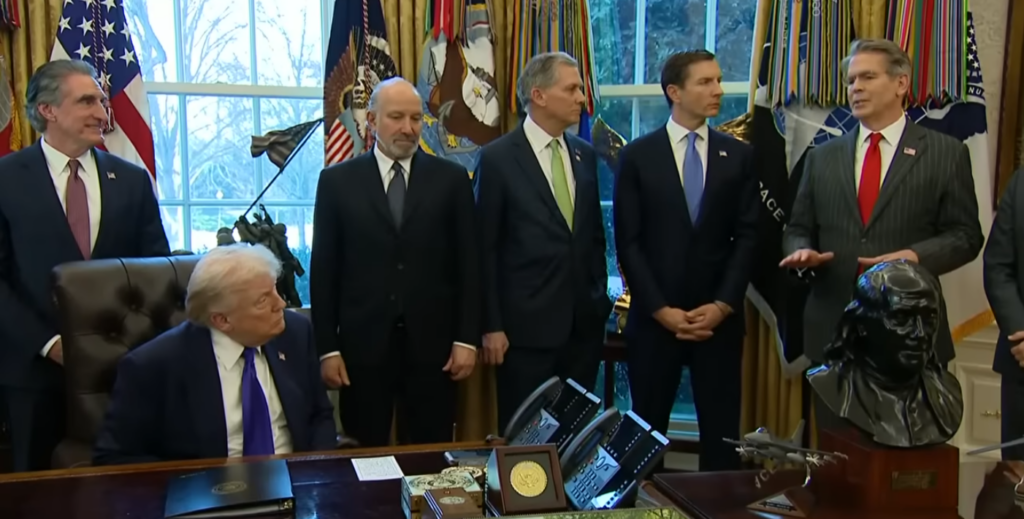
Other key steps included appointing Paul Atkins, a crypto-friendly regulator, as SEC chair instead of Gary Gensler, hosting the first crypto summit at the White House, and signing an executive order granting crypto access to $12.5 trillion in retirement funds.
Federal agencies also began to systematically drop lawsuits against crypto companies. Trump himself explained this simply: according to him, regulators were “pressuring banks to close crypto business accounts,” and he claimed to understand firsthand how this process works in practice.
The Paradox of Government Support Against this backdrop, one fact stands out: cryptocurrencies were not included in the list of “vital national interests” in the new U.S. national security strategy. The document focused entirely on artificial intelligence and quantum computing, leaving digital assets on the periphery of strategic planning.
Thus, Trump’s statements about supporting cryptocurrencies are partially validated by the creation of a strategic bitcoin reserve and attempts to establish a regulatory framework. However, aggressive tariff policies and the resulting economic uncertainty placed significant downward pressure on the market, reflected in falling prices, rising volatility, and mass liquidations.
From the perspective of data-driven analysis, the situation around Trump and cryptocurrencies illustrates a fundamental paradox: the more actively the state attempts to “help” cryptocurrencies, the more it subjects them to its own logic and political interests. Bitcoin was originally created as a decentralized alternative to government-issued currencies, yet today its price reacts to presidential statements and tariff decisions.
The creation of a strategic reserve effectively transforms cryptocurrency into an instrument of national policy, contradicting its original philosophy. Historical parallels with the Internet in the 1990s show a similar trajectory: from initial neglect to regulation and eventual integration into state systems.
Macroeconomic data also indicate that cryptocurrencies increasingly behave like traditional risk assets, falling during periods of geopolitical instability rather than serving as “digital gold.” In this context, the key question is not so much whether Trump helped cryptocurrencies, but whether this “help” undermined their original revolutionary essence.
All content provided on this website (https://wildinwest.com/) -including attachments, links, or referenced materials — is for informative and entertainment purposes only and should not be considered as financial advice. Third-party materials remain the property of their respective owners.