


When markets start to get nervous, politicians tend to add fuel to the fire. And Donald Trump, as usual, did not disappoint. His harsh statement that without the United States NATO is a “paper tiger” was not just a political jab, but a signal to the markets: tensions are rising, allies are not united, and the situation in the Middle East is far from over. He posted this on his social media platform Truth Social. “Without the United States, NATO is a paper tiger! They didn’t want to go into battle to stop a nuclear Iran. Now that the war is militarily won, and with very little danger to them, they complain about the high oil prices they are forced to pay, yet they don’t want to help open the Strait of Hormuz — a simple military operation that is the only reason for these high oil prices. It would be so easy for them to do, with very little risk. Cowards, and we will remember!” the U.S. president said.
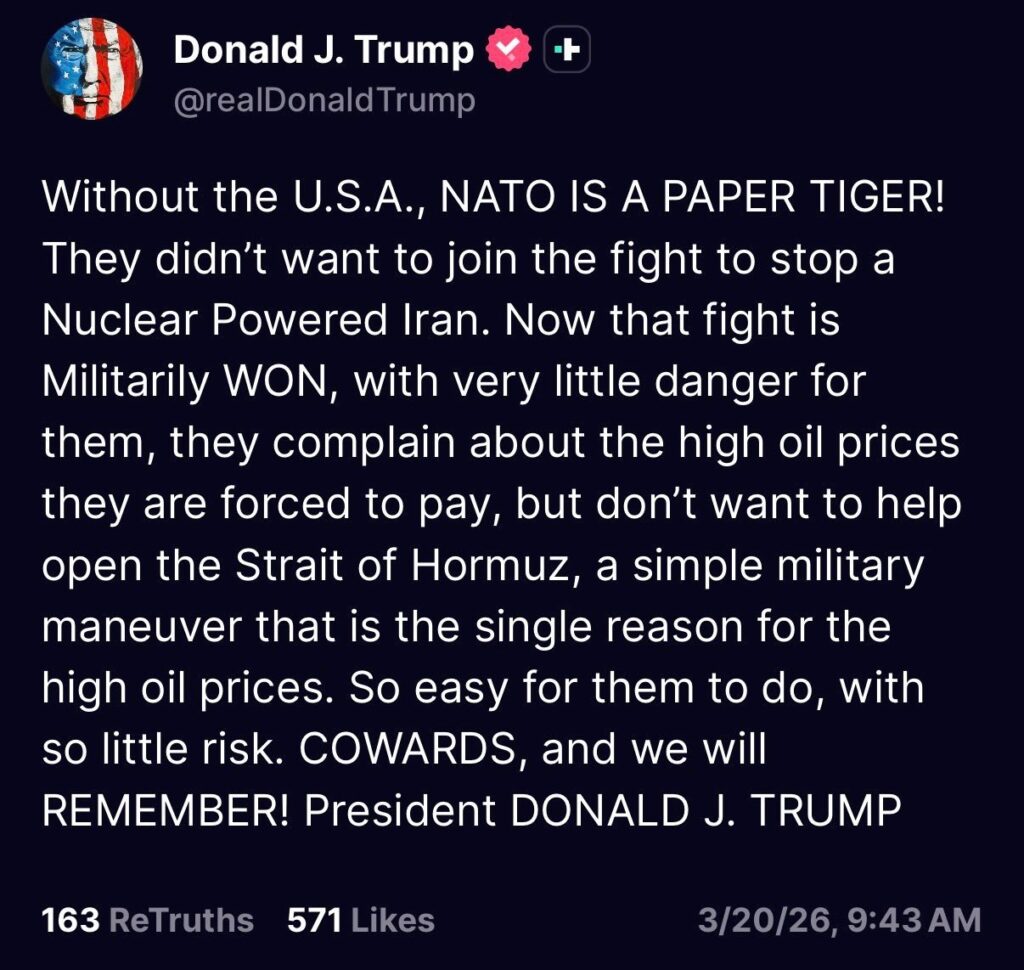
The essence of his position is extremely straightforward. According to him, European allies failed to show determination when it came to containing Iran and its nuclear program. And now that the main military phase is, in his view, “already won,” they complain about the consequences — primarily rising oil prices — but are not willing to participate in solving the key issue: reopening the Strait of Hormuz.
And here is an important point. The Strait of Hormuz is not just a geographic location, but one of the main arteries of global energy supply. A significant portion of the world’s oil flows through it. Any risks to shipping there are automatically priced in. So when statements appear suggesting that “a quick military operation would be enough to bring prices down,” the market, to put it mildly, becomes tense. Because such “simple solutions” usually have far from simple consequences.
Trump’s rhetoric in this case is not only criticism of allies, but also a hint at possible further actions by the United States. And the alignment with the current news flow looks too telling to be coincidental.
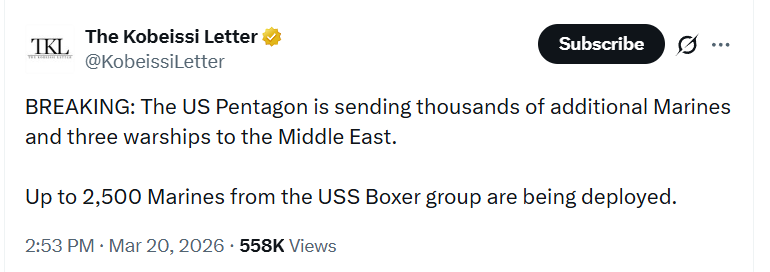
At the same time, reports are emerging about an increased U.S. military presence in the region. According to reports, the Pentagon is sending additional forces: up to 2,500 Marines and several warships, including the strike group centered around USS Boxer. Formally, this is about strengthening security and deterrence. In reality, it increases the probability of escalation.
And the market reads such signals quickly and without illusions. Oil is rising again. This is no longer just a reaction to current events, but a risk premium — for the possibility that the conflict could move beyond airstrikes and evolve into something larger. Even the mere possibility of a ground operation is already being priced in.
Against this backdrop, the behavior of other assets looks almost textbook-like. Gold, silver, the stock market represented by the S&P 500, and even Bitcoin are coming under pressure. Investors begin to take profits, reduce risk, and move into more liquid positions. This is not panic, but it is no longer calm either.
Interestingly, the classic logic of “crisis means gold rises” is not working as confidently now. We have already seen that the market can react differently when expectations about interest rates and liquidity take precedence over fear. The current situation confirms this: even safe-haven assets do not always behave according to the textbook.
Bitcoin in this setup looks particularly interesting. On the one hand, it is increasingly referred to as “digital gold.” On the other, during periods of sharp geopolitical tension, it still behaves like a risk asset. And now we see this duality again: some investors view it as protection, while others treat it as something to sell first when things get heated.
Returning to the words of Donald Trump, it is important to understand that such statements are not just эмоtions. They are an element of pressure, a negotiation tool, and at the same time a signal to his electorate. But for the market, it is also a trigger of uncertainty. Because strong rhetoric is often followed by actions. Not always immediately, but quickly enough to catch investors off guard. Especially considering Trump’s reputation as a politician who likes to act unexpectedly and often when markets are closed. That is why the current military buildup is perceived not as a formality, but as a potential preparation for the next phase. And the next phase is always uncertainty.
As a result, a rather tense picture emerges. Geopolitics pushes oil higher, increasing inflation risks. This, in turn, affects expectations for interest rates and pressures markets. Investors begin to rebalance portfolios, reduce risk, and seek liquidity. All of this is happening against a backdrop of statements that add more nervousness than clarity.
The main takeaway here is quite simple. The market is currently in a mode where news outweighs fundamentals in the short term. One statement, one troop movement — and prices move faster than models can update. Therefore, in such moments, it is worth remembering an old rule: it is not so important what exactly is happening, but how the market reacts to it. Because in the end, it is the reaction, not the event itself, that forms the price.
All content provided on this website (https://wildinwest.com/) -including attachments, links, or referenced materials — is for informative and entertainment purposes only and should not be considered as financial advice. Third-party materials remain the property of their respective owners.