

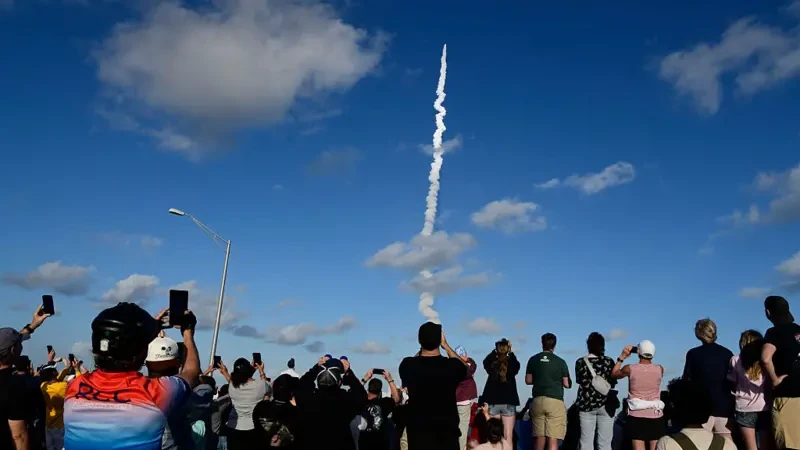
And this time — not for the symbolic “we can do it too,” but with a much more pragmatic goal: to закрепиться (to establish a foothold). The launch of the Artemis II mission has become one of the most significant events in modern space exploration — for the first time since the Apollo program era, humanity is once again sending people to the Moon. Back then it was a race. Now it is already a strategy.
The Space Launch System rocket with the Orion spacecraft launched from Cape Canaveral, and this moment can safely be called a return to the “top league” of space. On board are four astronauts: Reid Wiseman, Victor Glover, Christina Koch, and Jeremy Hansen. An international crew is no longer just a nice gesture, but a reflection of a new model of space programs: expensive, complex — therefore, together.
The flight will last about 10 days. During this time, the crew will fly around the Moon and return to Earth. It sounds almost modest — “a flyby.” But in reality, this is a step humanity has not taken for more than half a century. The last time humans were this far from Earth was in 1972. Since then, technology has advanced, but the practice of deep space crewed missions was put on pause. And now that pause has ended.
It is important to understand: Artemis II is not the final goal, but a system test. NASA is testing everything at once — from the rocket to life support, from navigation to crew psychology. This is a full-scale rehearsal before the next step — landing humans on the Moon as part of Artemis III. In other words, right now it is not about “conquering,” but about testing whether we can conquer again.
Technically, the mission is more complex than it seems. Yes, today we have computers more powerful than in the Apollo era, but the requirements have also increased. Safety, stability, long-term presence in space — all this requires a completely different level of reliability. Especially if we look beyond the Moon — toward Mars.
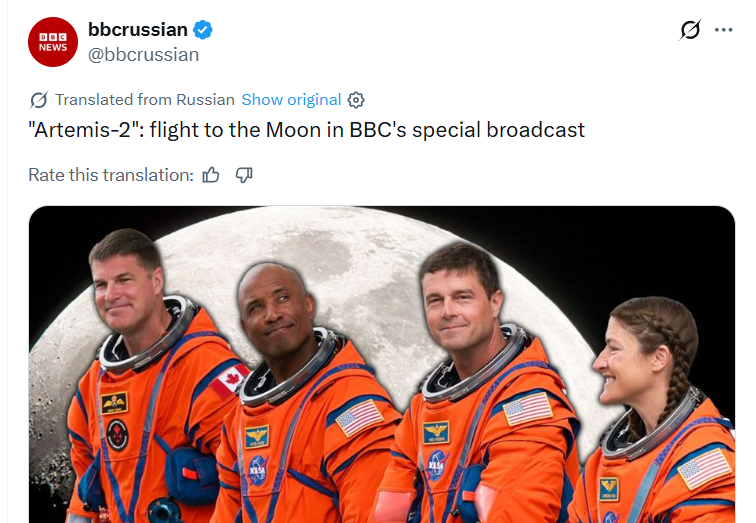
“Artemis II”: Moon flight in a BBC special broadcast.
And this is where it gets interesting. The Artemis program is not about the Moon itself. The Moon is a testing ground. A platform for developing technologies that will later be used for deeper missions. It’s like training in a swimming pool before going into the ocean. Only the pool is Earth’s satellite.
At the same time, the program has very earthly goals. Returning to the Moon is not only about science, but also about geopolitics. Space is once again becoming an arena of competition. China, private companies, and international alliances are actively entering the game. And if in the 20th century victory was measured by a flag on the surface, in the 21st — it is measured by infrastructure: bases, orbital stations, logistics.
The phrase of astronaut Jeremy Hansen before launch — “we are going for all humanity” — sounds beautiful, but behind it lies a much more pragmatic meaning: whoever establishes a foothold first will set the rules.
Another aspect is psychological. Over the past decades, humanity has become used to space as something in the background: satellites, GPS, the internet, orbit. But deep space is becoming something “real” again. Dangerous, expensive, and most importantly, rare. This restores a sense of scale that has long been missing. And there is a certain irony in this. Half a century ago, people flew to the Moon to prove they could. Today — to understand what to do next.
If everything goes well, the next step is not just the Moon, but a permanent presence there. And then — Mars. Not tomorrow, not in a year, but already within real planning, not science fiction.
In the end, Artemis II is not so much about the flight as it is about transition. From an era of individual feats to an era of systematic space exploration. And if раньше the main question was “can we get there,” now it sounds differently: “can we stay there.” And, apparently, humanity has decided to test this again in practice.
A video of the launch can be watched on our Telegram channel
All content provided on this website (https://wildinwest.com/) -including attachments, links, or referenced materials — is for informative and entertainment purposes only and should not be considered as financial advice. Third-party materials remain the property of their respective owners.